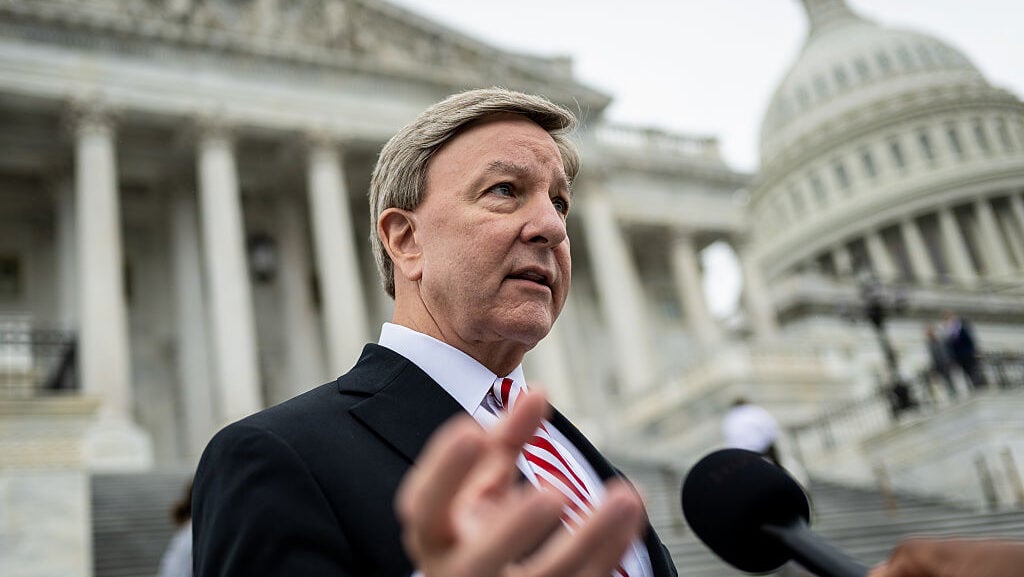
WASHINGTON — While a $350 billion reconciliation bill is “not going to happen,” a “skinnied down” version of the bill may still be possible, according to Rep. Mike Rogers, R-Ala., causing defense appropriators to rework the base fiscal 2027 defense spending bill to include chief priorities.
“What it looks like [is] we’re going to be able to get a reconciliation bill of some size, and by the way, $350 [billion] is not going to happen — you may have guessed that — but a reconciliation bill is still possible,” the outgoing House Armed Services Committee Chairman chairman quipped during a Hudson Institute event today.
Rogers is is not seeking a waiver to remain the top Republican on the HASC. Instead, two top competitors are lobbying for the job — Rep. Trent Kelly of Mississippi and Rep. Ronny Jackson of Texas.
His comments come as Republican lawmakers grapple with two looming deadlines. The continuing resolution that is currently funding the Pentagon is set to run out on Dec. 11, and Democrats are poised to take over both chambers on Jan. 3.
So with weeks left in control, the GOP-controlled chambers are weighing their options for a $1.5 trillion FY27 Defense Department request comprising $1.15 trillion in the base budget and $350 billion in a reconciliation bill. They are also sitting on a $87.6 billion supplemental request that includes $67.1 billion in defense funds to cover expenses associated with the war in Iran.
Those three moving pieces could combine in various ways over the coming weeks.
Since the reconciliation ask included big-ticket items like Golden Dome and multi-year munition buys, Rogers said appropriators are now working on “alternatives” to funnel them into the base budget.
Senate appropriators offered up one such version this week with a plan centered on a $1.1 trillion spending bill. This summer, the House Appropriations Committee released its $1 trillion defense spending bill for fiscal 2027. Neither have been approved by the full chamber and could significantly change.
What remains unclear, Rogers said, is lawmakers’ appetite for a smaller reconciliation bill that could include defense dollars along with other “little cats and dogs.”


A leap in drone range and payloads come from a battery with different chemistry
Lithium-metal batteries are one way to break the weight and endurance limits of today’s unmanned systems.
“If a reconciliation bill is still possible, It’s going to have to be skinnied down to deal with … the hole in the defense budget that Venezuela and Iran have created, there’s going to have to be some money for munitions stockpiles, and now we would have this FAA issue … and there’s an [agriculture] issue,” Rogers told the audience.
“But if they can skinny that reconciliation down from $350 [billion] down to $100 [billion] or somewhere in that nature, there is a path for that,” he added.
Rogers comments came as members of the Senate were having a closed-door briefing with Deputy Defense Secretary Steven Feinberg about the need for reconciliation to happen. After the briefing, Republicans after the briefing to indicated to Punchbowl News that a decision on whether to make a serious push for the defense spending could come shortly.
While Rogers’ committee oversees the annual defense policy bill that traditionally guides spending, the reconciliation request passes through the authorizers sitting on the House and Senate Armed Services Committees.
As Republicans use their final weeks to work through the spending bills, they have not yet passed the FY27 National Defense Authorization Act that contains defense policy changes ranging from troop pay raises to defense acquisition reform.
If they can get it out the door and to President Donald Trump’s desk by Jan. 3, Rogers predicted that it would not include a greenlight for the Pentagon to move out on a new Autonomous Warfare Command (AUTOWARCOM) proposed by Defense Secretary Pete Hegseth.
“Autonomy is going to be here to stay, but it’s too premature to say that we need a command for that,” Rogers said. “But we’re having a debate. Big things don’t happen fast. … That may happen one day, but it’s just not going to happen in this year’s NDAA”
“I could be wrong,” he added. “ I mean, I’m one vote, but I have not seen it mature enough to to think that it’s going to happen this year.”
If Rogers’ prediction comes to fruition, Hegseth’s plans to stand up a new command could be on ice depending on Democrats’ priorities.
Rogers also poured cold water on any possible “right to repair” legislation this year. The initiative is aimed at giving troops the ability to fix their equipment while deployed, but industry groups have said the measure could have grave implications for intellectual property.
He said the Pentagon was unable to provide a single example of when it had been unable to not get what it wants from companies via contracts.
“If it was this big a problem, you think we’d have a list of examples, but they haven’t,” he said. “The fact is, this is something that can be contractually dealt with. They just don’t want to.
“I don’t see us changing our policy anytime in the near future,” Rogers added.
Breaking Defense Video