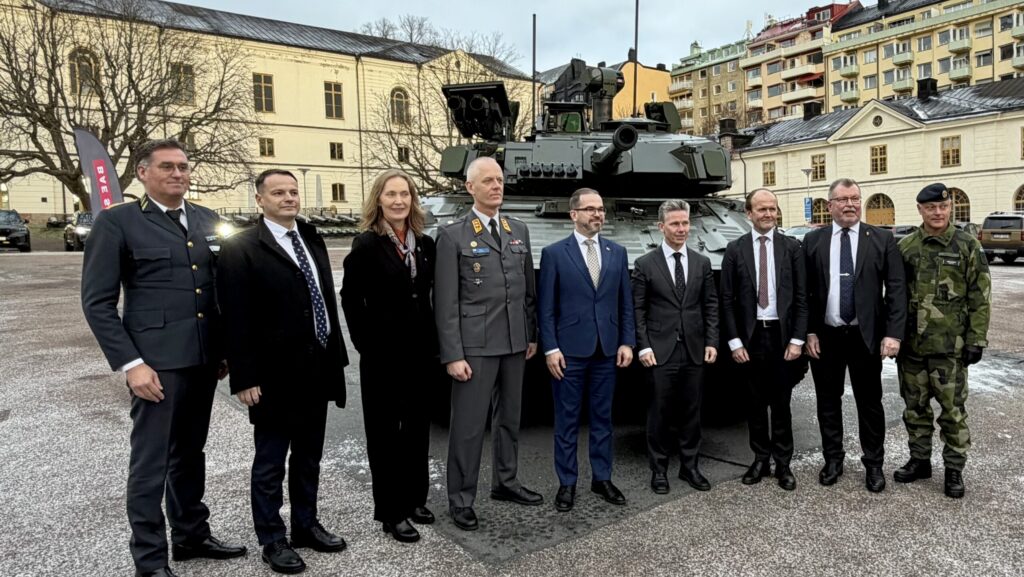
STOCKHOLM — After months of waiting, BAE Systems Hägglunds has finally landed contracts totaling $6 billion (€5.5 billion) to supply more than 400 CV90 infantry fighting vehicles (IFV) in a joint procurement by Finland, Lithuania, the Netherlands, Norway and Sweden.
“It’s the biggest deal we [have] ever done, and actually number two in Swedish history of signing international contracts,” Tommy Gustafsson-Rask, general manager at BAE Systems Hägglunds, told Breaking Defense on the sidelines of the signing ceremony in the Swedish capital today.
The joint deal, inked by the five nations for the CV9035 MkIV — dubbed the Nordic Edition — is a clear response to countries concerned about Russia’s threat to NATO’s northern flank. . Sweden’s Defense Material Administration (FMV) has signed the main contract with BAE Systems Hägglunds, with each country then signing off on its own deal.
“Deliveries will start in [2029] and then commence in a couple of years after that,” Gustafsson-Rask said, declining to go into exact details about production capacity per year. “But we talk many hundreds [per year],” he added. The chasis hill structures will all be welded at BAE Hägglunds’ Örnsköldsvik facility, but then “chassis assembly, turret welding, turret assembly will be done in the different nations.”
“Then they [nations] have some, as we call them, selectable options. That’s typically their own radio system, their soldier equipment. Then there are some technical options that can be mounted or integrated depending on how they decide,” he added.
The contracts inked today follows last years formalized intention by the five countries and Estonia at a NATO defence ministers’ meeting in Brussels. Estonia withdrew from the plans earlier this year, stating that it needs to prioritizeprefers to prioritise air defense systems and will instead upgrade its existing fleet of roughly 50 CV90s.
The common CV90 Nordic Edition configuration is expected to generate “synergies beneificial toin development, spare-parts lead times, integrated logistic support, sustainment and operations,” according to a BAE statement.. Shared design features between the Nordic Edition and previous designs are also being touted as a selling point by the company.

European-made Black Hawk gets an armed upgrade
New kits turn Black Hawks into attack Hawks in just three hours.
Sweden is procuring “about 60” vehicles, valued at 8–10 billion Swedish kronor ($700-$970 million) according to defense minister Pål Jonson.
“This is going to be very important for our mechanised brigades to get this capability,” Jonson told Breaking Defense, adding that Sweden has donated 50 of its older CV90s to Ukraine in 2024, and previously replenished them with an order to fill up the stocks, in addition to today’s announcement.
Mikael Granholm, the general manager of Sweden’s FMV, seemed to take a more conservative approach regarding when the first deliveries of the 400+ CV90s could begin. Those would be “starting in 2030 and going on until 2033” he told Breaking Defense while standing next to a CV90 on display outside the Army Museum, where the signing ceremony was completed.
Lithuania is ordering “a little bit more than 100” new CV90s, its defense minister Robertas Kaunas said on the sidelines to Breaking Defense, while stressingthat speed of delivery is important to counter the Russian threat.
“It’s crucial for us to receive as much as possible until 2030, because we are building our national division, and our national division should be ready till 2030.” The Lithuanian contract is worth around $1.3 billion, he stated.
“It does build military strength, deterrence first of all, and this is [a] reaction to the war that Russia started in Ukraine. We don’t have any different options,” Kaunas said.
Lithuania is the only nation of the five that does not currently operate versions of the tracked CV90. It currently operates Boxer wheeled infantry fighting vehicles made by Germany’s ARTEC, a joint venture between KNDS and Rheinmetall.
“This asset [CV9035 MkIV Nordic Edition] enhances our firepower and creates capability to stand firm on the ground and creates capability to all NATO to enhance eastern flank defence and deterrence,” Kaunas said.
Finland confirmed yesterday that it will buy 160 of the more than 400 CV90s for the Finnish Army. The Finnish contract covers the vehicles, spare parts, maintenance kits, testing equipment, technical documentation, training and licences, together with an option for an additional 100 vehicles. Finland’s project is budgeted at €2.8 billion, with a portion of the funding expected to come from loans under the EU’s Security Action for Europe (SAFE) instrument, for deliveries in 2029–2030.
Norway is purchasing 70 CV90s, with an option to acquire four more later. The vehicles are scheduled for delivery between 2030 and 2034 and will be used by Brigade Nord and the Finnmark Brigade on the Northern flank, according to the country’s acquisition agency. There were no details further made public by Friday.
The Dutch side of the deal has been kept mostly under wraps, with no details made public immediately at the signing.
BAE Systems’ CV90 infantry fighting vehicle sits inthe 20–38-ton class that can integrate a wide range of weapon systems. More than 2,300 vehicles have been ordered by 11 European nations (nine of them NATO members), with combat experience in Afghanistan and Ukraine, while BAE Systems Hägglunds has invested roughly $450 million to expand production capacity in Örnsköldsvik, per the company.
Breaking Defense Video