WASHINGTON — The Pentagon’s unclassified version of the National Defense Strategy places the homeland as the department’s number one priority above the Indo-Pacific, and seemingly signals cuts to come to US forces in Europe and South Korea.
However, the document denies a push towards “isolationism” while calling for greater burden sharing from allies and increased investments in the defense industrial base.
The NDS, which lays out how the Defense Department will follow the guidance of the National Security Strategy (NSS), is traditionally considered a foundational document for the Pentagon. But in a contrast with past releases, the department chose an unusual lack of fanfare: it emailed the document with no warning at almost 7:00 pm on a Friday, when the entire east coast is focused on a major snowstorm that is approaching.
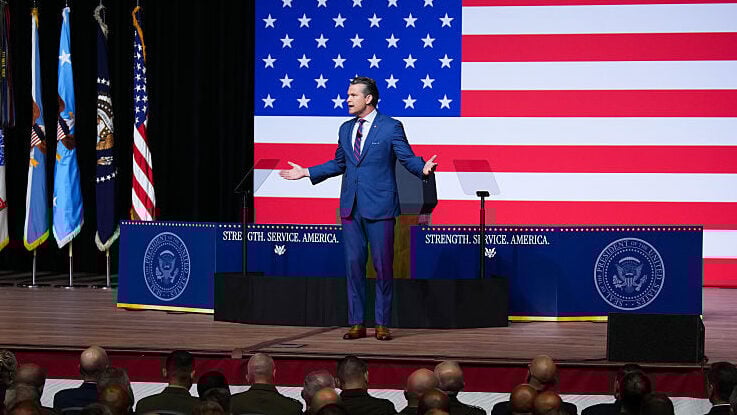
The document’s release also was not accompanied by a video from Defense Secretary Pete Hegseth, which has become his preferred way of making announcements.
The unclassified document is thin on details, which is not unusual for an NDS. However, there are clear signs for allies, partners and industry about where Pentagon leadership’s priorities will lie for the Trump administration.
There are also clear political differences between the 2022 NDS and the newer version. For instance, “President Biden” appears only twice in the older document; “President Trump” appears 47 times in the released PDF for the 2026 edition, despite it being a smaller page count.
The NDS’s release comes weeks after the White House published in December its National Security Strategy (NSS), which always comes before the NDS, focusing America’s attention more on its own hemisphere than in decades past.


Winning the cognitive domain — A methodology built for democratic constraints
The challenge for Western democratic institutions is not a lack of capability — it is a structural one.
“After years of neglect, the United States will restore US military dominance in the Western Hemisphere,” Secretary of Defense Pete Hegseth told the Reagan Defense Forum in December, in a speech that seemed to preview the document to come. “We will use it to protect our homeland and access to key terrain throughout the region, we will also deny adversaries ability to position forces or other threatening capabilities in our hemisphere.
“Past administrations perpetuated the belief that the Monroe Doctrine had expired,” he added. “They were wrong. The Monroe Doctrine is in effect, and it is stronger than ever.”
The increasing emphasis on the Americas in both strategies had been expected during a time in which the administration has been flooding the region with maritime assets, striking vessels it claims are ferrying drugs, and, more recently, the early January US military operation capturing Venezuelan President Nicolas Maduro.
The top four priorities for the Pentagon, as ordered by the NDS, are:
- Defend the US homeland
- Deter China in the Indo-Pacific “through strength, not confrontation”
- Increase burden-sharing with US allies and partners
- “Supercharge” the US Defense industrial base
Homeland defense: Given the emphasis from the NSS, a focus on the Americas was expected, but is still striking compared to previous versions of the document.
“As President Trump has said, the U.S. military’s foremost priority is to defend the U.S. Homeland. The Department will therefore prioritize doing just that, including by defending America’s interests throughout the Western Hemisphere,” the NDS reads. That means securing the homeland in part by securing the boards, countering narcoterrorism. and protecting the skies, per key points in the document.
The document calls out Trump’s Golden Dome effort, what appears to be a separate “renewed focus” on counter-drone systems, and a “robust and modern” nuclear deterrent as key parts of this strategy. It also emphasizes Trump’s new interpretation of the Monroe Doctrine, in terms that may make regional partners nervous.
“We will guarantee U.S. military and commercial access to key terrain, especially the Panama Canal, Gulf of America, and Greenland,” the document reads, marking one of five times Greenland appears in the unclassified document.
“We will provide President Trump with credible military options to use against narco-terrorists wherever they may be. We will engage in good faith with our neighbors, from Canada to our partners in Central and South America, but we will ensure that they respect and do their part to defend our shared interests. And where they do not, we will stand ready to take focused, decisive action that concretely advances U.S. interests.”
Deterring China: The 2018 National Defense Strategy, released by the first Trump administration, marked a watershed in how the Pentagon talked about China, fully calling out Beijing as a major challenger in an era of “great power competition.” The 2022 framework, released by the Biden administration, doubled down on that, calling China the “pacing challenge” for the department, even ahead of Russia despite being released shortly after Moscow’s invasion of Ukraine.
The 2026 lists deterring China in the Indo-Pacific region as the second priority, noting that the department plans to focus on supporting strategic stability, deconfliction and de-escalation “more broadly.”
“President Trump has made clear his desire for a decent peace in the Indo-Pacific, where trade flows openly and fairly, we can all prosper, and our interests are respected,” the NDS said. “DoW will use these engagements to help communicate that vision and intent to Chinese authorities, while also demonstrating through our behavior our own sincere desire to achieve and sustain such a peaceful and prosperous future.”
However, the document says the US will still seek to “build, posture, and sustain a strong denial defense along the [First Island Chain]. We will also work closely with our allies and partners in the region to incentivize and enable them to do more for our collective defense, especially in ways that are relevant to an effective denial defense. Through these efforts, we will make clear that any attempt at aggression against U.S. interests will fail and is therefore not worth attempting in the first place.”
Interestingly, “Taiwan” does not appear mentioned anywhere in the document.
Burden sharing: Increased burden sharing with partners and allies takes the third spot, with the Pentagon laying out the expectation that other nations take on “primary responsibility” in their geographic regions to allow the department to refocus elsewhere.
“At the same time, we will seek to make it as easy as possible for allies and partners to take on a greater share of the burden of our collective defense, including through close collaboration on force and operational planning and working closely to bolster their forces’ readiness for key missions,” the NDS said.
The NDS specifically calls out the Korean Peninsula as an area where the relationship between the US and an ally will be shifting – which comes after multiple reports that the US may draw down forces in South Korea.
“South Korea is capable of taking primary responsibility for deterring North Korea with critical but more limited U.S. support,” the document reads. “South Korea also has the will to do so, given that it faces a direct and clear threat from North Korea. This shift in the balance of responsibility is consistent with America’s interest in updating U.S. force posture on the Korean Peninsula.”
Another area where there appears to be signals of a coming drawdown in Europe. The document goes to length to make the case that Europe should be able to easily overwhelm Russia, even including a graph showing the non-US NATO economies drawing that of Russia and stating that “Moscow is in no position to make a bid for European hegemony.”
“Our NATO allies are therefore strongly positioned to take primary responsibility for Europe’s conventional defense, with critical but more limited U.S. support,” the NDS reads. “This includes taking the lead in supporting Ukraine’s defense. As President Trump has said, the war in Ukraine must end. As he has also emphasized, however, this is Europe’s responsibility first and foremost.
Industrial base: In the 2022 edition, the term “defense industrial base” appears only eight times in an almost 80 page document, and gets little attention. In the 2026 edition, the health of the industrial base is listed as the fourth point of focus for the department going forward, with the document stating that the industrial base “undergirds the other key pillars of this Strategy.”
Without going into details, the report states the department plans to take “urgent action to mobilize, renew, and secure it—to supercharge American defense industry so that it is ready to meet the challenges of our era as effectively as it did those of the last century.”
“We will therefore bolster our organic sustainment capabilities, grow nontraditional vendors, and partner with traditional DIB vendors,” the document states, “Congress, our allies and partners, and other federal departments and agencies to reinvigorate and mobilize our great nation’s unrivaled creativity and ingenuity, re-spark our innovative spirit, and restore our industrial capacity.”
This article was updated at 7:54 pm EST on 1/23/2026 with additional details from the NDS.