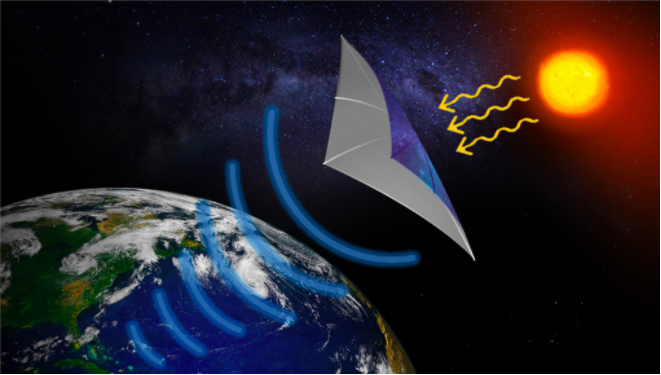
WASHINGTON — Virginia-based startup Overview Energy has been contracted by the Pentagon’s Operational Energy Capability Improvement Fund (OECIF) to demonstrate a key enabling technology for beaming solar energy to users on Earth, according to a company announcement.
Under the contract, Overview will design, build and test the homing beacon for the company’s satellite-based solar energy system, which converts the Sun’s radiation to near-infrared light to safely transmit power to terrestrial power plants, the Sept. 30 announcement said.
“Ground crews install the beacon at solar receiver sites, enabling Overview satellites to locate the site, lock on, and beam power with high precision. The system requires an active, authenticated beacon before a satellite transmits energy, which prevents signal spoofing and hijacking,” the announcement elaborated.
The OECIF contract is one of several Defense Department research programs on space-based solar power moving ahead in recent years, after decades of fits and starts for the futuristic but potentially revolutionary tech.
“Delivering reliable power to remote and contested locations remains one of the military’s most persistent operational challenges,” Christopher DePuma, combat power portfolio lead at OECIF, said in the announcement.
“Overview Energy’s technology opens up a new source of reliable power, and the homing beacon ensures precise, secure power delivery from orbit to an authenticated destination. This award advances key technology to bring resilient energy safely to the warfighter,” he added.
According to a Pentagon fact sheet issued by the Office of the Assistant Secretary of Defense for Energy Resilience and Optimization, the OECIF is a “joint operational energy investment program” aimed at “pre-commercialization” technology.


How the industrial base is responding to Air Force, Space Force needs
Demand signals from leadership are shaping investments in design, engineering and manufacturing.
“Through highly targeted science and technology investments, it guides and matures advanced, first-of-a-kind operational energy technologies across warfighting platforms and domains,” the fact sheet says.
Overview’s announcement did not include the contract’s value or the projected data of the on-orbit experiment.
A company spokesperson told Breaking Defense that the demo is planned for early next year, but declined to provide a contract value citing customer constraints on releasing that information.
This isn’t a first defense-related contract for the Virginia startup. In May, the Air Force contracted Overview for a year-long study on the use cases in which space-based solar power could supply electricity “in constrained and contested logistics environments.”
Nor is it the first OECIF contract for a space-based solar power demonstration — as Defense Department interest grows in the potential for rapidly getting power supplies to far-flung bases and into the battlefield without relying on expensive, slow and vulnerable air, sea and land logistics operations.
Katalyst Space on Sept. 21 announced it had been tapped by OECIF to “develop and launch a robotic spacecraft that will assemble a large-format power beaming system on orbit and transmit power back to Earth.”
Katalyst’s Advanced Scalable Growth Architecture for Robotic Deployment (ASGARD) program also is building satellites to harvest the Sun’s rays, but is using microwaves instead of near-infrared to transmit the energy. The microwaves are generated on-board by conversion tiles developed by the Naval Research Laboratory, which has been involved in research on space-based solar power and microwave transmission for a number of years.
Katalyst’s announcement did not reveal the contract’s value, nor the planned date of the demonstration. The company did not respond to a request for comment.
The Pentagon’s Office of Public Affairs did not respond to a request for comment about the two contracts and OECIF’s larger interest in space-based solar power.