uscapitolhouse

WASHINGTON: If anyone at the White House had hoped the new chairman of the House Armed Services Committee would be more compliant than his predecessor, the defense bill out today should end their illusions. Sure, Rep. Mac Thornberry has consulted closely with the Pentagon and his ranking member on issues like acquisition reform.

But Thornberry’s draft of the National Defense Authorization Act for 2016 would seem in many ways a repeat of last year’s discussion between the Obama administration and the Hill. The administration wanted authority to close bases, retire the A-10 fleet, and to rejigger military pay and benefits last year, among other things. Here’s what the 2016 NDAA draft from the HASC would do:

  • It authorizes $682.7 million to save the A-10 “Warthog” ground attack plane, the Army’s favorite Air Force program. Reallocating specific funds to the A-10, at the expense of other programs, is a more concrete measure than past congressional declarations that the aircraft simply mustn’t retire. It also halves the number of A-10s the Air Force is allowed to mothball in ’16, from 36 to 18. The bill doesn’t forbid A-10 retirement outright, but expect an amendment at Wednesday’s marathon mark-up session: “With funding secured, the Chairman would welcome efforts at markup to prohibit the retirement of the A-10 fleet,” the official summary says.
  • The bill would also block the Air Force plan to retire half its fleet of EC-130H Compass Call aircraft, adding $48 million to keep the unique electronic warfare planes. Meanwhile the Navy gets an extra $1.2 billion for a dozen new F/A-18E/F Super Hornets and the Marines get $1 billion for six additional F-35B Joint Strike Fighters.
  • The National Guard gets $139 million for eight new UH-60M Black Hawk helicopters and $87 million for upgrades to old UH-60As, while the regular Army gets $110 million to upgrade its AH-64 Apache gunships and $80 million for Stryker vehicle upgrades.
  • It funds the requested $715 million for aid to Iraq, but with caveats that will frustrate the White House and outrage Baghdad. First, the bill earmarks 25 percent of the money ($179 million) for forces not truly subject to the Shiite-dominated central government: Kurdish Pershmerga, Sunni tribes, and the nascent Iraqi National Guard, a collection of Sunni militias — all of which would be officially deemed “countries” to allow them to receive US aid directly, bypassing Baghdad.

What’s more, the bill would withhold the remaining 75 percent until the Secretaries of Defense and State formally tell Congress that “Government of Iraq is meeting certain conditions relating to political inclusion of ethnic and sectarian minorities within the security forces of Iraq.” If the administration finds Baghdad isn’t meeting the standard — and there’s no waiver provision allowing them to say “yes, but” — no money would go to the central government, and 60 percent would go to the Kurds and Sunnis.

The bill “rescinds the President’s authority to unilaterally transfer detainees” from the prison at Guantanamo Bay, reinstating stricter congressional controls from the 2013 NDAA. This move is part of the backlash against Obama’s release of five prisoners in exchange for captured Army soldier Robert Berghdal. In a statement generally praising Thornberry’s bill, HASC’s top Democrat, Adam Smith, singled out the Guantanamo provision as “perilous policy” and “a political position driving bad policy.”


The mark pushes the Air Force to retire Russian-made RD-180 engines and replace them with US-made rocket boosters. Specifically, the bill provides $187 million more to develop the new engine, but no more time, keeping to a strict 2019 deadline. Air Force Secretary Deborah Lee James, industry leaders, and others have said this is the kind of tough technical problem that can’t be rushed: Throwing more money at it and expecting invention on deadline may just end in rush to failure, they argue.

The bill lauds the Defense Department’s downsizing efforts and offers it new flexibility in managing its workforce — but only if it meets a multitude of preconditions. The budget, military manpower, and contractor workforce must all be downsized as well as the civil service; attrition and voluntary incentives must be the first resort before involuntarily getting rid of civilians; and no job vacated by a civilian federal worker may be filled by a contractor “for six years” (boldface in the original). The president of the Professional Services Council, which advocates for more flexible workforce management (and more use of contractors) said the NDAA provision “strikes me as half a loaf.”

“Those kind of restrictions tend to really limit your ability to do smart human capital planning and strategy,” PSC president Stan Soloway told me.

At the same time, the bill eases the restrictions on multi-year procurement contracts, a cost-saving measure favored by industry but which Congress has historically restricted in favor of buying things year-by-year. Under current law, agencies “must determine that substantial savings would be achieved before entering into a multiyear contract.” The HASC NDAA would lower that threshold to “a reasonable expectation that the use of a multiyear contract would result in lower total anticipated costs.” That could give much more freedom to Pentagon acquisition officials. But Frank Kendall, the head of Pentagon acquisition, has signaled he isn’t comfortable with this approach: He likes having the “substantial savings” requirement in law as a tool to extract pricing concessions from contractors.

Another measure that might do more to endear Thornberry to Pentagon officials: The bill would, “over the next six years, eliminate over 460 congressionally-mandated reports.”

Thornberry’s purge of obsolete annual reports doesn’t mean he swears off the use of reporting requirement as a policy tool. To the contrary, the bill includes some extremely interesting report requirements that could help shape the future of the force:

It asks the Defense Department to submit a general strategy to counter “unconventional threats [from both] state and non-state actors,” plus a specific study on the Russian threat. The danger is not just conventional forces, the bill emphasizes, but the combination of those forces with “propaganda in media, economic warfare, cyber warfare, criminal acts, and intelligence operations.

It asks the Defense Department to study “the feasibility, utility, and options for mobile, land-based systems to provide anti-ship fires.” Former Defense Secretary Chuck Hagel, Seapower subcommittee chairman Randy Forbes, the thinktank CSBA, and (elliptically) the new Army Operating Concept have all touted land-based ship-killer missiles as a way to level the balance of power in the Western Pacific against China’s 2nd Artillery Force. It could also be a major new mission for the Army.

Updated 6:20 pm with Stan Soloway comment
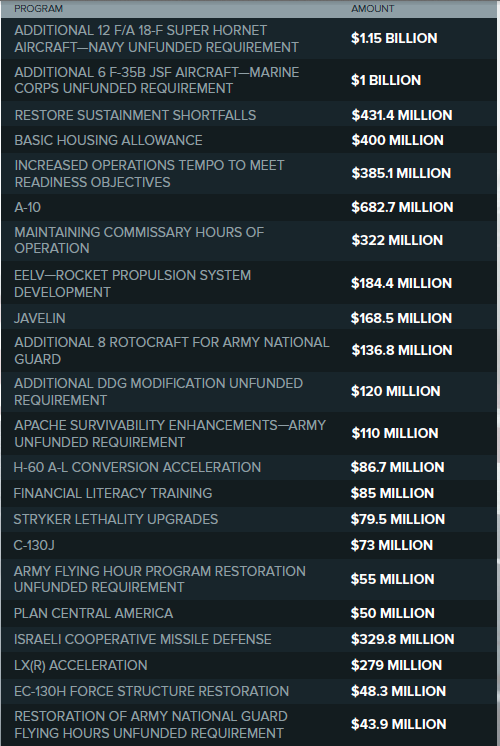
Selected plus-ups in the HASC draft of the National Defense Authorization Act

Selected plus-ups in the HASC draft of the National Defense Authorization Act

Comments

  • Ctrot

    The total cost of every single item on the list, $6.1 billion, is approximately what the US spends on means tested welfare programs every 45 hours.

    • dukeofurl

      US agriculture subsidies are $20 bill a year.Then there is the crop insurance subsidy, and so on. A new LRB would cost less than the money paid to bail out AIG

    • bobbymike34

      I think that is also about the amount Obama approved for feeding, caring and housing the so-called ‘unaccompanied minor’ illegal immigrants last year.

    • Jeffery Surratt

      Why does everyone complain about 44 billion spent on welfare for the poor, but say nothing about the 88 billion spent on welfare for corporations. Both need to be reformed. $6.1 Billion added to the DoD budget? Tell the bean counters at DoD that you will give them 1% of any savings they could find and I bet they could find 61 Billion in the 500+ Billion dollar budget without any problems. Spend, Spend, Spend that is all the clowns in D.C. Know.

      • Ctrot

        There is no such thing as “welfare for corporations”. There is only government taking more or less from those who create wealth.

        • Jeffery Surratt

          Yes there is. When the government picks winners and losers using the tax code to give favored business interest special tax breaks that others do not receive. Like the 300 million dollar tax break they gave Boeing back in the 1990s Or writing tax law that allows GE to pay zero taxes on 4 Billion in profits. That is why we have 18 Trillion dollars in debt, because everyone is not paying what they should, so we have a balanced budget. There needs to be a minimum tax rate on profits. Everyone including business benefit by the services government provides. So GE, Boeing and others should not be required to pay for the roads and services, but the average taxpayer has no choice but pay the bill.

  • dukeofurl

    Maintaining Commissary hours of operation-322 million

    Good to see they have made sure the top 20 military needs are answered

    • vincedc

      Actually, that is where they are hiding the funding for alien spacecraft engineering in Area 51.

  • Herb

    I see spinmasters are here with absurd comparisons. Gee, these Republicans are bigger spenders than Democrats. They are trying to bankrupt us faster. Speed up the printing presses. Their campaign donors want to their ROI.

  • Robert Warner

    The smart folks in DOD and Congress are now talking with each other, making sense, and gaining ground.

  • vegass04 .

    I like the last part.. Giving the Army a set of capabilities that all other near peer powers have – mobile land based anti ship missiles. I simply can’t understand what were they waiting for till now. These missiles should have come from the assembly lines by the hundreds already. It shouldn’t be so hard, Russia has supersonic anti ship missiles for decades, is it to much to ask for a strongest military to have them to?? Get to the work lazy bastards.

    • Raptor1

      We shouldn’t give a rat’s a@^ if all other near peer powers have land-based anti-ship missiles… We have ship and sub-based anti-ship missiles that are constantly mobile at what, 30 knots, protected by AEGIS, AWACS, and thousands of miles of ocean; as opposed to a land-based system that’s fired from ground over which we can and would attain air superiority? And that’s not even mentioning the air-launched cruise missiles that we can deploy thousands of miles in a matter of hours and launch from B-2s by the dozens. Land-based cruise missiles are the way to go?… Really?

      • vegass04 .

        Those platforms that shoot cruise missiles (subs, surface combatants, B-2s) cost billions while TEL costs like a Mack truck. Are you seriously that dumb to compare the two? You could position hundreds of surface launched missiles that can attack from multiple axis and are virtually impossible to locate and track while future Chinese surveillance assets will be able to find an Aegis ship or a carrier in a minute.

        • Raptor1

          Are you really that ignorant that you think I’d take seriously the notion that buying hundreds of ground-based cruise launchers to supplement the HUNDREDS we already have is a GOOD idea? And where the heck would we be firing them from anyways? And what planet are we on where we can, or would, position hundreds of these things AROUND a country, for the purpose of attacking “from multiple axis.”Just because Russia or China or anyone else thinks a land-based system is the way to go because they don’t have the type and numberr of platforms we have (sub, air, etc.) doesn’t mean squat.

          And did it occur to you that land-based cruise can only be fired from LAND within the missile’s range?… A cruise missile from an aircraft, ANY aircraft, can be launched from any direction, out to the range the aircraft can reach with refueling.
          I’m not even saying we SHOULD buy more cruise missiles – My POINT was that buying land-based is a fool’s bet. If China loaded up 600 cruise missiles to defend her shores, they would be targeted, and retargeted until, ships could move closer; all the while, they’d be absorbing devastating attacks from B-2s, B-1s, F-22s, Sub-launched cruisers, etc… So no, land-based is not really necessary. If we were fighting Mexico, maybe.

          • vegass04 .

            Again, why do you think cost scale is so against US military in Asia-Pacific? Why do you think Chinese can field dozens of land based missiles for one U.S. platform that shoots missiles. It was not me suggesting that but rep Randy Forbes in his letter to army chief Odierno. RAND corporation also had the great study on that theme that suggests land based missiles to give Chinese taste of their own medicine, a kind of US made A2/AD. Read man, read, there was a great article about it here on BD. don’t attack people just because you’re uninformed.

          • Paul

            Attacking you?… Really? READ your own post before being a hypocrite. My gosh, we digress.

          • vegass04 .

            As far as Tor second comment I am really afraid for your health. My comment wasn’t directed to you but to Raptor so I don’t know why you thought you have something to say to me. Ridiculous.

          • Paul

            We’re one in the same person… I know it’s difficult to keep up, but really, that never crossed your mind?
            Anyways, there’s a reason the Chinese rolled out the J-20 and -31, they understand what they need to truly contest carriers and striking stealth aircraft. And there’s also a reason we likely won’t see the real fruits of these aircraft until another 10 years, if ever – the costs associated with fielding that kind of capability
            You might be right about cost-effectiveness of GLCMs vs subs, etc… but cost-effectiveness amounts to little when the only thing you can do is hide them where they hopefully won’t get obliterated. By the time an asset positions itself in a location that you can reach it, you’ve basically lost the ability to do much about it. Air and sea-launched works MUCH better for us, considering that places where these things might get fired from can be reached by the same sort of missiles that are targeting you – Tit for tat is a game; war is not.

          • vegass04 .

            Again, it is gonna happen, wether you like it or not. It means just giving an Army some punch, role, a meaning if you will, in Asia pacific and Air-sea battle. Otherwise they’ll become irrelevant since you won’t see any massive ground wars in that theater. This is just adding capability, not replacing subs and stealth bombers with GLMs. If you don’t see an advantage in that then I guess we’ll just have to agree that we disagree P.S. Why the hell would you want to have to account?? You can talk to yourself looking in the mirror. There are some great medicine these days for your condition.

          • Paul

            Giving them a taste of their own medicine?… IF China and U.S. engaged in hostilities, we would give them a taste of OUR medicine; that’s what separates us from everyone else.

          • vegass04 .

            Apples and oranges man. The taste of their own medicine meant giving them A2/AD environment for the fraction of cost US military spends or is thinking of spending in the case of a possible breaking that A2/AD, kicking the door and entering the area of operation. In current doctrine (envisioned by Air-Sea battle) includes multi billion $ assets like new stelath bombers, Raptors, F-35s, super expensive aircraft carriers and so on and so fort. Since China is the one wanting to change the current state of affairs it is they that are gonna have to do the offensive part of the story. By including land based missiles USA gives its theater commander more options for the fraction of the cost it would take to employ all those platform I mentioned earlier. How hard is it to understand what I’m trying to say?? Jeez.

  • Jeffery Surratt

    I retired from the USAF in 1995. I have always adjusted my shopping schedule to the hours stores are open. Can we really afford 322 million just to keep the Commissary open for a few more hours per week. I love the DoD never cut, if we can get Congress to pay for it.