
WASHINGTON: As the US military refocuses on Russia and China, it mustn’t forget the hard-won lessons of Afghanistan and Iraq, because they’ll only become more relevant in future conflicts. With technology spreading, populations rising, and megacities sprawling, “war among the people” — whether it’s counterinsurgency, counterterrorism, or just conventional warfare in an urban setting — will only get nastier and harder to avoid.
You thought roadside bombs were bad? Imagine off-the-shelf mini-drones bombing US troops. Homebrewed high explosives got you down? Imagine extremists with 3D printers and a database of weapon designs. Suicide car bombs? Imagine explosive-laden cars that drive themselves. US military transmissions jamming each other by accident? Imagine guerrillas getting cheap GPS and radio jammers online. Media revealing military secrets or reporting faux pas that get the local population up in arms? Imagine that local population, enemy informants included, tweeting video of everything US forces do.
“The problem of war among the people is getting harder,” said Paul Scharre, a former Army Ranger and civil affairs officer. “It’s getting more lethal, and people are empowered by information technology: They’re able to communicate and organize for action in ways they weren’t ten years ago. All of that makes war on the ground much more challenging.”

As result, “US forces cannot afford a return to the pre-9/11 era when training and equipping focused principally on nation-states,” Scharre writes in a study out today. And even nation-states can adopt guerrilla tactics when it suits them, as shown by Russia in Ukraine today or, for that matter, Chinese troops infiltrating under MacArthur’s nose in the Korean War. Such “grey” or “hybrid” warfare happened plenty in the past and is only more likely in the future, even though it doesn’t fit into American mental categories.
“In many ways,” Scharre told me, “the root of intellectual stagnation here in US defense circles comes from watching too many World War II movies.” In those films, there’s a clear start to the war, clearly uniformed combatants (except for the occasional partisan), and a clear happy ending. Historically, he said, “that’s the exception rather than the rule.”

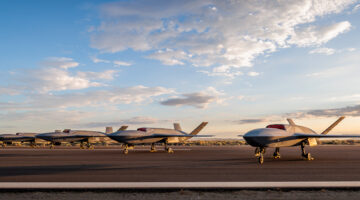
A new era of uncrewed airpower: GA-ASI’s lineup for high-tech warfare
GA-ASI is serious about retaining its position as the leading provider of UAS to the United States and its allies.
Scharre is an Iraq and Afghanistan veteran who heads the 20YY Future of Warfare Initiative at the Center for a New American Security. He’s also one of my favorite futurists, and I’ve interviewed him many times on topics from the ethics of armed robots to keeping combat operations secret in the age of YouTube and Twitter. The report out today, Uncertain Ground: Emerging Challenges in Land Warfare, pulls together all that work and more to present a distinctly unsettling picture of future land combat.
There are already cases where modern off-the-shelf information technology has allowed angry civilians to outmaneuver security forces. The Arab Spring is a famous example and — for all its tragic consequences — still widely lauded. But there’s also the case of the 2011 riots in London, Scharre writes, when
“rioters used decentralized communication over BlackBerry messenger networks to share information about police barricades, allowing them to circumvent police checkpoints and loot unprotected areas. Communication and coordination among rioters was entirely decentralized and organic, giving them more accurate real-time information about changing events on the ground than the police.”
The London rioters weren’t an organized underground or even a loose political movement: They came together almost overnight. That’s an alarming precedent, one which could negate American expertise in taking down formally organized networks like al-Qaeda. This kind of spontaneous self-organization over the Internet is what could take all the other technologies and integrate improvised weapons, social media savvy, and non-violent resistance into a dangerous new form of guerrilla warfare, Scharre continues:
“Similarly, ad hoc networks of likeminded individuals could swarm military forces, disrupting their movements via digitally-empowered ‘smart mobs’ on landing zones or roads. Unarmed mobs could incite military forces to respond, all the while filming their actions for broadcast. Militaries will be hard pressed to hide their movements in a world of radical transparency, and greater connectivity will enable enemies to rapidly organize to attack U.S. forces.”
Not all the new technologies that concern Scharre are commercially available off the shelf, but even strictly military tech is proliferating beyond the hands of states. Precision firearms, for example have remained experimental even for the US Army — the XM-25 smart grenade launcher was never fully fielded — but cheaper aim-correcting technologies now in development could make every untrained insurgent a marksman.
Already, anti-tank and anti-aircraft missiles are widely available across the Middle East, Scharre notes, and “over 90 countries and non-state groups already have drones, and 30 countries have or are developing armed variants.” While America’s stealth-fighter fleet may dominate at high altitudes, he writes, low-flying swarms of expendable drones may bring US ground troops under enemy air attack for the first time since 1953.
Such tactics might be tempting even for well-armed nation-states, Scharre argues. Yes, conventional massed artillery has worked well for Russia so far in Ukraine, with drones omnipresent as spotters but rarely armed. Both Russia and China maintain large conventional forces of tanks, ships, and aircraft. But the US military has shown remarkable proficiency in destroying such targets from a distance, and it doesn’t hurt to have a backup plan — say, being able to disperse your surviving forces and operate as well-armed guerrillas. “Drones, precision guided anti-tank weapons, and more sophisticated shaped-charged RPGs are making that a much more lethal threat,” Scharre told me.
As a result, “even in a conflict against a nation-state, enemies will still be able to employ significant lethality after the U.S. military has destroyed major military combat capabilities,” Scharre writes. “After seizing ground and destroying the enemy’s major military units, U.S. forces cannot simply [declare victory]. The unfortunate reality is that, in many conflicts, seizing ground may be the equivalent of merely grabbing hold of the hornet’s nest.”
Even a conflict that starts out with two conventional militaries, in other words, may well degenerate to guerrilla warfare before the end. That means the US military must learn how to wage war amongst the people in a new age, when there are more people with more technology and more capability to mobilize themselves for political causes — including acts of violence.
“This democratization of information dramatically changes the social landscape in which conflict occurs,” Scharre writes. That means we’d better understand that changing landscape before we send troops into it. “Training in kinetic operations cannot neglect the parallel fight for the human terrain….Bullets do not fire on their own. Tanks and bombs are merely tools; wars are fought by people.”