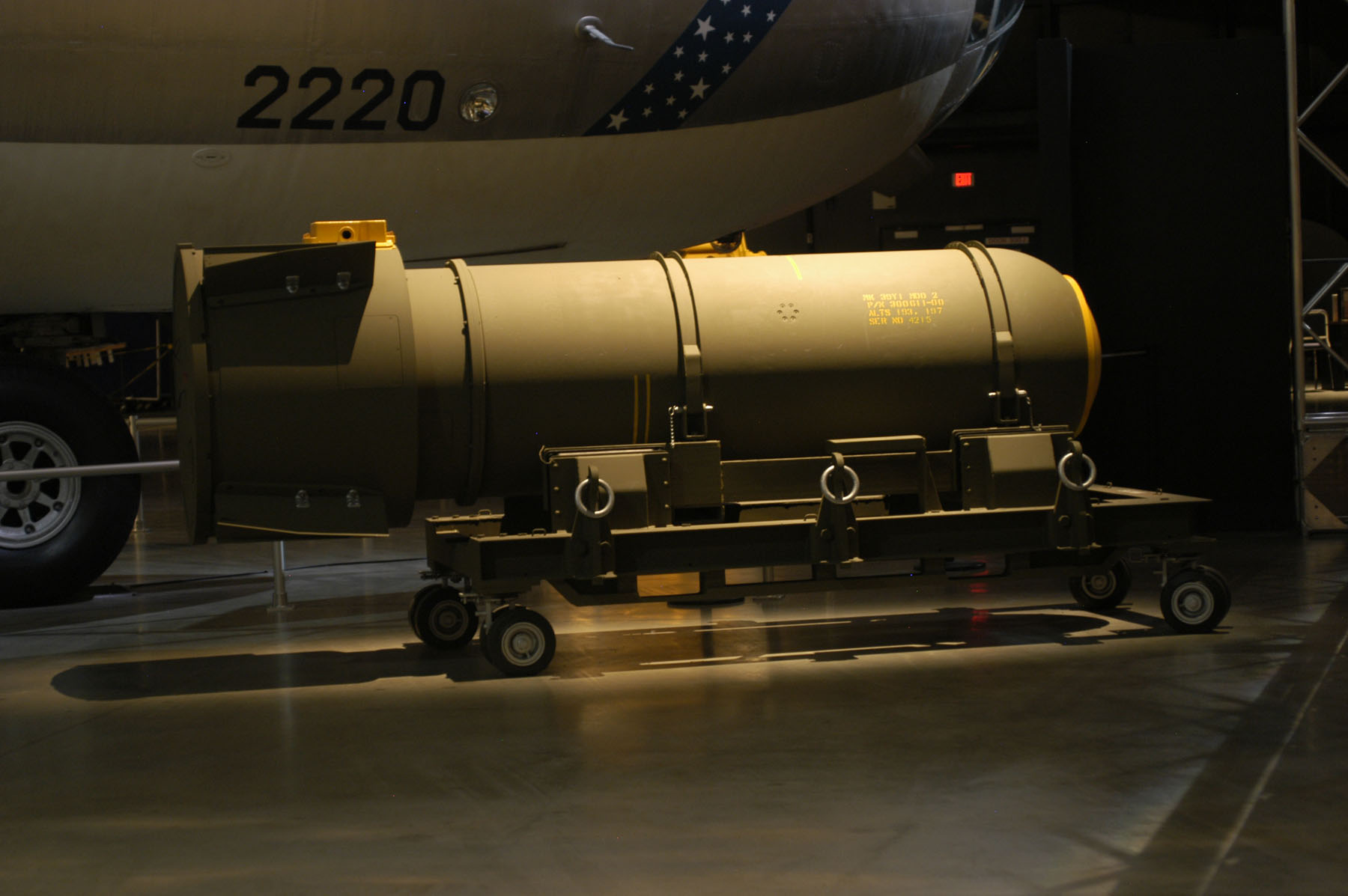
“Jones found that of the four safety mechanisms in the Faro bomb, designed to prevent unintended detonation, three failed to operate properly. When the bomb hit the ground, a firing signal was sent to the nuclear core of the device, and it was only that final, highly vulnerable switch that averted calamity. ‘The MK 39 Mod 2 bomb did not possess adequate safety for the airborne alert role in the B-52,’ Jones concludes.”
(Here’s a fine video showing the loading, dropping and detonation of a Mk 39 thermonuclear bomb.)
http://youtu.be/SaVqDT12Pu0
I checked with one of the top experts on nuclear weapons and the complex that builds and maintains them to see just how close things were and whether this incident might be indicative of any current problems. (Bear in the mind that the Mark 39 bomb and its warhead have been out service since 1966.)
“It strikes me as another in the ‘hype’ category, where ‘OMG only one safety feature saved us from a horrible accident.’ Well, yes, it did,” Bob Butterworth, a member of the Breaking Defense Board of Contributors who was former chief for strategic planning, policy and doctrine at Air Force Space Command and deputy director of the Presidents Foreign Intelligence Advisory Board, says in an email. “True, we get better at safety all the time, and today’s safety precautions are far better than those designed in the 1950s. But even the ones in the 1950s apparently worked.”
The Government Accountability Office recently issued a new report on nuclear weapon safety and reliability, concluding that while some processes needed tightening, it did not mention any safety concerns.

Why Bigger Fences Aren’t Enough in the Age of Drones
Traditional thinking about how to protect facilities must adapt to new threats such as drones or downstream attacks.
DoD and the National Nuclear Security Administration (NNSA) identify and monitor “limitations” on the use of nuclear weapons. Here’s what GAO says about those invovling what is called “detonation safety under abnormal conditions,” which would include something like the Goldsboro incident. “Thirteen limitations—25 percent of all nuclear weapon limitations—are associated with detonation safety under abnormal conditions (i.e., conditions not expected to occur during nuclear explosive operations and associated activities). DOD officials did not raise concerns with any limitations of this type. As established by DOD, the probability of a nuclear detonation must not exceed 1 in a million per exposure to abnormal conditions (i.e., detonation safety standard for abnormal conditions). NNSA has issued a safety limitation for each weapon concerning potential exposure to a certain combination of abnormal conditions. DOD officials told us that these safety limitations are not a concern, provided that established procedures are followed, because of the extremely low probability of a weapon’s exposure to the abnormal conditions.”
There is a rub to all this, of course. The report notes that, “it is very difficult for NNSA to produce computational models that can verify DOD’s detonation safety standard is met for each possibility” because “there is infinite combination of possibilities for the specified abnormal conditions.” Or, as Don Rumsfeld might say, we just don’t know the unknown unknowns. (For an intriguing look at a declassified history of nuclear safety devices, click here.)
Jones, who wrote the report raising alarms about the safety systems, called it: “Goldsboro Revisited or: How I learned to Mistrust the H-Bomb,” clearly a play on Stanley Kubrick’s 1964 film about nuclear holocaust, “Dr Strangelove or: How I Learned to Stop Worrying and Love the Bomb.” The good news: nuclear weapons’ safety systems have worked and nuclear war has not broken out yet.
Breaking Defense Video