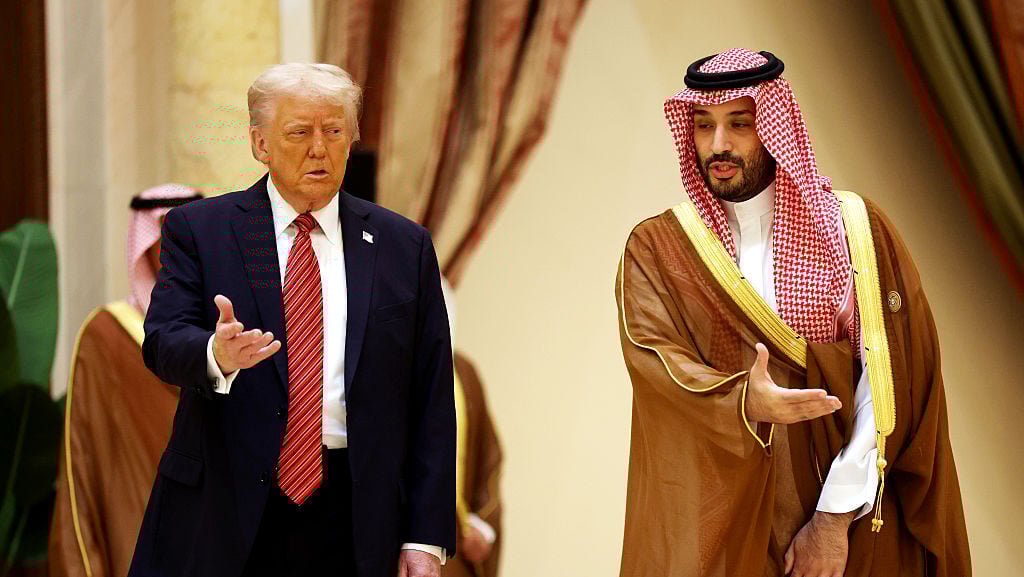
BEIRUT — American President Donald Trump may appear confident that Saudi Arabia will join the Abraham Accords and normalize relations with Israel, but at a recent Middle East conference officials from two other potential entrants — Lebanon and Syria — signaled that at least for them, there was a long way to go.
Trump made his latest prediction about Saudi accession in a recent interview on 60 Minutes, in which he said he believed Saudi Crown Prince Mohammed bin Salman, with whom Trump has a personal relationship, is “gonna join,” with or without the establishment of a two-state solution for Palestinians.
“I think we will have a solution. I don’t know if it’s gonna be two-state. That’s gonna be up to Israel and other people, and me,” he told the American TV program. “But look, the main thing is you could’ve never had any kind of a deal if you had a nuclear Iran. And you essentially had a nuclear Iran. And I blasted the hell out of ’em.”
Saudi officials haven’t publicly commented since those remarks, but officials and experts previously emphasized multiple times that a two-state solution is a prerequisite for any prospective normalization with Israel.
Trump’s latest push for Saudi Arabia to join the accords followed shortly after another, broader call from senior US officials at the IISS Manama Dialogue in Bahrain to several Middle Eastern nations to join as well.
“We’ve heard President Trump and Vice President [JD] Vance speak just last week about their hope that the Abraham Accords will continue to grow and expand to allow for a true, lasting regional stability and peace,” US Director of National Intelligence Tulsi Gabbard said in the opening keynote.
US Ambassador to Turkey and Special Envoy to Lebanon and Syria Tom Barrack likewise called for regional states to “align” with Israel.


From requirement-driven to market-ready: Rethinking how defense technology reaches the warfighter
As threats continue to evolve, speed will increasingly depend on what is already available when the need emerges.
Specifically Barrack said he would “urge and usher Lebanon” to have direct talks with Israel.
“It’s clear that Israel has become a dominant ally in this repositioning of the chessboard of what happens in the Middle East and the Abraham Accords, at least for what we have in front of us, seems to be the road that everybody needs to jump on. We’re building a new hybrid, and that new hybrid has to come from alignment,” he added. “Rather than thinking that you’re going to fight them [Israel] at the moment, is to align with them.”
But some Middle Eastern officials at the conference did not exactly sound optimistic about their capitals’ near-term participation in the agreement.
On the Lebanese side, the only Lebanese official who spoke during the public panels was Minister of Interior Ahmad Al-Hajjar. Al-Hajjar did not directly address the question of Lebanon joining the Abraham Accords, but he made a salient point about the difficulty of any negotiations: it’s currently illegal under Lebanese law for Lebanese citizens to speak to Israelis.
Another potential entrant to the accords is Syria, since longtime dictator Bashar al-Assad has been deposed. The nation’s new president, Ahmed al-Sharaa, has publicly spoken about some kind of security arrangement with Israel, if not going as far as some US lawmakers claim in saying Syria would be open to joining the accords.
At Manama, Syrian Foreign Minister Asaad Hassan al-Shaibani echoed the position, criticizing Israel’s military actions in Syria.
“With regards to the [Abraham Accords] with Israel, this is something that has not been discussed. And this is not new. We have already said this. There is a provocative case in Syria. We have Israeli provocative attacks on a daily basis in Syria,” he said, likely referring to the Israeli invasion of southern Syria to support the Druze community and the Israeli strikes of Damascus after Al-Sharaa took office.
“Today we have negotiations that want to reach a security agreement that, of course, does not affect the 1974 agreement, nor accept a new de facto situation in the south for Israel. So we want to have a an agreement that allows Syria to rebuild itself,” Al-Shaibani said. In 1974 Syria and Israel signed a disengagement agreement in Geneva to refrain from military actions against each other.
Whether there will be any movement on the Abraham Accords, the next clue could come later this month when Saudi Arabia’s bin Salman visits the White House.
Breaking Defense Video