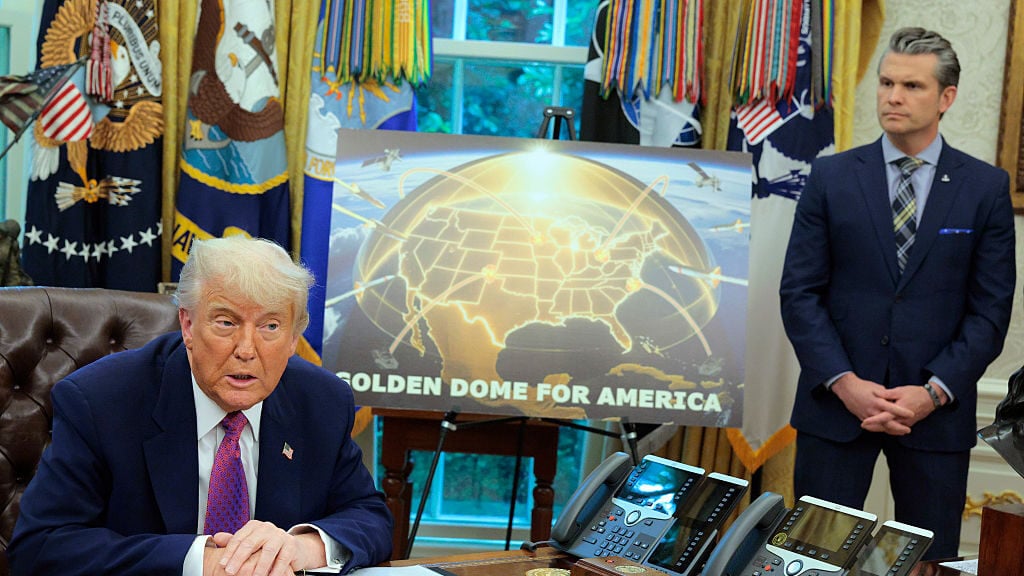
WASHINGTON — The Space Force has made a first set of awards for prototypes for space-based interceptors (SBIs) meant to shoot down incoming enemy missiles in their boost-phase just minutes after launch — but the winners of the relatively small contracts are shrouded in secrecy.
“The U.S. Space Force awarded multiple contracts for Space-Based Interceptor prototype agreements to multiple performers through competitive Other Transaction Agreements. The selection process was robust and thorough,” a Space Force spokesperson said.
“The names of the contractors are currently not releasable as they are protected by enhanced security measures,” the spokesperson added, explaining that due to the nature of the contracts they do not need to be publicly recorded.
“In accordance with Defense Federal Acquisition (DFAR) Supplement, 205.303 Announcement of contract awards, contracts under a $9 million threshold are not publicly released on War.gov. Other Transaction Awards are not subject to the DFARS, so they are not required to be publicly announced,” the Space Force spokesperson said.
After the initial Oval Office fanfare over the sprawling, multi-billion-dollar Golden Dome initiative, the Pentagon has clamped down on discussion of the project, going as far as apparently discouraging references to it during trade association conferences, citing “operational security.”
RELATED: At missile defense conference the first rule of Golden Dome is don’t talk about Golden Dome
One industry source said the secrecy effort includes using classified sole-source contracts and expanding existing contracts for missile defense related programs issued by the Missile Defense Agency (MDA) and the Space Force to encompass new work and, hopefully, speed development/deployment.


Biodefense is force protection: Ready today, prepared for tomorrow
A decorated combat aviator and biotech CEO advocates preparing for novel viral threats before the next crisis.
Assuming the boost-phase SBI awards, first reported by Bloomberg, follow the acquisition plan provided to industry this summer by Space Systems Command, each of the winners received only $120,000 is “prize” funds contract with three one-year options to complete a ground demonstration. The bulk of the costs for the demonstrations would be borne by the companies themselves.
That said, SBIs are a key element in the Trump administration’s Golden Dome initiative for which Congress has slated $25 billion over the next decade. Thus the competition implicitly dangles the promise of future big bucks in formal contracts in return for corporate buy-in to the development effort.
Under the acquisition current plan, there are several follow-on phases for two separate boost-phase intercept contests: one for endo-atmospheric intercept hitting adversary missiles just after they launch and before they exit the atmosphere; the other for exoatmospheric intercept hitting the target just after it leaves the atmosphere. Each contest is worth a few hundred million total — but no decisions on a lucrative production contract would be made until after 2028.
“Putting all the onus on industry has potential upsides and downsides for both suppliers and the government customer,” said Tom Karako, director of the Center for Strategic and International Studies’ Missile Defense Project. “But for it to work, there will need to be some level of confidence on the front end that the customer’s commitment is not just solid in the short term, but can be counted on two, five, ten years from now.”
“Behind broader understanding of the need must first be a communication and persuasion campaign about Golden Dome and both offensive and defensive space capabilities more broadly,” he added.
At least two defense giants, Lockheed Martin and Northrop Grumman, had publicly pledged to bid on the boost-phase SBI effort; as well as startup spacecraft manufacturer Apex.