WASHINGTON — A top service official at the Army’s Space and Missile Defense Command recently attempted to reassure skeptics that the service’s new space career field will not interfere with the Space Force’s missions.
“It is not like we’re trying to encroach on their requirements, or their mission set,” Col. Felix Torres, commandant of the Army’s SMDC Center of Excellence, said in a recent interview.
Though the Army is looking to fill 1,000 new positions for a new space-centric military occupational specialty, he noted that services’ capabilities often overlap. “We look at the Army, we have tons of rotary wing aircraft that do close air support. The Navy probably has, if not mistaken, has more airplanes than the Air Force does. The Marines have their own airplanes too. We didn’t say, ‘Give it all to the Air Force,’ because it wouldn’t work that way. Because we each have our unique skills and sets and schemes.”
The new Army MOS, dubbed 40D Tactical Space Operations Specialist, aims to equip the service with “best and brightest” space professionals to deter and defeat adversaries in the space domain, Torres said.
Following the announcement last spring that 40D would be established, arguments, some published in the opinion pages of Breaking Defense, emerged about whether the Army should have such an organization given the existence of the Space Force. One side, backed by some defense analysts, argued that having a space specialty career field within the Army is a waste of resources, “undermines” the joint force, and “drives organizational fissures,” which will lead to the US’ inability to “fight and win.”
On the other hand, Army officials argued that each service is not only directed by the Defense Department (in Directive 5100.01) to man, train and equip space forces, but it is also necessary for each service to have its own space operations, adding that “the Space Force can’t do it all” and each service has its own space capabilities that have “distinct purposes based on service-specific requirements.”
“We’re directed to do it. It is not that we’re trying to take over their job, or anything like that,” Torres echoed in the interview. “I’ve seen all the articles and stuff too, and I laugh to be honest with you, but we have very specific mission sets.”


America must adopt a Sixth Domain of warfare doctrine
The Sixth Domain is not defined by geography. It’s a new kind of conflict in which autonomy and networked systems allow thousand-dollar consumer electronics to destroy multi-million-dollar conventional weapons systems.
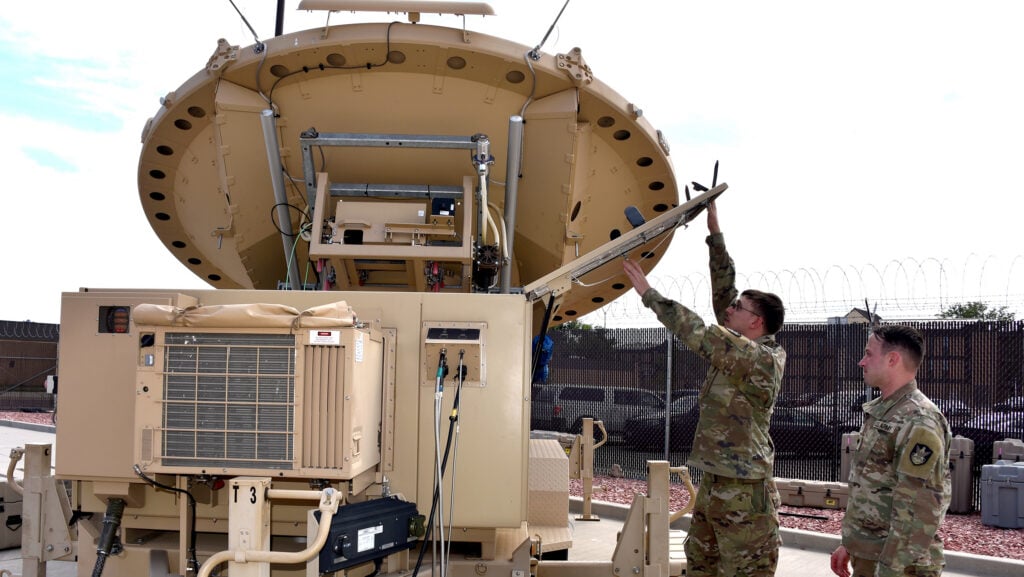
Further, Torres added that 40D’s mission will be operating the Army’s ground-based electronic warfare and satellite communications in the tactical realm focused on supporting and protecting the ground force, while the Space Force tends to focus more on on-orbit operations and orbital warfare.
“When you look at it from a Space Force perspective, […] they’re controlling satellites, they’re flying them. They’re uploading the communications payloads and things like that, synchronizing those capabilities on orbit. They’re doing rendezvous and proximity operations. We don’t do that,” he said. “I don’t do any of that, and no Army folks do that.”
Torres told Breaking Defense that while the service is looking for those 1,000 40Ds, a large majority of the soldiers will come from existing units that have expertise in areas such as detecting aerial threats, satellite communications and other space-based intelligence operations. He added that while all soldiers in 40D must be of the grades of E-4 (a specialist) to E-9 (sergeant major), they don’t necessarily have to have a space-related background.
“Does it help if they’ve had a space experience? Yes, from an Army perspective, it helps us financially so we don’t have to put people through schools, and it also allows us to get them to the operational force faster. But it doesn’t necessarily mean they’re the only ones we want, because it really comes down to a matter of performance, and we want the best and the brightest to get into this job,” Torres said.
Torres said where the nearly 1,000 space soldiers will be assigned varies. Some will be working with Army combatant commands like Army Europe, Africa and Pacific. Others may provide support for multi-domain task forces or theater strike effect groups. Others could work at SMDC proper where they will be in support of the Space Force, Space Command, North American Aerospace Defense Command, or Northern Command. They could also work for SMDC’s center of excellence in the school house, Torres added.
In these roles the soldiers will have a variety of tasks, which include: the early detection and tracking of ballistic missiles; high altitude navigation warfare; intelligence, surveillance and reconnaissance (ISR) missions; counter ISR missions and instructing among others, Torres explained.
In terms of training, Torres said that Army space professionals will be training soldiers enlisted in 40D, and they will not receive any training from the Space Force. The reason is simply because the missions between the two services are different, Torres said.
Torres said the Army still “100 percent collaborate[s]” with the Space Force and the other services on space-based operations. He said in order to achieve space superiority and defeat adversarial threats posed by Russia and China, such collaboration will continue with the existence of 40D to synchronize terrestrial based effects, target development and “weaponeering” through its space control planning teams.
“Both China and Russia pose grave stress to US and international space capabilities. They both have a broad array of counter-space weapons and via open source support, and you can see how impactful those systems are to modern warfare,” Torres said, adding that to defeat both countries, the US military will have to fight a joint fight.