
PARIS — European missile giant MBDA plans hire 2,800 new workers and invest €5 billion ($5.8 billion) over the next five years in order to increase weapons production, CEO Eric Béranger said on Thursday during the firm’s 2025 results.
In comments that often sounded like a victory lap, Béranger stated that “MBDA has attained an unprecedented strategic dimension as one of the instrumental pillars of rearmament in Europe,” a claim he based off of three key figures: that MBDA’s 2025 revenues amounted to €5.8 billion ($6.7 billion), that the order intake was €13.2 billion ($15.2 billion) of which 70 percent came from European customers, and the order backlog was worth €44.4 billion ($51.3 billion).
Béranger stressed that missile systems are a critical capability in “the shift from an international order to brute force, which has crossed a new threshold with the conflict in Iran.” But even before this in 2025 “we did walk the talk,” by “producing more and producing faster.”
While declining to give specific production figures on any individual weapon system, Béranger claimed the firm delivered “five times more Asters than initially planned” and the production capability of the Mistral is “four times more than in 2022.”
That industrial plus-up was achieved by investing a “huge lot” of money in industrial capability. He said that “on each and every site there are new buildings, extensions and new machines” with workers’ production schedules increased to three shifts per 24 hours, when necessary. In addition, the group recruited more than 2,700 people in 2025 taking it to a total of more than 20,000 employees.
The group had spent €1 billion ($1.1 billion) to achieve this, he said, adding that current production of the Mistral, for example, was not sufficient to meet demand “so we’ll continue ramping-up.”
For 2026, investments would be three times what they were in 2021, Béranger said, though again gave no specific euro figures associated with that claim. He said the group would be intensifying its ramp-up increasing overall output by a “very significant” 40 percent, notably because it is “receiving a lot of demand” from Middle Eastern countries and needs to meet the “high demand” for the MICA multi-mission air-to-air missile system. He added that production of the Aster will double.


Interoperability becomes the price of entry for next-gen warfighting tech
AI, autonomous systems, cyber, and EW converge as industry targets faster battlefield effects.
And while MBDA currently plans to hire a further 2,800 people and make that €5 billion investment, he specified that these decisions predated the crisis in Iran, and that “further work is underway to evaluate further possibilities” to increase production. Béranger added that a great deal of effort had been put into managing the group’s supply chain of about 2,000 suppliers and supporting them in this ramp-up.
During the peace dividend period of the 1990s and early 2000s “orders were pretty scarce and we only produced to contract,” he said. “Today we no longer produce to contract we produce to stock. We start production without waiting for contracts especially where air-defense is concerned.”
Béranger stated that the group had responded to “25 percent more urgent operational requirements in 2025 than a year earlier.” One of the most significant was adapting Storm Shadows under the wings of the Ukrainian air force’s Sukhoi SU-24s “which we did in a few weeks instead of the years it might have taken in the past.”
One of the reasons this was achievable, he stressed, is because MBDA owns the design authority of these missiles “so we didn’t need to ask anyone.” This possession of the design authority is vital for European sovereignty he stressed, adding that it was “absolutely imperative” to ensure that European countries give preference to European equipment.
“Europe is massively rearming and the integrated European model of MBDA enables it to play an important role,” Béranger said, noting that cooperation, joint programs and joint procurement are “absolutely essential.”
Despite the focus on current weapons production, MBDA is also investing in new systems.
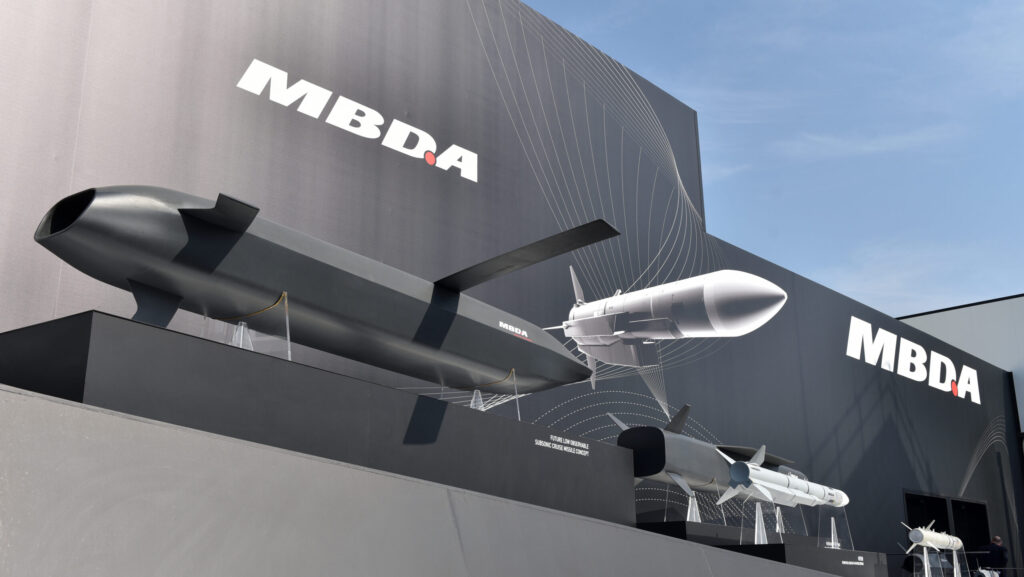
The successor to the Exocet 4 and Storm Shadow, the Stratus, formerly known as FC/ASW (Future Cruise/Anti-Ship Weapon), comes in two versions – Stratus LO (Low Observable) and Stratus RS (Rapid Strike) – which have both completed their assessment phase. Following the commitment made by the French and British governments in 2025 to move forward with the development phase which will be launched “imminently,” Italy has now joined the Stratus LO missile project.
Responding to a question regarding MBDA’s involvement in the troubled SCAF Franco-German-Spanish future air combat system, Béranger said that MBDA’s involvement was limited to pillar 3 working with Airbus to develop remote carriers and that this was “working very well and we’ve made a lot of progress.” He added that “whatever happens [to the project] I hope we can continue this very fruitful and useful cooperation.”