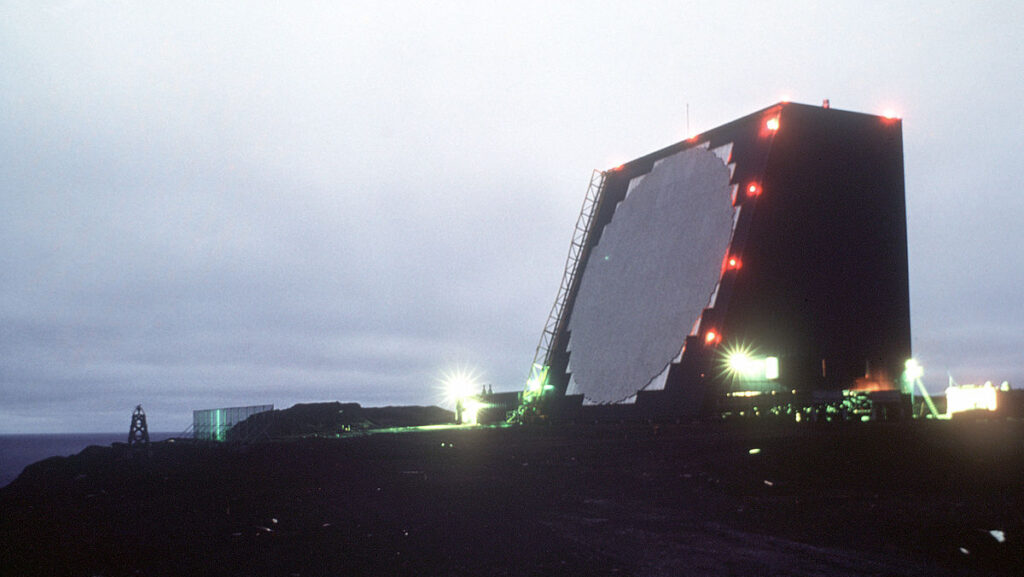
WASHINGTON — The Space Force has broadened its plans to upgrade its legacy ground-based radars to improve their missile defense and space monitoring capabilities, now envisioning a sweeping program to digitize the mostly analog antennas and computer processors for all eight of the aging systems, according to a Space Systems Command (SSC) spokesperson.
The expanded Ground Based Radar Digitization (GBRD) effort is “transformational,” as it will allow the service to put into place “better ways to defeat modern digital threats (smaller, faster, more numerous objects),” the spokesperson said.
The re-scoped GBRD effort replaces a plan first put forward in a request for information (RFI) from industry last July which would have upgraded only six of the radars and involved only partial subsystem modernizations rather than a comprehensive overhaul, the SSC spokesperson explained.
SSC “is seeking industry inputs on a potential larger scope program to include all eight of our ground-based strategic radars,” a Space Systems Command (SSC) spokesperson told Breaking Defense. “In addition to the five Upgraded Early Warning Radars (UEWRs) and the PARCS radar in North Dakota, the RFI now includes the Cobra Dane radar in Alaska and the AN/FPS-85 radar at Eglin AFB, Florida.”
“These aging systems are nearing obsolescence, necessitating technological upgrades. GBRD aims to digitize these radars for enhanced battlespace awareness, reduced sustainment costs, and resolution of obsolescence challenges,” according to the RFI.
The Pentagon’s fiscal 2026 reconciliation package included $1.98 billion for “improved ground-based missile defense radar” related to the Pentagon’s Golden Dome initiative. However, the SSC spokesperson declined to comment on whether some of those funds would be used to support the broadened GBRD effort.
Stressing that at the moment SSC is only “seeking information, not committing to any specific sites in the final program,” the spokesperson said that “the program office is unable to provide specific details on the status of funding at this time; however, the program office continues to seek information on fast-moving efforts with the desire to execute as soon as able.”


Interoperability becomes the price of entry for next-gen warfighting tech
AI, autonomous systems, cyber, and EW converge as industry targets faster battlefield effects.
The UEWR radars directly feed into the Missile Defense Agency’s Ground-based Midcourse Defense system, with three UEWRs located at at Beale AFB in California, one at Fylingdales in the United Kingdom, and one at Thule AFB in Greenland.
The PARCS radar, formally the AN/FPQ‑16 Perimeter Acquisition Radar Attack Characterization System, first came online in the 1970s and supports the Space Force’s missile warning and space situational awareness missions.
Cobra Dane, which faces the western part of US Indo-Pacific Command according to a Space Force fact sheet, primarily supports the North American Aerospace Defense Command with missile warning data, but also serves as a node in the US Space Command’s Space Surveillance Network.
The AN/FPS-85 phased-array radar is primarily used for space surveillance, and can detect, track and identify up to 200 satellites simultaneously, according to a Space Force fact sheet.
The revised GBRD effort will equip all eight radars with the same “back end” computers, servers and software, as well as updating the radar’s “front end” antennas, the SSC spokesperson said — a major shift in approach from the original plan.
“The analogy is to think of the radar system ‘front end’ as the eyes and ears of the radar. It’s the large, physical hardware array that transmits and receives the radio frequency (RF) energy. The ‘back end’ is the brain. It’s the computers, servers, and software that take the raw energy received by the front end, process it, and turn it into understandable data — like identifying an object, its location, and its trajectory,” the SSC spokesperson explained.
The original RFI was seeking information on how “to give each radar a new, modern ‘brain’ (back end). While this was an improvement, it was like giving eight different people eight different, newer models of computers. They would all be better, but they would still operate differently. The new RFI is seeking input on giving all eight radars the same ‘brain’—a single, common, virtual stack software architecture,” the spokesperson added.
The change will put into place a common software update across the entire radar fleet, and will “dramatically” cut long-term costs, the spokesperson said. Further, the common back end means tracking data from all eight radars can be fused into a “much more comprehensive picture of the space domain.”
Unlike under the first GBRD plan, each radar also now will get a makeover of its “old, 1970s-era analog,” the spokesperson said.
“Digitizing the front end is like upgrading from an old analog television camera to a new 8K digital camera. It provides the new brain with an incredibly clear, high-fidelity data stream, unlocking the system’s full potential and allowing us to see the threats we couldn’t see before.”
According to the revised RFI, the Space Force is planning to reach initial operational capability with four “Rapid Prototype” sites completed in the first quarter of FY30; and full operational capability for all sites by the second quarter of FY31.
Interested vendors have until April 1 to respond to the revamped RFI.