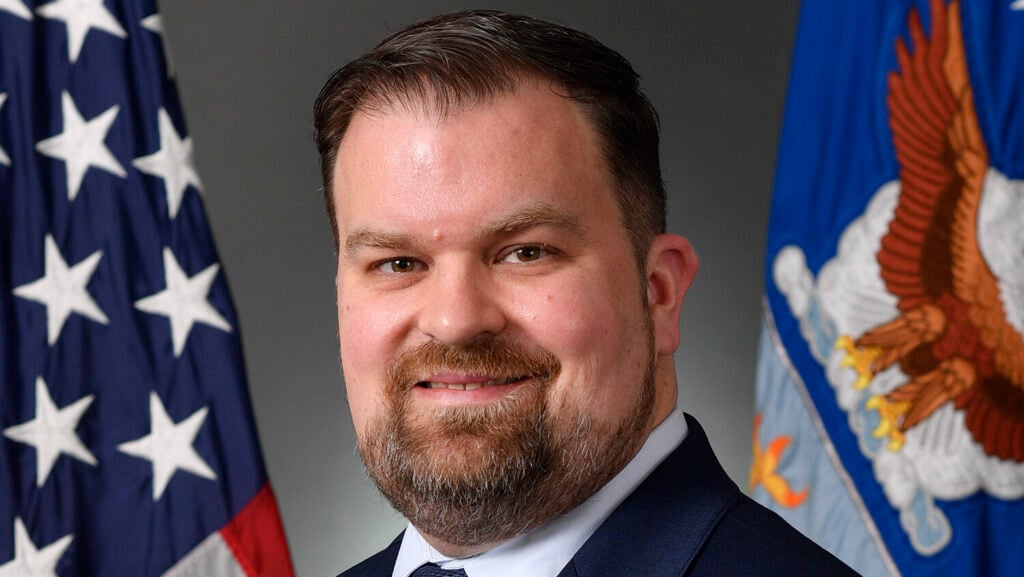
WASHINGTON ― Department of the Air Force (DAF) acting space acquisition czar Thomas Ainsworth said today that work is not yet finished to sort Space Force programs into the new portfolio acquisition executive (PAE) structure mandated by Defense Secretary Pete Hegseth.
“We’re not done yet. We’re still working it,” he told the State of the Space Industrial Base (SSIB) conference in New Mexico.
For example, he said that there has yet to be a decision which of the nine mission-oriented PAEs would be put in charge of programs exploring space debris mitigation.
The DAF, which oversees Space Force acquisition via Ainsworth’s shop, has officially announced six PAEs: Space Access; Space Based Sensing and Targeting; Infrastructure; Battle Management, Command, Control, Communication & Space Intelligence (BMC3I); Satellite Communication and Positioning, Navigation & Timing; and Missile Warning and Tracking. Ainsworth in March indicated that there would be at least three other PAEs set up to cover space control; electronic, cyber and orbital warfare; and integration.
“The majority of the PAEs that have been assigned right now are acting,” he told the SSIB conference. “We have a couple of permanent ones. One of them is Infrastructure, and we just recently named BMC3I.”
Shannon Pallone, who previously served as program executive officer at Space System Command’s BMC3I office, now is the permanent PAE for that mission. Col. Corey Klopstein, former Space System Command program executive officer for Operational Test & Training Infrastructure, has been named permanent PAE for Infrastructure.
Ainsworth further provided additional details on how the PAEs are being structured and will do their work.


America needs next-gen solutions to counter modern air and missile threats
Defending a country the size of the US from threats requires advanced sensing, communications and interception capabilities.
First, he said, the DAF based its approach to setting up the offices on “a couple of models,” including the “towers” of excellence structure used by the National Reconnaissance Office (NRO), the Space Development Agency (SDA) and the Space Rapid Capabilities Office (Space RCO).
“We’re looking at the best of those capabilities,” Ainsworth said. “I won’t bore you with the details … [but] we ran down the list of all of the SDA authorities, all of the Space RCO authorities, all of the AFRCO [Air Force RCO] authorities, everything that the NRO does, and everything that we can do on the Title 10 side. And we streamline all of those, and then we distribute those to all of the PAEs.”
As an example, he noted that “the chief of contracts for every PAE has 89 percent of all of the contract authority ― we lowered every single thing we possibly could under statute all the way down to the chief of contracts for every PAE.”
Each of the new PAE heads also will chair a “capability trade council” for their portfolio that will include “warfighters in the room” representing the operations, intelligence and testing communities, Ainsworth said.
He stressed that the DAF worked to ensure that all of the new offices all “work consistently” based on the “same authorities” to make decisions.
“[I]f you move between one PAE and another, you’re not sitting there having to figure out a whole new process; everyone’s working off of the same process and the same rule book,” Ainsworth said.
Finally, he assured the audience of industry representatives that the DAF will publicly release the overarching PAE organization once it is finalized.
“We’ll make sure we get a broad announcement out for all of the PAEs ― who’s leading them, and how we’re setting all of those up ― in the coming days,” Ainsworth said.