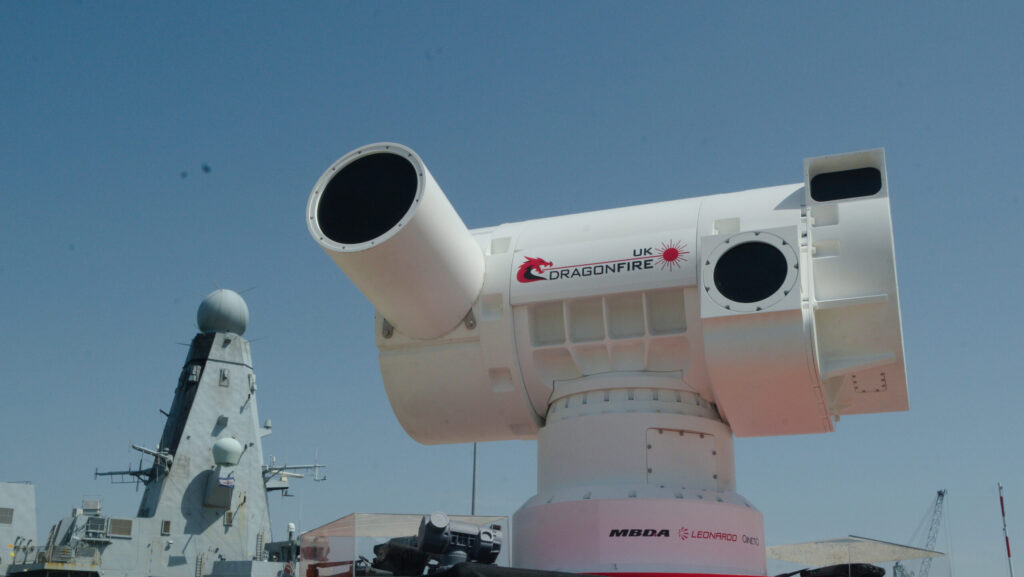
PORTSMOUTH, England — A trio of British industry partners are exploring how to reduce the size of an in-development high energy laser set to be equipped for the first time on a Royal Navy Type 45 destroyer next year.
Local firm QinetiQ, alongside the British divisions of MBDA and Leonardo, are collaborating on the DragonFire weapon system. The platform is estimated to cost less than £10 ($13) per shot, as new test and evaluation activities focus on miniaturizing the laser.
Qinetic’s ongoing work is focused on exploring “the overall manufacture of the [laser] beam, trying to reduce the size further of the whole system … [and] understanding the through-life support of a system like this,” said James Anderson, Royal Navy account lead at QinetiQ.
He told Breaking Defense and other trade media outlets during a NATO Industrial Advisory Group (NIAG) industry day on Tuesday that the target of installing DragonFire on a Type 45 ship before the end of 2027 remains “on track.”
In keeping with this timeline, the UK is set to become the first European NATO nation to deploy novel laser-directed energy technology operationally.
Industry has not set out a specific target for how small the DragonFire’s laser beam director should be, said Graeme McNaught, campaign manager for EO, infrared and laser directed energy at Leonardo.
He added during the NIAG industry day, “Our main thrust right now is just to … get the weapon onto the Type 45. There’s only so much you can do in a tight timescale. We’ve had to do what we can to secure ingress to the system to protect it from the high seas. That’s been our main mission, rather than collapsing the modularity of the system.”


Localizing tactical communications for sovereign, NATO-ready C3I
Beyond foreign sales, Rafael’s model enables tech transfer, local engineering, and is a template for NATO partners.
Additionally, he noted that, at the industry level, priority is being given to resolving “minimum deployable decisions,” such as the development of DragonFire “spiralling” software.
Designed to intercept Class 1 and Class 2 drones, the weapon system operates within line of sight or at a relatively short range. Based on its “pinpoint accuracy,” it could be used in the future to provide the UK with more precise targeting than other weapons, while cutting down on expensive ammunition.
“If you look at the UK’s ability to take out swarms of drones and the economic balance of war, where we’re currently using some fairly exquisite missiles … we’ve got to do something about that,” said Anderson. “I think lasers are a real opportunity,” to break such an imbalance.
McNaught said that DragonFire can be used to “deepen the reservoir” of a ship’s kinetic weapons inventory. “If you’re using direct energy more, the ship can stay and patrol for longer, because it’s not using up the stockpile [of other munitions] as fast, but it will always be part of a layered defense,” approach, he explained.
In the long term, Anderson forecasts that demand for laser weapons will spike.
“I think we haven’t seen signs of it yet, because … no one’s actually demonstrated they can effectively field this in the battle space,” he added.
Making the leap to operate laser weapons will take “confidence” on the part of the end user because they have been deploying “missiles and guns for years,” Anderson shared, as he stressed that Western navies will likely also want to gain a better understanding of laser capabilities in “severe weather conditions.”