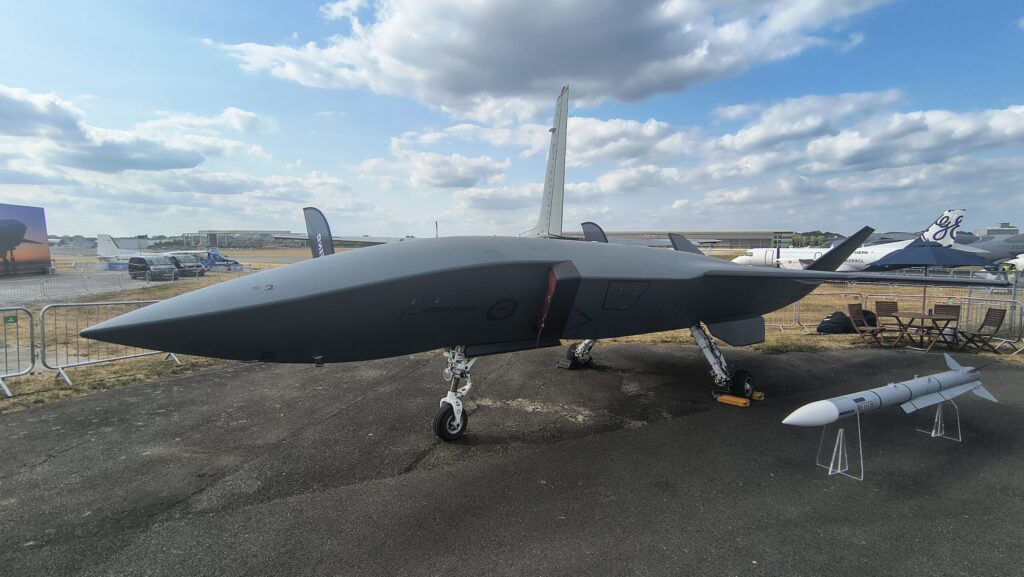
FARNBOROUGH — Boeing is considering plans to build MQ-28 Ghost Bat production facilities in more countries, as it steps up a major push to secure international orders of the drone wingman from foreign leaders who increasingly prioritize weapons that can be built within the secure confines of their own borders.
“I think we’d rather have many smaller factories building them, localized for countries to meet their own local needs than having one mega factory,” said Glen Ferguson, MQ-28 global program director, during a press briefing on Tuesday.
Ferguson said the US giant has not locked down future production plans for the Collaborative Combat Aircraft (CCA), but he added that the idea of a “mega factory somewhere that builds thousands is probably not the best answer.”
“Most countries will want their own sovereign capability,” Ferguson said, “because these things you need to regenerate, you need to be able to build at rate, and you need to be able to build them when you’re in a supply chain denied environment.”
There is “urgency” across the CCA market right now, driven by the war in Ukraine and NATO spending that’s opening up a push for new capabilities, according to Tim Flood, Boeing’s director of business development and strategy for the UK, Europe and Americas.
“Everyone talks about the need to address a growing threat across Europe. We’re seeing increased activity…..The urgency aspect is real,” he told reporters.
Against this backdrop, Boeing announced that Hensoldt has been added to its German MQ-28 supplier base in support of a bid to land Berlin’s CCA requirement. Germany is on course to become the first European CCA operator under a target to field the drones with crewed fighters in 2029.


How integrated modeling and simulation accelerates Europe’s defensive edge
Lockheed Martin’s ACES platform delivers a shared virtual battlespace that strengthens readiness, interoperability, and faster decision-making through advanced, integrated modeling and simulation capabilities designed for evolving global threats.
The addition of Hensoldt, an electronics specialist, follows local firms including Rheinmetall and Rhode and Schwartz joining the German Ghost Bat industrial base last month, though the agreements don’t currently involve producing the system in Germany.
Multinational firm Eaton has also joined the MQ-28 industrial base for supply of the drones internal weapons bay launcher. After eight years of partnership, Leonardo has also been formally inducted to integrate infrared search-and-track system (IRST) systems.
Breaking Defense Video