DETROIT — The Army has awarded six vendors for its Infantry Last Tactical Mile (ILTM) initiative, a program seeking to replace humans with unmanned ground vehicles (UGVs) for both logistics and casualty evacuation (casevac) missions in contested areas, the service’s CPE Mission Autonomy office announced today.
The six companies awarded through prototype Other Transaction Agreements are: Maren-Go, Overland AI, Forterra, Hendrick’s Motorsports, American Rheinmetall and HDT, according to a service release.
The vendors will each deliver “production-ready prototype” autonomous systems that can operate in the “last tactical mile” — the treacherous area between support units and the forward lines where supplies, equipment and personnel must be moved while often facing risky adversarial encounters.
Such systems will support “manned close combat formations through rapidly deployable logistical resupply platforms capable of performing casualty evacuation operations and network extension to the forward line of own troops,” Col. Ken Bernier, the Army’s project manager for Autonomous Robotic Capabilities, said in the release.
Today’s announcement comes after the Army released a Commercial Solutions Opening in April looking for UGVs capable of casevac and logistics missions in the last tactile mile. An Army spokesperson told Breaking Defense today each vendor will deliver four prototypes.
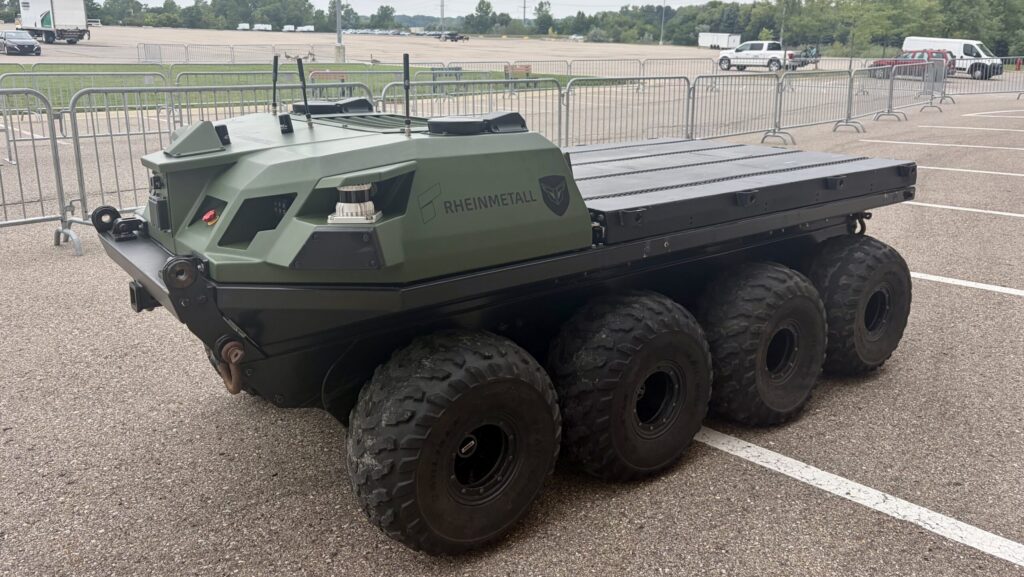
Adam Horton, director of business development from American Rheinmetall, told Breaking Defense today on the sidelines of the GVSETS conference here that his team will be providing its Mission Master SP-H model outfitted with the company’s own Path autonomy kits for the ILTM program. Horton said American Rheinmetall currently supplies the Marines with the Mission Master SP-H models and the service “really loves it.”
Further, Brian Hester, senior manager of business development for Army projects at Overland AI, told Breaking Defense on the sidelines of the conference that Overland AI will be providing its ULTRA platform for the ILTM program. ULTRA is a tricked out version of Polaris’ RZR 100 model outfitted with Overland AI’s autonomy stack, built to sustain off-roading in the “harshest conditions,” Hester said.
Forterra declined to disclose what vehicle it would be using for the ILTM program today, but as Breaking Defense reported in April, Forterra and Polaris unveiled a new vehicle for casevac and logistics missions in the last tactical mile, dubbed MESA. At the time, Forterra Chief Growth Officer Scott Sanders told Breaking Defense that the company has an “intent to bid” on a potential competition that could derive from the Army’s CSO. He said the company plans to enter “both as a partner with some other primes,” and “likely” as a prime themselves as well.
MESA is based on Polaris’ Ranger XD 1500 and uses Forterra’s AutoDrive autonomy stack paired with its Vektor communications capability designed to work in low-bandwidth environments, a Forterra executive said at the time.
Maren-Go and HDT did not respond to a request for comment today. Breaking Defense could not get in contact with Hendrick’s Motorsports.
According to the Army’s release today, the ILTM initiative awards are expected to be finalized in the coming weeks. After the awards are finalized, the vendors will participate in a slew of demonstrations and assessments which will ultimately result in an “Operational Assessment” with an Army unit at the beginning of 2027.
“This rotation will allow the Army to collect direct, unit-level feedback to inform the production decision for the next generation of autonomous infantry systems,” the service said in its release today.