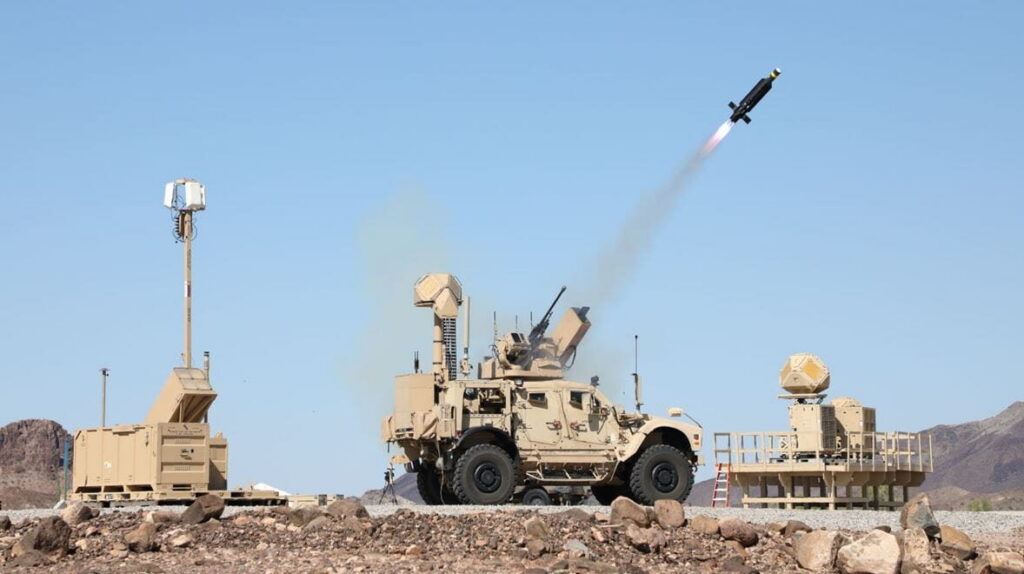
WASHINGTON — The Army is seeking industry input to acquire a new missile that costs less than $150,000 while still capable of taking down Group 2 and 3 small unmanned aircraft systems (sUAS) and compatible with Raytheon’s Coyote launcher, according to a request for information.
The Army also wants the missile, dubbed the Next Generation C-sUAS Missile (NGCM), to go faster and farther than current systems capable of countering drones weighing 21 to 1,320 lbs.
“The principal objectives for this effort are to develop, produce, and sustain a missile capability at extended ranges with rapid launch and reduced time-to-target over existing effectors,” the RFI published Tuesday read.
Those extended ranges specifically refer to targeting small drones farther than 16 kilometers (9.94 miles) at an altitude of at least 6 kilometers. Ideally, however, the Army is looking for the missiles to hit drones further than 25 kilometers at more than 8 kilometers in altitude, per the solicitation.
Further, the RFI states that the missile “shall be capable of leaving the rail within a launch response of [less than] 5 seconds from operator initiation.”
Though the Army has put out similar solicitations as part of its low-cost interceptor (LCI) program, this is the first time the service has asked for a missile with such a low price tag. According to the solicitation, the service is looking to buy at least 5,000 of the missiles, and is hoping to acquire 50 NGCMs to be ready for operational assessments by the first quarter of fiscal 2028.
The RFI also states that the missiles will be “expected” to achieve technology readiness level seven after the “initial developmental test series” concludes in the fourth quarter of FY27. Such tests will support “immediate deployment.”

In the age of drones, a bigger fence around your facility doesn’t protect you anymore
Traditional thinking about how to protect facilities must adapt to new threats such as drones or downstream attacks.
Regarding compatibility, the NGCMs must be able to integrate into Raytheon’s Coyote Launcher with “minimal to no modifications,” per the RFI. It also must be agnostic with the following radar systems: Patriot, AN/TPQ-53 and Sentinel A3 and A4.
The Army anticipates the NGCM will have two variants. One will be a fixed-site version that incorporates electronic warfare, radar, electro-optical/infrared sensors and “kinetic options.” The second variant is a mobile version that can be mounted on tactical vehicles “providing a scalable capability at the tactical edge” that uses the “same baselines” as the fixed site variant, per the solicitation.
Responses to the RFI are due on August 20.
Tuesday’s RFI comes after the Army launched its low-cost interceptor program earlier this summer — created to end the days of relying exclusively on multimillion-dollar exquisite systems to defeat airborne threats, especially low-cost drones that only cost a few thousand dollars. A white paper published last month by the Army sought solutions from industry for separate components of the missile such as: rocket motors; seekers; fire control and guidance tools; and a weapons system integrator responsible for designing the open systems architecture. Together, these parts will comprise the all-up round, which the white paper also asked for.
Army Secretary Dan Driscoll told reporters in May that ideally, each interceptor for the LCI program would cost less than $250,000. Further, a slide shown during a separate discussion at an event in June indicated that the Army wants the all-up rounds to cost less than $1 million.
An Army spokesperson told Breaking Defense after publication that the NGCM program “is a separately defined initiative” than its LCI program.
UPDATED 8/5/26 at 3:47 p.m. ET to include comment from an Army spokesperson.