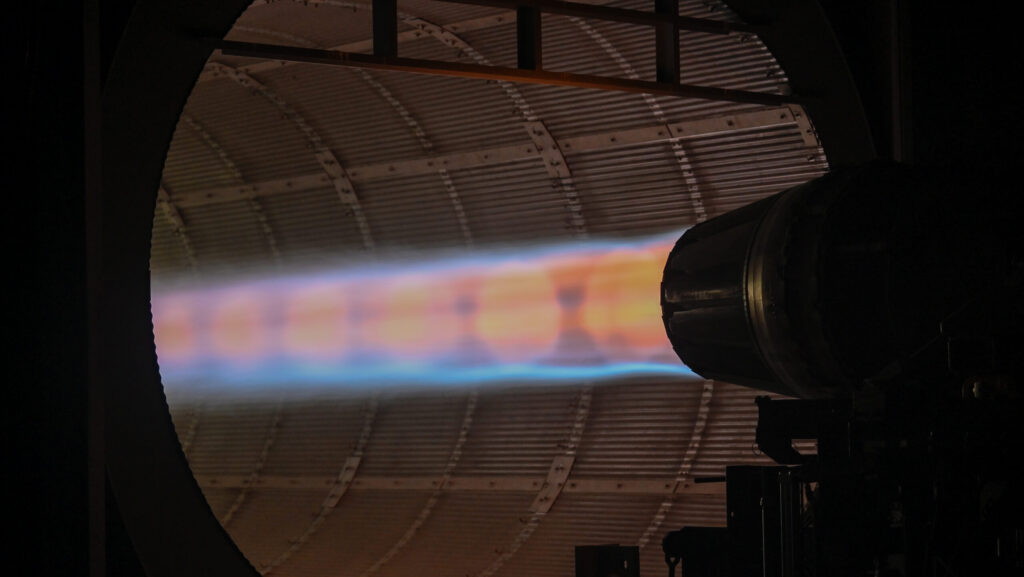
NATIONAL HARBOR, Md. — Engine maker Pratt & Whitney is licensing aircraft startup Hermeus to produce Pratt’s F100 fighter jet engine, the companies revealed to Breaking Defense, the first such license for a fellow American firm.
In an exclusive interview, Jill Albertelli, the president of Pratt’s military engines business, described the agreement as a natural one to boost the industrial base in the face of growing powerplant demand for existing aircraft and for in-development programs like the Air Force’s Collaborative Combat Aircraft project.
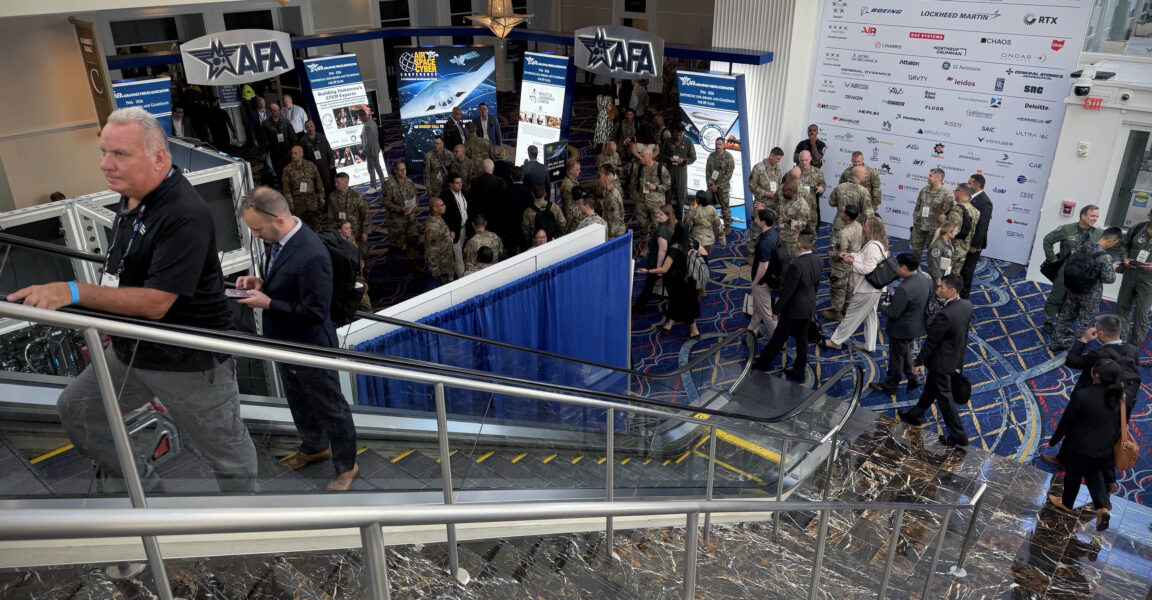
“So we look at it as like, yeah, why wouldn’t we do this? We are all aligned that the defense industrial base needs to be bigger than it is today, and this is a great opportunity together,” she said on the sidelines of the of the Air and Space Forces Association conference here.
The agreement covers the production of the F100-PW-229 turbofan, which entered service in 1992 and is used to power some versions of the F-15 and F-16.
In addition to potential CCA customers, the new license comes after an Air Force request for information in August said the government intends to “pursue a strategic competition requiring industry to innovate manufacturing and guarantee supply chain resiliency.” Engines will be needed to power aircraft like the F-15EX and F-16s for domestic and foreign aircraft, the notice says, which projects “peak demand” surpassing 180 engines annually by fiscal year 2034.
“We are very interest in the entire maket space,” Albertelli told Breaking Defense. CCA, especially, “has a very large range of what that might look like.”
Hermeus has a particular interest in the F100: it powers the company’s high-speed Quarterhorse drone. In an interview with Breaking Defense, Hermeus CEO Zach Shore said the deal means the company would additionally be the first vertically integrated aircraft manufacturer under the Quarterhorse program.
Beyond the Quarterhorse, Shore emphasized that a production outlook for the F100 engine and overall timeline would be driven by customer demand, and that the company will start making capital investments at scale accordingly to support engine manufacturing. “It’s not an if, it’s a when,” Shore said.
“There is a wide array of customers. I think right now we’re focused on domestic manufacturing, domestic builds, and certainly for supporting our program,” Shore continued, noting that initial production work would be done within the firm’s existing production footprints. “We see ourselves as just an extension of Pratt here to support engine manufacturing” as a second source of engines.
Shore clarified, however, that Hermeus’ overall “expansion path” is focused around airframes rather than engine production. “We’re not in the business of being a clean sheet engine manufacturer. That is a long way away,” he said. “So for us, to just do this work is plenty.”
Hermeus is iteratively developing the Quarterhorse drone and plans to fly the aircraft at speeds up to Mach 3 under a $219 million contract awarded by the Pentagon’s Defense Innovation Unit. Air Force Maj. Gen. Joseph Kunkel, the DIU’s military deputy, previously expressed strong support for the drone, stating that its mass production could create a “game-changing warfighting capability” with a “significant number of use cases where it can be used as a weapon.”
Hermeus is also building its own turbine-based combined cycle (TBCC) engine based on the F100. A TBCC engine combines a jet turbine with a ramjet engine to create an integrated propulsion system capable of flying at hypersonic speeds exceeding Mach 5. Hermeus’ TBCC concept, dubbed Chimera, would form the core of an envisioned hypersonic aircraft the company refers to as the Darkhorse.
Pratt’s selection of Hermeus to manufacture the F100 adds another industry heavyweight to the startup’s growing number of collaborators. Earlier this month, Hermeus and Anduril forged a partnership to pair Anduril’s mission autonomy suite with the Quarterhorse aircraft for upcoming flight testing, Breaking Defense previously reported.
Shore noted that the relationship may also position Hermeus to find new efficiencies in F100 manufacturing.
“We’ve been working with this engine for a long time, and there’s an opportunity for us to pull some cost out of the engine,” Shore said. Or, in other words, to “DOGE it, if you will, and help make the engine more competitive. We’re excited to become part of the Pratt family.”
PHOTOS: AFA 2026

 Gallery