
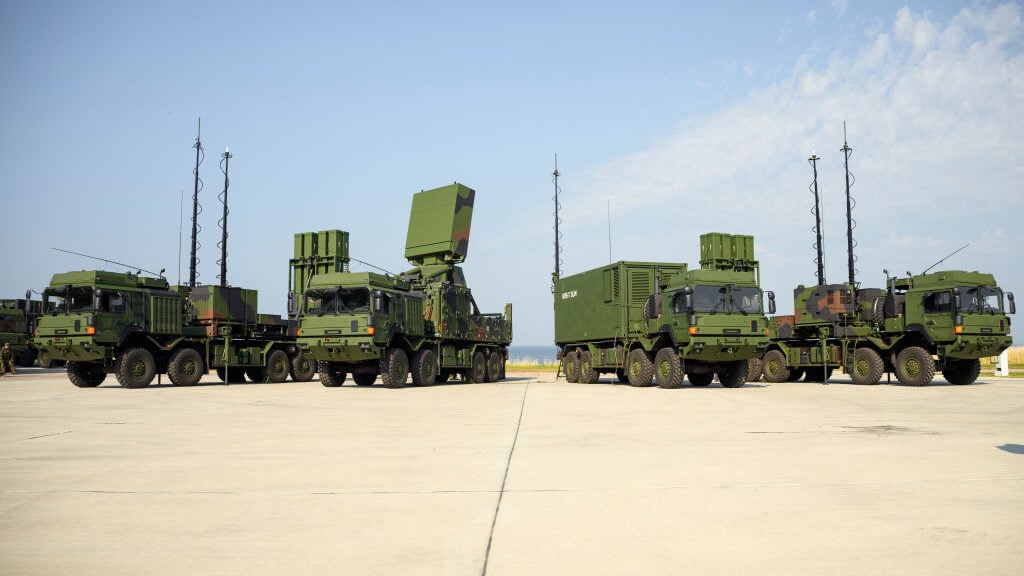
RAUFOSS, Norway — Norwegian defense firm Nammo is taking its first steps in developing a new prototype rocket motor engine, envisioned as powering a long-range variant of the German-made IRIS-T air defense system, a company official told Breaking Defense.
Nammo produces rocket motor engines for other munitions, but “this is a totally new development project for us … [without] that much piggybacking on different things or from previous kinds” of programs, a Nammo program manager said Thursday on the sidelines of the company’s multipurpose symposium. “We will start building [a prototype] as soon as we can.”
At the company’s production site in Raufoss, more than 100 kilometers (62 miles) north of Oslo, Nammo expects to conduct early prototype activities for the so-called “dual pulse” concept, including static firings to validate engineering analysis and simulated modelling, with “adjustments” to be made if necessary, according to the program manager, who spoke on the condition of anonymity. “We design the propellant with a certain thrust profile, but also we divide [the rocket motor engine] into two different sections,” as part of the dual pulse concept.
The push comes as German defense firm Diehl targets a first development or Safety Integrity Level (SIL) firing test of the surface-launched IRIS-T SLX in 2027, according to Alexander Linss, GBAD business unit executive at Diehl. Serial production of the longer range missile is reportedly slated for 2029. (Breaking Defense accepted travel and accommodation from Nammo for the company’s symposium.)
The company said the SLX variant can intercept targets at a range of 80 kilometers (50 miles), doubling the capability of the SLM model, while opening the way for the targeting of enemy fighter jets, bombers, long endurance drones and support aircraft. The extended range interceptor was first unveiled by Diehl at the 2024 Berlin Air Show.
Linss said that Ukrainian forces have used both the IRIS-T SLS and SLM to destroy over 1,000 Russian targets since the outbreak of the war in 2022. He said that the pair of short- and medium-range interceptors have registered a hit rate of 95 percent during the conflict, with key targets covering Russian Kh101, 3M14 Kalibr cruise missiles and Shahed 136 drones.
In July, Diehl CEO Helmut Rauch said that the SLX could lessen reliance on US-produced Patriot missiles, amid a shortage that has caused Ukraine to plead with Western allies to urgently donate their stocks.


Localizing tactical communications for sovereign, NATO-ready C3I
Beyond foreign sales, Rafael’s model enables tech transfer, local engineering, and is a template for NATO partners.
“We are ramping up our volumes a lot” for the IRIS-T SLS and IRIS-T SLM rocket motor engine programs, added the Nammo program manager, as “they are very important” for Ukraine’s ground based air defense.
Outlining why the SLX represents a “big step up” in capability terms, Linss said a number of the missiles can be added to a common launcher that can also carry SLM missiles and thereby deliver a “mixed” load.
He added that the SLX will rely on a host of supporting equipment elements that serve the SLM, including the system’s radar, common tactical operations center and software.
European nations that have acquired the SLM variant include Germany, Estonia, Latvia, Bulgaria, Sweden, Denmark and Switzerland. The missile is also a core part of the European Sky Shield Initiative (ESSI), which is intended to boost the region’s air and missile defense capabilities.