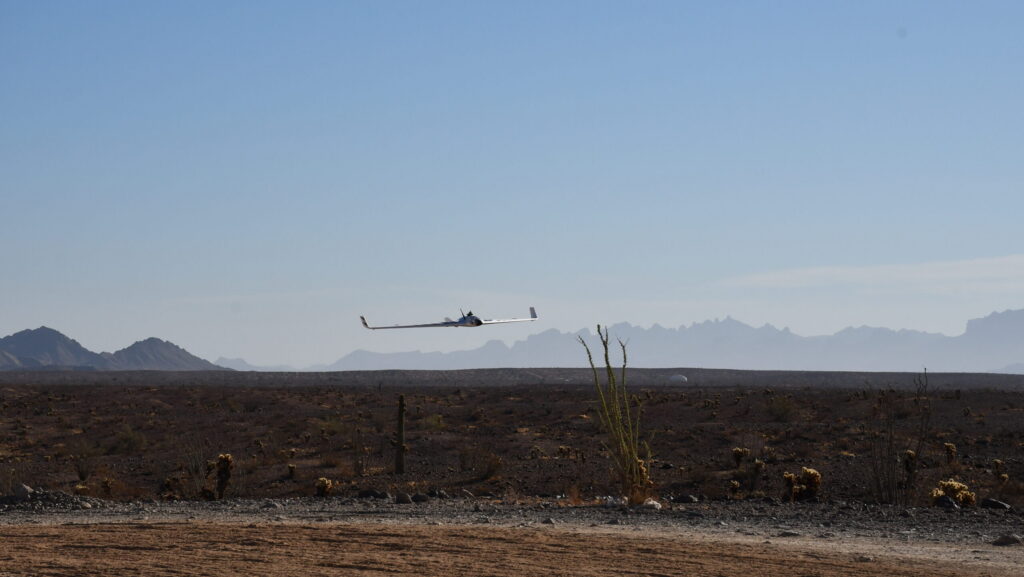
YUMA PROVING GROUND, Ariz. — About seven miles away from the Mexico-United States border, an infrequent breeze provides a reprieve from the 100-degree-plus scorching heat. The reprieve is short-lived, as each zephyr comes with a cloud of dust. Weapons vendors, soldiers, drone operators and reporters cover their faces and squint their eyes, but inevitably it gets everywhere, including in equipment.
This is the scene of Falcon Peak 26.2, US Northern Command’s fourth and most recent counter-drone exercise designed to test up-and-coming tech that can defeat drones encroaching on the homeland. The exercise, which spanned from Aug. 31 to Sept. 25, saw NORTHCOM, its subordinate Joint Task Force-Southern Border (JTF-SB), the Department of Homeland Security, the Defense Innovation Unit and the Army’s Joint Interagency Task Force (JIATF 401) come together to witness vendors demo their tech — with a goal of awarding contracts soon after.
Smaller iterations of the exercise took place late last year, but the most recent Falcon Peak was the biggest yet, coming amid the Trump administration’s push to seal the border as tightly as possible. The timing is just right, too, as the Defense Department says it has experienced a “very noticeable” uptick in the number of cartel drone detections over the past several months.
“Its an increasing trend,” Air Force Brig. Gen. Brian Filler, deputy commanding general for operations for JTF-SB, told reporters on Sept. 24. “I don’t have those numbers committed to memory, but I mean it is increasing at a rate that’s very noticeable.”
Maj. Gen. Curtis Taylor, commanding general of JTF-SB, told an audience earlier that day that over the past 30 days there have been 378 detections, 75 turnbacks (instances when a counter-drone device disconnects a drone from its operator, automatically sending it limping home), 15 “engagements” (otherwise known as drone take downs), and one capture of an adversarial drone coming over the border.
Taylor acknowledged that while he would like those numbers to be higher, he’s pleased that the team has seen an uptick in both detections and turnbacks. The detections come from a variety of radar systems, Taylor said, and turn backs are possible through devices like DZYNE’s Dronebuster, a handheld device that uses radio frequency and GPS jamming to force drones to land or return to their operator.
The next step is moving from turn backs to “actual engagement” and eventually captures.


Biodefense is force protection: Ready today, prepared for tomorrow
A decorated combat aviator and biotech CEO advocates preparing for novel viral threats before the next crisis.
Most recently, an engagement on Sept. 24 involved using a high-energy laser system to down two cartel drones, Taylor said. He added that the one capture was initiated by a “cyber takedown system,” though both he and Filler declined to provide additional information on the system.
Detections have increased in part due to JIATF 401 bringing additional capabilities to the region, according to Brig. Gen. Jason Rueschhoff, operations director of NORTHCOM. He said more detections mean “better protection” and better data collection.
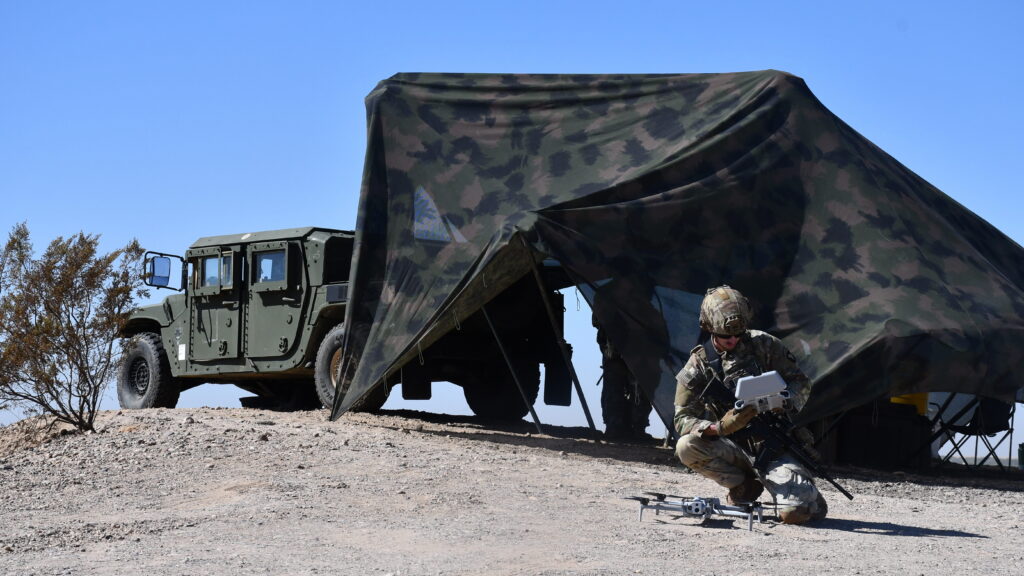
Taylor said the “predominant drone threat” coming across the border are reconnaissance aircraft designed to “support human trafficking operations.” The drones are primarily Group 1, commercial off-the-shelf quadcopters, both Taylor and Filler said. To date, the task force and its partners have not seen any drones attached with “lethal” payloads cross the border, but that doesn’t mean that the possibility “does not exist,” Taylor said.
“We know from open source information that’s securely available that there is a growing use of lethal drones in cartel violence in Mexico, and we all are concerned about the diffusion of lessons learned from Russia and Ukraine into the cartel fight in the hemisphere,” Taylor said.
Meanwhile, just 100 yards from the border wall, Lt. Commander Lauren Cole, the JTF-SB deputy director of public affairs, told reporters that the “narco-terrorist cartels are evolving in how they use drones, and they’re enhancing how they use drones.”
She added that they are using “different tactics in different places” causing the US military and agencies like DHS to try to stay ahead.
“We are constantly ensuring that we can meet and exceed the threats of how they use them.”
A Slew Of Industry Offerings
“Staying ahead” is the purpose of exercises like Falcon Peak, Cole said.
During the demonstration, officials covered three “lanes” of capabilities: sensing, kinetic interceptors (also known as drone-on-drone take downs) and ballistic take downs, which primarily consisted of small ammunition taking down the aircraft.
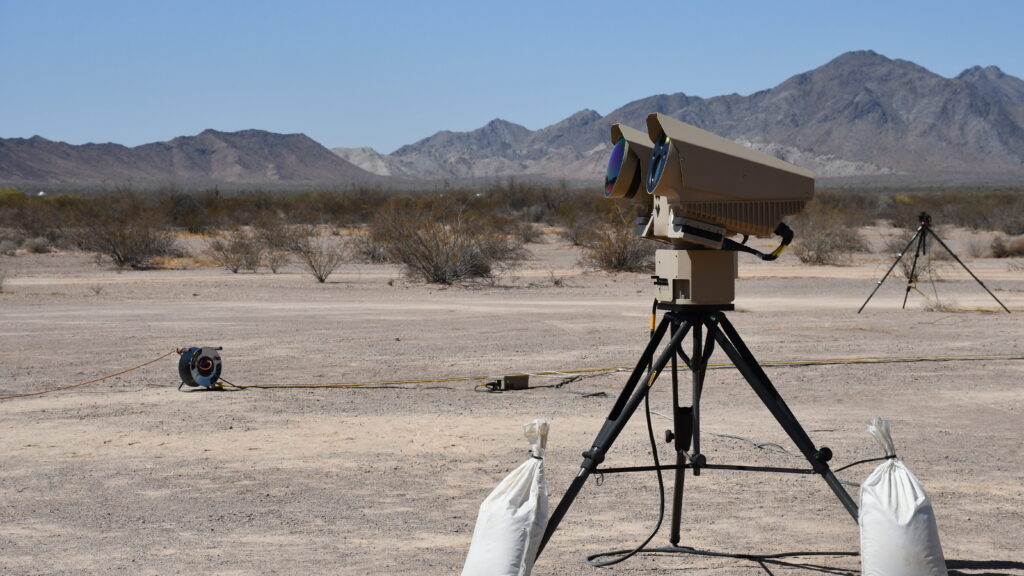
A dozen vendors showed off their various solutions. Three were used for sensing operations, five for kinetic interceptors and four for ballistic capabilities. The vendors ranged from well-known firms such as Teledyne FLIR, offering its counter-drone radar dubbed Cerberus, and Allen Control Systems, with its kinetic Bullfrog interceptor, to lesser-known vendors such as Harmattan AI, with its hit-to-kill interceptor dubbed GOBI, and Genesis Arms, with its GEN-12 12-gauge, magazine-fed shotgun.
Of the tech tested, Breaking Defense was only shown Teledyne FLIR’s radar and Genesis Arms’ GEN 12 device. After three days in the desert, a small group of reporters saw a total of three test drones taken down by the GEN 12.
Additionally, during the last day, on Sept. 25, NORTHCOM also showed off its flyaway kit made by Anduril. The kit consists of a combination of sensors and effectors like the Heimdal 360-degree sensor, Anvil drone interceptors, the electromagnetic warfare effector called Pulsar, an AI-enabled infrared system dubbed the Wisp and the company’s Ghost-X reconnaissance drones.
Reporters and other observers witnessed the reconnaissance drones fly off to detect the whereabouts of “enemy drones” and then return to their launch site. The flyaway kit was purchased by NORTHCOM last fall.
Learning From Tough Conditions
Here the ubiquitous sand and winds aren’t only inconveniences, but operational challenges the military expects the counter-drone tech to withstand. Executives from Harmattan AI told reporters that the company has learned its tech will have to “overcome” the harsh desert environments over the course of Falcon Peak. Reporters didn’t get to observe GOBI’s kinetic attack in action, but executives gave accounts on how the capability works.
“We’ve been out here for a sustained period of time, which now also teaches us the endurance of our technology’s battery life. How does dust really affect it over time? Does that make a difference?” Callie Roth, one of Harmattan AI’s executives, told reporters during the exercise. “How do we kind of overcome some of those hurdles?”
Roth didn’t reveal specifics , but said the company is learning how to make the GOBI more resilient with every test in the desert.
Robert Fletcher, Yuma Proving Ground’s sensor branch team lead, told reporters other vendors have learned the harsh realities of the desert environments.
“A lot of people make assumptions when they come out here, and then when they’ve got the sun glaring off their system all day long, certain things melt. Certain electronics don’t work as well. So that’s always a hardship for the systems or the owners,” Fletcher said. (Breaking Defense previously reported how the harsh desert environment takes a toll on communications equipment as well.)
Apart from the heat and dust, the strong desert winds pose their own challenges, Joe Cornelius, CEO and Co-founder of Perseus, a company making a small interceptor that costs under $5,000 a hit, told Breaking Defense.
“Some of the big takeaways we took from [the exercise] were like we need to do more robust testing on different wind environments and things like that.” Cornelius said. “The winds out here at Yuma are about twice what we’ve ever tested with down in Texas. So that was a pretty big thing that we learned. We need to be a little bit more rigorous about testing in adverse conditions, such as wind, or such as … humidity, or such as fog, or rain, or whatever it may be.”
Feedback … Loading
Ross told reporters that one of JIATF 401’s commitments going into Falcon Peak was to award contracts after the exercise. While he said on Sept. 24 that he didn’t yet know when those contracts will be awarded or how much they will be worth, he said the task force is using an agentic AI-powered “central repository” — a single database containing data collected during the exercise — to determine which vendors performed most successfully. He said that feedback will be available “in days, not weeks.”
“One of the things it does really well is it helps us sort through consolidated unstructured data. So our test reports will be in emails, Word documents, PowerPoint slides, Excel spreadsheets and sometimes a randomly formatted PDF document, but AI can help us kind of make sense of that,” Ross said. “I want to move really quickly because we’ve got some committed industry partners that are downstairs right now that took their time and money to come out here and perform.”
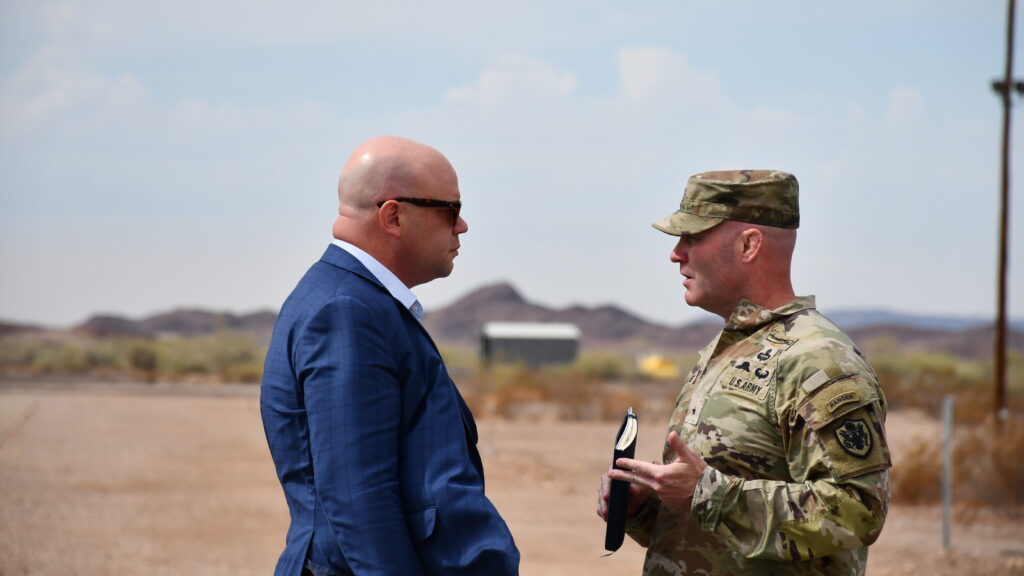
Ross declined to say if there was any one capability that stood out during the exercise, saying that what’s important is a “layered defense,” which combines the processes of detecting, tracking, identifying, mitigating and capturing. So, instead of buying one system that performs all of the functions, it would be ideal to purchase a variety of technology that is interoperable.
Further, when buying such technology, he said it’s better to have capabilities that are expansive in scope versus acquiring tech that can only take down a certain type of drone.
“We really want to focus on those first principles that are common to all unmanned systems, and so there are solutions that will provide detection over radio frequencies and control frequencies, to jam that control, that modality of control. I’d much rather focus on sensing based [on] physical mass in the airspace, and defeating the drone based off the things that are common among all drones,” Ross said.
“If we can focus on that for our defeat mechanisms, then our countermeasures will be resilient, regardless of the type of systems we start to see being used from the adversary,” he said.