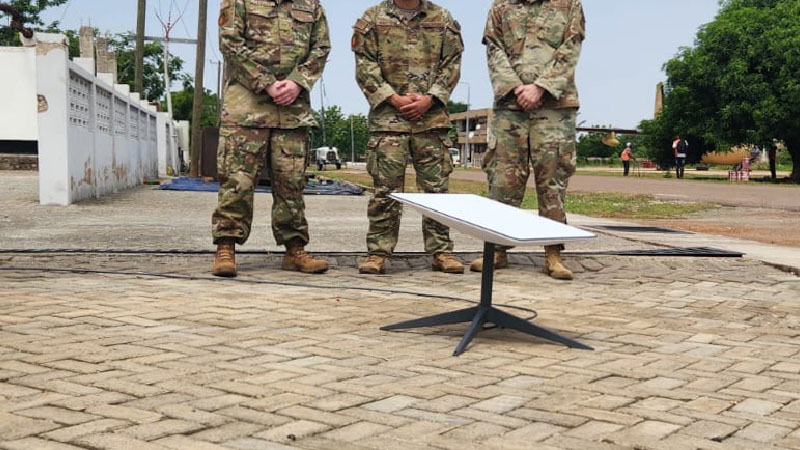
WASHINGTON — In the sweltering 100-plus degree Mojave Desert heat, some of the Army’s Starlink ground terminals were overheating, reducing the throughput soldiers needed to pass and receive data. With no contractor support in the field, soldiers were left to troubleshoot solutions themselves.
Their straightforward fix: soaking T-shirts with water and draping them on the terminals’ antennas to cool them down.
“We did have a couple cases where things were overheating … but we see when you have commercial-first [tech], it’s not necessarily purely ruggedized, we see that we have some shortcomings in some of the technology’s ability just to handle the heat,” Maj. Gen. Patrick Ellis, commander of 4th Infantry Division (4ID), told reporters in July. “But we also found there’s some pretty basic ways for us to accommodate for the heat. Some soldiers figured out that by soaking a T-shirt in ice water, you can put on top of some of the antennas and cool them off enough for them to function. We may not always need to buy [a] hardened, boutique capability.”
The overheating Starlink incidents happened back in July, during the Army’s high-profile tech experimentation event called Project Convergence Capstone 6 at Fort Irwin. At the time, the 4ID was testing the bounds of the service’s Next Generation Command and Control hardware and software in harsh, more real-world conditions.
It was a significant test for the Army’s latest acquisition strategy, which focuses on using commercially available equipment first, which can be fielded much faster than bespoke, exquisite systems built for the military. For NGC2 it means using Starlink, 5G- and WiFi-enabled systems, among others. (SpaceX, which developed and maintains Starlink, did not respond to a request for comment for this report.)
The primary prototyping period for NGC2 concluded with Project Convergence, informing how the Army’s baseline of capabilities for the architecture. The service will be weighing just how much to mix commercial options with ruggedized or bespoke ones for both hardware and software. Ruggedized and bespoke equipment is typically more expensive and takes longer to develop but generally can withstand harsher conditions or has specific, military-centric capabilities. Commercial, on the other hand, is usually less expensive but doesn’t always stand up to austere conditions.
Going into Project Convergence, Army officials “knew the known limitations from some of that” commercial tech, Brig. Gen. Shane Taylor, capability program executive for Command and Control Information Network, told Breaking Defense.

The gap between demand and delivery is widening. AI can help close it.
Supply chains are only as strong as their weakest link, which has been repeatedly proven to be true over the last few years.
But even then he said that a big lesson from PCC6, was that soldiers used tactics, techniques and procedures (TTPs) on the battlefield to mitigate unforeseen problems, like using the wet T-shirts to cool the terminals.
“Before we go spend quadruple the cost of that equipment, are there some things that we can do?” Taylor said, adding that in the past, if systems didn’t work exactly, the thinking was to reengineer or design the whole system, or, in his words, “Army-ize” the capability.
Joseph Welch, portfolio acquisition executive for command and control and counter-command and control, told Breaking Defense at the TechNet conference in Augusta, Ga., that he agreed. “Anytime a TTP can be utilized and taught and understood in a very straightforward manner, and it’s not detracting from mission effectiveness, I mean that’s something I think that’s obviously appealing compared to over-ruggedized or telling vendors to make more rugged equipment,” he said.
The feedback also has spurred discussion on what types of cooling technology, for example, the Army can add to vehicles to help mitigate issues.
“The good thing is the commercial market’s continuing to move forward as well. So there’ll be more solutions that the Army will be able to take advantage of when you look out several years,” Welch said regarding SATCOM and resiliency and cost.
“When we took a look back at what it was costing the Army to outfit divisions with legacy C2 capability compared to as our notion of a baseline is, we’re under review now coming out of PCC6, but we’re anywhere from 50 percent less expensive to another, I don’t know, 25 percent on top of that depending on the selections that we make,” he added. “We already know that the commercial first is going to significantly lower our costs and allow us to go faster.”
Breaking Defense Video