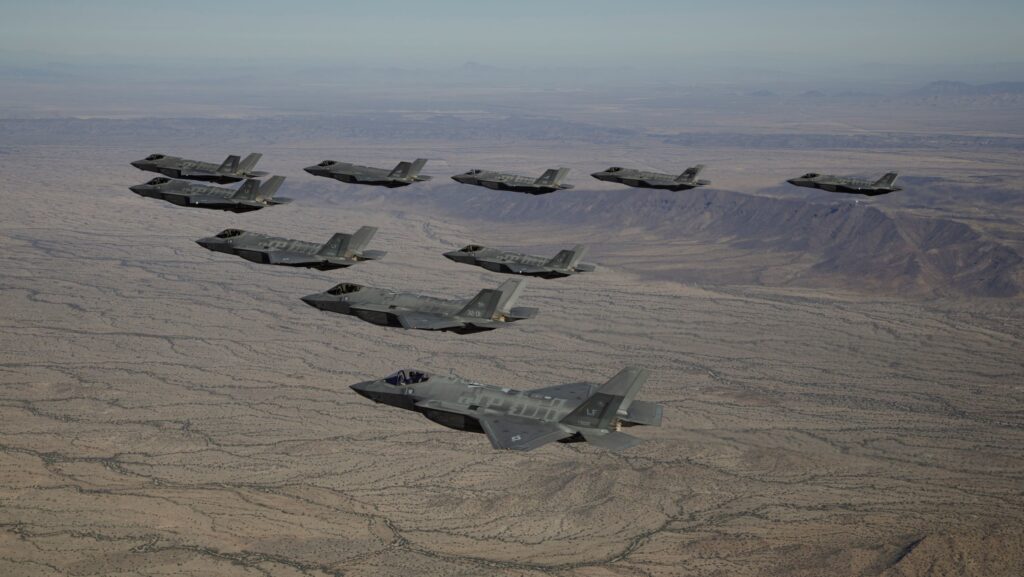
WASHINGTON — The F-35 Joint Program Office cannot reliably track thousands of spare parts undergoing maintenance or repair, leaving officials without a clear picture on the location of as much as $2.5 billion worth of components across the aircraft’s global supply chain, according to a new government watchdog report.
The Government Accountability Office’s findings come against the backdrop of a Pentagon investigation into how F-35 components shipped from Australia to the United States ended up in Hong Kong, potentially exposing the jet’s secrets to the Chinese government. While GAO did not link the incident to inventory problems detailed in the report, the watchdog’s findings underscore the Pentagon’s broader challenges in tracking F-35 parts.
As of March 2026, when the GAO conducted its research, more than 17,000 F-35 Lightning II parts, worth an estimated $1.3 billion, were missing from the program’s inventory system. The value could be as high as $2.5 billion when accounting for missing cost information and other acquisition expenses, officials told GAO.
The gaps stem in part from incomplete contractor records that are not routinely integrated into the program’s inventory system, making it difficult for the JPO to determine what parts are available and where they are.
“Without accurate data in its [accountable property system of record] and properly executed inventory procedures for F-35 parts, DOD management will not have the information it needs to support warfighter readiness and reliable financial reporting,” the GAO said.
The F-35 comes in three primary variants that are operated by the Air Force, Marine Corps and Navy, as well as specialized configurations for 19 international customers. Lockheed Martin serves as the stealth fighter’s prime contractor, while RTX subsidiary Pratt & Whitney supplies its engine.
Overall, the F-35 program relies on over 1,900 domestic and 2,100 global suppliers, with approximately 26 million parts distributed across more than 700 contractor- and government-management facilities worldwide, per the GAO. The Defense Department uses the Enterprise Logistics Management System (ELMS) to manage the fighter jet’s sprawling inventory.

Precision at scale: APKWS counters the threat
APKWS® laser‑guidance kit provides reliable precision‑guided munitions across missions and platforms, delivered quickly to meet evolving operational demands.
While the ELMS is able to capture real-time inventory changes, the platform cannot interface with property management systems run by Lockheed Martin and Pratt & Whitney — an issue first reported by GAO in 2022, which has persisted as of August 2026, according to the watchdog.
Instead, the JPO relies on periodic contractor data submissions and information from other Pentagon systems to update its records. Those submissions occur quarterly for the joint spare parts pool, meaning some inventory records can be more than three months old, GAO found.
Furthermore, the JPO lacks procedures to validate the accuracy of contractor data before entering it into the ELMS. A December 2025 submission included serial numbers for only 29 percent of parts records and National Stock Numbers for 43 percent. Some of those records indicated the components cost just one cent or less, which GAO said indicated possible data errors.
The program office has also struggled to verify how many F-35 parts are at facilities. Since fiscal 2020, the JPO has spent at least $17 million conducting inventories, but GAO found that its most recent effort did not fully verify that parts were physically in place or that inventory records accounted for all of them.
The F-35 Joint Program Office did not respond to Breaking Defense’s requests for comment on the report. Lockheed Martin did not immediately return Breaking Defense’s requests for comment.
An Ongoing Concern
The report echoes concerns the watchdog has raised in previous reviews of the Pentagon’s costliest program. In 2023, GAO found that a prime contractor had lost more than 1 million F-35 parts worth over $85 million between May 2018 and October 2022.
By March 2026, the contractor had submitted about $28 million in loss reports covering the missing parts between 2012 and 2025. The Defense Contract Management Agency determined the contractor should be financially liable for about $6 million, but the JPO could not determine whether those reports included any of the losses identified in GAO’s earlier review because it had not kept records of outstanding cases, according to the latest report.
The accounting problems could also affect the Pentagon’s ability to keep the F-35 ready for operations, GAO warned. Without accurate inventory records, the department may struggle to determine which parts it needs and in what quantities.
That could complicate the Pentagon’s $13.7 billion Global Support Solution Reset strategy, which calls for additional investment to improve F-35 performance — including increasing spare parts availability. The watchdog cautioned that the Pentagon may be unable to identify its needs or account for additional parts purchased under the strategy.
In the report, GAO recommended that DoD strengthen its oversight of reported parts losses and establish clearer procedures, training and responsibilities for officials who track government-owned property. The Pentagon agreed with all four recommendations and said it was developing corrective actions.
The Defense Contract Audit Agency is also working with the JPO on a full inventory of F-35 parts, targeted for completion in March 2027.
Breaking Defense Video