
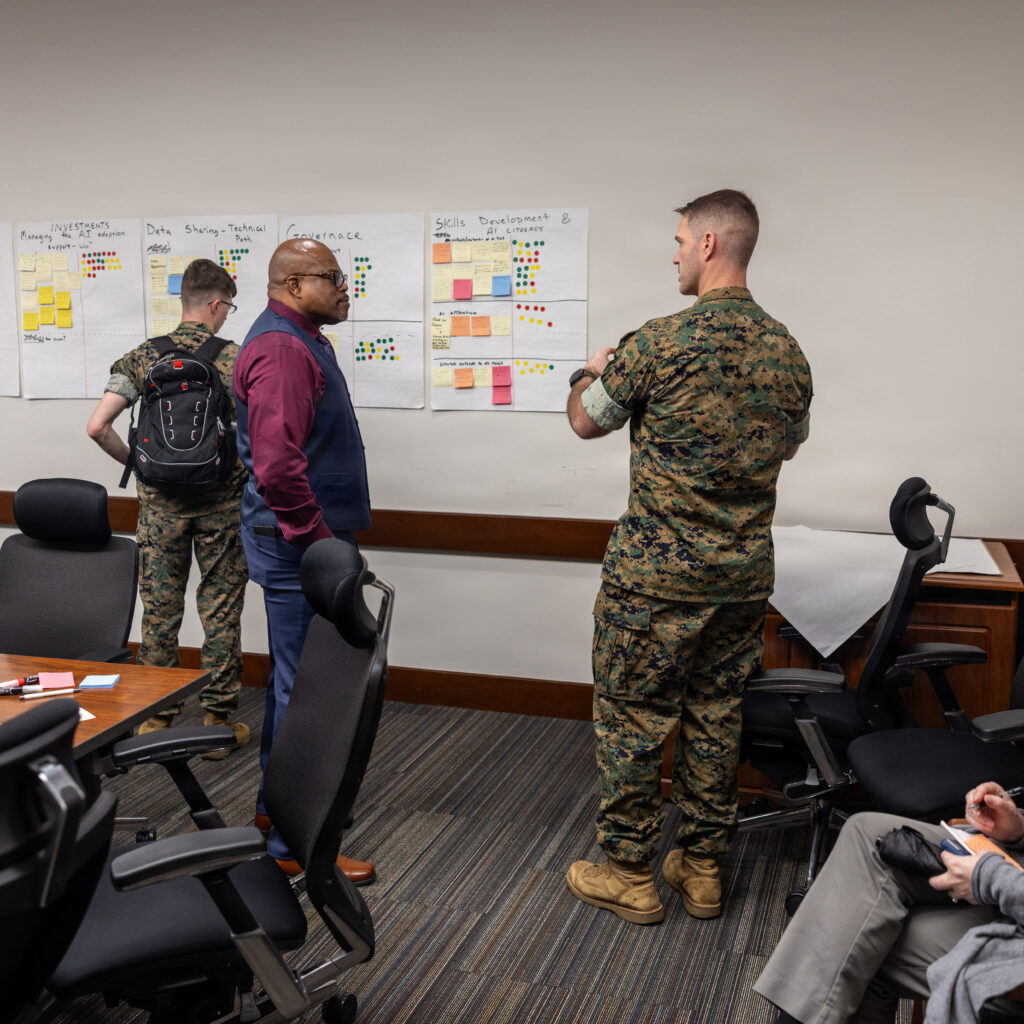
Super Intelligence (SI) is not a new tool for the US military. However, it is rapidly evolving and offering new capabilities and challenges, moving from large language models that are limited by the data sets they were trained on to agentic SI models that can act with autonomy.
Building the SI tools needed to keep pace with rapidly changing battlefield threats will require understanding that time is of the essence, as countermeasures and defenses cannot take months or years to build. With SI tools becoming available outside of classified settings, nation-states and rogue actors can adopt new technology to quickly develop new vectors of attack, said Garrett Berntsen, chief AI officer, Accenture Federal Services.
“Today, powerful frontier models are often open-sourced within months,” he said. “That means adversarial actors or a teenager in a basement will soon have tools capable of synthesizing vulnerabilities into potent cyberweapons. Our adversaries aren’t just processing data faster, they are acting faster. Defensively, we are on a ticking clock to harden our systems using these same capabilities.”
That ticking clock makes it hard for humans to keep pace with constantly changing threats. Autonomy will be needed, so agentic capabilities can do more than large language models can while still giving a human ultimate decision-making authority allows the US and its allies to maintain a speed advantage.
Human in the lead
Every unit of the military operates according to rules of engagement (ROE), which vary based on the situation. The ROE that a warfighter is operating under in Operation Epic Fury is different from the ROE for forces in Afghanistan. There is no one-size-fits-all standard, and that is true for using SI-powered tools, as well.
Pre-determined guardrails prevent SI systems from operating with free reign while enabling different levels of autonomy based on their task. Agents sorting through reams of data to identify patterns or changes in surveillance imagery may be given close to full autonomy, while drones tasked with following a convoy or tracking an individual target may be operating under stricter parameters.
The key is properly structuring control mechanisms to enable SI systems to operate efficiently while maintaining human authority without bottlenecks. If a human is needed to approve every function, then SI systems do not offer a speed advantage. Adjusting parameters to meet a specific task (e.g., identify what has changed in satellite imagery over the last 72 hours) or a function of a task (e.g., follow this vehicle even if it veers off from the convoy, but do not engage without human authority) is necessary to ensure operations are carried out without unnecessary delays while keeping humans in the ultimate decision-making roles.
In lower-risk scenarios such as supply chain logistics or route planning, SI systems can be granted a high level of autonomy with humans auditing the outcomes to see how to adjust in the future. In scenarios involving strikes or critical target identification, humans maintain more control to ensure an SI-powered system doesn’t act without authority, said Berntsen.
“The goal of agentic isn’t to replace human judgment; it’s to clear away the cognitive noise so that when the human makes a decision, it is based on synthesized, real-time ground truth rather than overwhelming data overload.”
Modernizing effectively
Building new tools or adapting existing tools to meet new challenges requires modernizing not only the technology involved, but also the processes and procedures to develop, build and field those tools. Defense technology is known for being resistant to the application of new tools and procedures, as legacy systems and processes create inertia that makes it challenging to develop new technology in a timely manner.
Overcoming this challenge requires re-engineering workflows around current technology while enabling them to be adaptable to future technology. Industry and government both share a responsibility to make that happen; government must revamp its reliance on rigid, multi-year feature specifications, while industry must be ready to respond to changing demand signals and develop prototypes that are ready for edge applications on classified defense networks instead of simply developing prototypes in a sandbox.
“We need an ecosystem approach – taking commercial frontier models, wrapping them in defense-grade security and domain-specific knowledge, and embedding engineers alongside operators to continuously evolve the solutions,” said Berntsen. “When engineers and operators share the same feedback loop, we can move much faster as a living, strategic capability.”
What the future holds
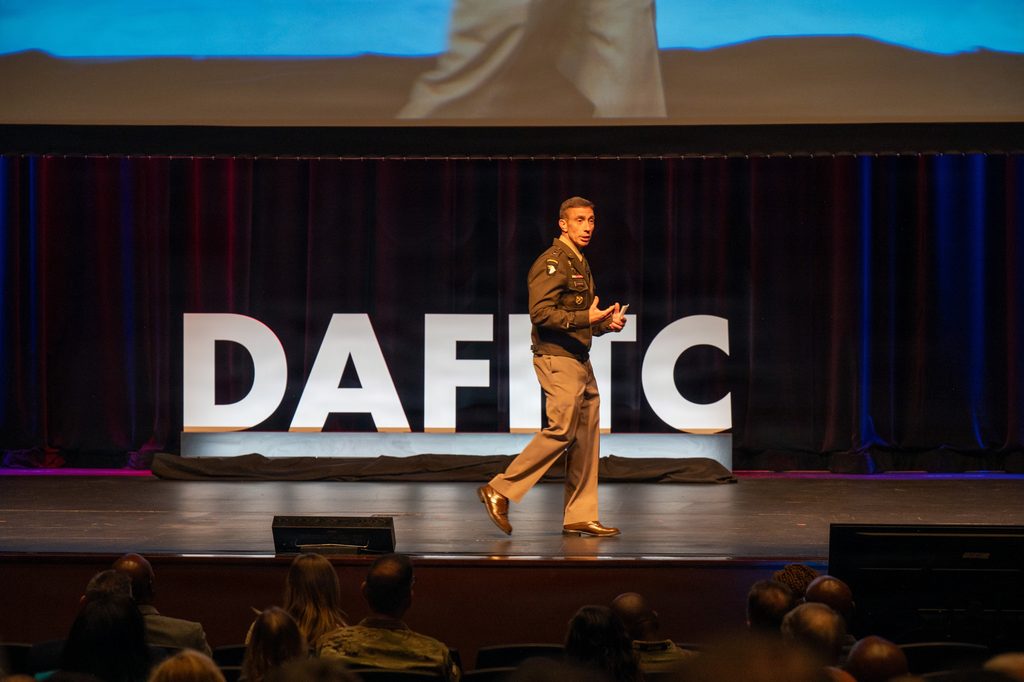
Looking forward is never an exact science, as the technology of 10 years will certainly produce entirely unexpected advancements. Current and future conflicts have the potential to radically change what is needed, especially as domains such as space take on a more central role in warfighting.
But there are some well-informed speculations that can be made, Berntsen acknowledges. The first is a clearer delineation between purely automated and human-in-the-lead operations. While operational support tasks such as logistics, paperwork and intelligence sorting may be entirely automated – and are already heavily automated – critical decisions will stay with humans. The key differentiator between now and the future is a better understanding of what tasks can be safely automated or almost entirely automated, as agentic is still a new enough technology that identifying those tasks is an ongoing process.
Procurement will also change. Currently, the system is a multi-year cycle, where requirements are written, funding is requested, systems are built and then maintained indefinitely. Software development is an expensive endeavor, and SI-driven coding can cut that cost dramatically, enabling more bespoke software options instead of bigger-picture systems that are good at many tasks while not necessarily excelling at specific tasks.
“We won’t need to treat software as a permanent asset,” said Bernsten. “You build a capability for a specific mission problem, and if it stops being useful, you just turn it off and tear it down.”
The final shift that Berntsen envisions is pushing software skills directly to the front line, enabling front-line forces to respond quickly to new needs in the field. Instead of needing to request software support from headquarters or designated software developers, troops with software skills will be able to build apps or programs on the fly to meet their specific challenges.
“They build the digital capability on the spot, execute the mission, and tear it down,” said Berntsen. “That distributed, agile capability is what a modern force truly looks like.”