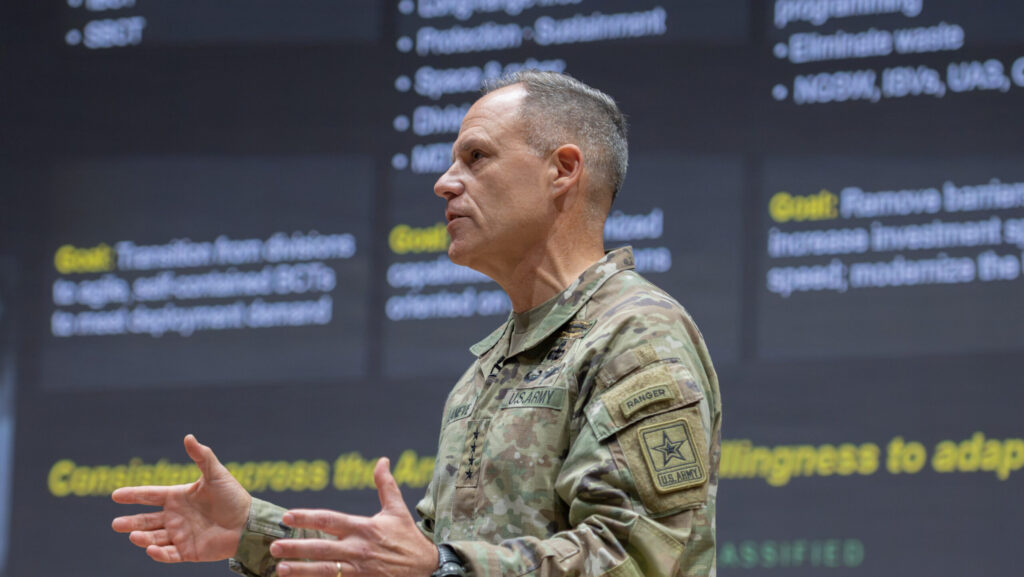
WASHINGTON — The decision by Gen. Christopher LaNeve, the Army’s top uniformed officer, to move away from the Army’s “Continuous Transformation” campaign plan in favor of more top-down guidance was driven in part by burnout from soldiers, one of LaNeve’s top advisors told Breaking Defense in a recent interview.
If the new campaign plan, released in an early form last month as a document titled “How the Army Fights,” is officially codified, it would flip the current campaign plan on its head, Col. Pete Walther, one of LaNeve’s special assistants, told Breaking Defense in a Nov. 17 interview.
Unlike the previous “bottom-up” concept, which lacked distinct objectives for each echelon, the new guidance emphasizes top-down direction to standardize and align the Army’s approach to fighting and training, something Walther said was designed to make sure the service is more aligned across the board.
“‘How the Army Fights’ is something our Army needs. It plants the flag for where we are going and unifies the team around a common understanding of our contribution to the Joint Force against the pacing challenge,” LaNeve said during the annual AUSA conference in October. “It defines the operational environment and articulates how operational-level maneuver bridges tactical and strategic success.”
The guidance is scheduled to become the Army’s official campaign plan by Feb. 1, replacing “Continuous Transformation,” developed under former Army Chief Gen. Randy George, who was ousted by Defense Secretary Pete Hegseth in April. Right now, “How the Army Fights” is in the “execute order” stage, Walther explained, the step before it becomes the official campaign plan.
Though “How the Army Fights” was born under LaNeve, his spokesperson told Breaking Defense that the intent is “that it’s not tied to an individual, it’s about large organizational change.” Therefore, even if LaNeve is not confirmed in the Senate, such changes that the new guidance is trying to implement ideally won’t become moot.
The transition marks a shift in how the Army approaches modernization and experimentation. Under the “Continuous Transformation” campaign, the service underwent the sprawling Army Transformation Initiative (ATI), which cut programs and top officers and rearranged money and priorities. The effort also included Transformation in Contact (TiC), an initiative that rapidly put new experimental commercial technology and gear into soldiers’ hands during rotations at Combat Training Centers (CTCs), allowing units to experiment with new capabilities in the field. (CTCs are large-scale, realistic combat training exercises).

Securing the Asia-Pacific digital battlespace
From electronic warfare threats to coalition data sharing, discover how US and allied forces are strengthening the digital battlespace across the Indo-Pacific.
But Walther said the emphasis on bottom-up experimentation under the previous campaign sometimes came at the expense of clear direction from Army leadership.
“[LaNeve] is absolutely focused on divisions, corps and theater armies. I think we focused a great deal on companies, battalions and brigades during the Army Transformation Initiative,” Walther said. “It was beneficial, and we don’t want to lose what we gained through that. But for him, he wants to build on that, and the next logical step is the divisions, the corps and the theater armies.”
As it is now, soldiers at each echelon don’t necessarily have clear cut responsibilities, Walther said, hindering the Army from carrying out its goal of “operational maneuver” — the service’s ability to avoid becoming static or attritional in warfare. LaNeve wants commanders of battalions and below, and sometimes brigades, to focus on close battle operations, where strike should happen at the brigade level and above and convergence should happen at the division levels and above. Endurance, Walther said, is needed at every echelon.
“We haven’t necessarily for a while had that level of focus,” Walther said. “What we’re doing is providing clarity. We had battalion commanders that thought they were hunting 300 kilometers deep [for strike missions]. We need them in close battle. We need corps to be manned, trained and equipped to be able to do convergence with the joint force.”
Although initiatives such as ATI and TiC will end, modernization will not, LaNeve’s spokesperson emphasized to Breaking Defense. ‘“Continuous Transformation’ was motion, but ‘How the Army Fights’ is direction,” they said.
But make no mistake, TiC and ATI are definitively ending, not simply going through a rebranding effort.
Instead of commanders at the brigade level and below deciding what kind of experimental tech they want to test out during CTCs, that guidance will now come from the division level or above, often coming directly from the Army’s headquarters. Commanders will then report back up to division headquarters and above on how such experimental tech is performing.
The End Of TiC
Walther acknowledged that TiC produced “good lessons learned” and made it possible for “a lot of material tactical lethality” to be pushed down quickly. However, its bottom-up experimentation approach also created what is sometimes known as tech fatigue — when soldiers become overburdened with having too much new tech, or “kit,” not enough time to experiment with it, paired with confusion on what missions the tech is built for.
“It was done on the side of angels. It was a good intention, but it was a disservice to that brigade commander and his team. You can’t evaluate their core competencies if you just gave them brand new kit. That was ostensibly what was happening as Gen. LaNeve was doing some of his initial battlefield circulation,” Walther said.
He added that over the past few years, TiC was “somewhat predicated on, ‘Just throw material to companies and battalions, let them iterate on it, and tell the Army what they think about it.’”
Walther denied that LaNeve’s decision to move away from TiC was politically motivated by previous tensions between Hegseth and George and former Army Secretary Dan Driscoll, both champions of the effort. Instead, he argued that the experimentation model was always intended to be transitional.
“Eventually, you have to stop transforming at the lowest echelons, and you’ve got to get back to a more deliberate modernization program,” Walther said. “I would argue, regardless of Gen. LaNeve coming into this position, the force was ready for clarification. They had done enough experimentation at the lowest echelons, and so some kind of deliberate framework from HQDA [headquarters of the Department of the Army] was needed and wanted.”
“We’re not leaving modernization behind, and there’s lots of avenues to continue to experiment throughout. But we need focus,” he added.
A former brigade innovation officer, who served as a captain, told Breaking Defense in a recent interview that he witnessed soldiers facing tech fatigue as they were only given new tech just as they were leaving for CTCs.
“They got pushed this equipment. They never had a chance to train on it. There was a big thing because they were TIC 1.0 brigade, and Gen. George was in attendance […] there was pressure to really get these guys to show off this new equipment, and it kind of became less of a value for the soldiers and much more of a distraction and a show and tell exercise,” they said.
The former captain, who was granted anonymity to speak freely, also said that sometimes brigade commanders would receive equipment that didn’t necessarily meet a mission requirement, creating confusion on why they were made to experiment with something that didn’t have an assigned purpose, or sometimes it simply wouldn’t work.
An industry executive who participated in CTCs shared similar concerns, noting that soldiers were sometimes given technology without knowing how to use it or what problem it was intended to solve.
“There’s a lot of solutions that are looking for problems,” the industry exec said. “That’s where the tech fatigue comes — there’s a lot of over-engineered solutions that don’t really solve a problem or optimize the reality of how the soldier fights”
The industry official highlighted another issue, when units are given tech that’s not yet ready for soldier use, whether that means it’s not yet ruggedized or it can’t connect to the Army’s command and control networks.
“Is it ready for me to include into a [CTC] rotation? Leaders go there to get certified to be leaders in combat, and so if it’s no kidding, something my guys or gals will take out into the field and put on the truck to take to the fight. Then that’s what I want,” they said.
A New 180 Day Mandate
Another major change under “How the Army Fights” is a requirement that soldiers receive experimentation tech that leaders want to test during CTCs at least 180 days before they leave for such exercises. Previously, there was no deadline for introducing new equipment before these large-scale combat training exercises, Walther said.
Lt. Gen. James Isenhower, commanding general of the Army Combined Arms Command, previewed such changes in September. He explained that the Army wants to be more “careful” with the experimentation requirements they put on the rotational force, or the BlueFOR, and giving them time to integrate before CTC should do the trick.
The BlueFOR will still test experimental tech, but a portion of what was dumped on them will now be sent to the opposition force, who “fights” the BlueFOR in CTCs. He said this is because the opposition force is generally stationed at training locations, so they have more time to become accustomed to experimental tech before they have to participate in CTCs.
Isenhower told reporters in a September call that the Army is making this change so the rotational force can focus on their own processes, standards and operating procedures to ensure they are “tactically proficient” and to avoid tech fatigue.
“We’ve had a couple of examples in the recent past where we’ve given new technology to units just as they were entering what we call ‘the box,’” he said. “The reality is, we owe them more time so they can integrate that equipment and focus on fighting the enemy as opposed to what oftentimes is a focus on simply trying to understand the equipment,” Isenhower said in September.
The former captain said the new 180 day mandate could be a promising solution to alleviate tech fatigue. But, they said, the rule shouldn’t focus so much on a distinct timeline, but instead the blueprint should be, “if you aren’t trained and certified on that technology during your culminating brigade exercise prior to CTCs, then you absolutely should not be able to incorporate that.”
Ultimately, LaNeve’s approach with “How the Army Fights” is intended to ensure that soldiers receive new tech with adequate preparation before they enter CTCs, such tech comes with a clearer purpose from top leaders and it has a defined place within the Army’s broader warfighting structure.
“This is about the Department of the Army saying, ‘This is how we’re going to fight. This is how we’re going to man train and equip you. This is your doctrine.’’ That theoretically will “alleviate a lot of the tech fatigue that the force is starting to feel,” Walther said.
Breaking Defense Video