
WASHINGTON — The annual defense policy bill gives the Pentagon’s new counter-small-drone task force extraordinary authority over acquisition programs across the armed forces — including the power to set technical standards, run field tests, and, if a system doesn’t pass muster, forbid the armed services from acquiring it, said a senior officer from Joint Interagency Task Force 401.
“The acquisition authority that we now have is the [National Defense Authorization Act],” said Col. Jonathan “Hammer” Beha, JIATF-401’s chief of requirements, data analysis, and training. The colonel, an Air Force electronic warfare (EW) officer, was speaking to the Association of Old Crows EW conference Dec. 10, the same day the bill passed the House. (Senate approval is likely this week).
While the Pentagon still has to write its internal policy on how to implement the NDAA, Beha continued, “I’ll tell you my interpretation of that law is that we won’t let a service procure something that doesn’t perform, and if they want to, JIATF-401 gets to say no.”
It’s important to note that this authority only covers defenses against small Unmanned Aerial Systems (sUAS), what the military calls Groups 1-3. The growing threat of smaller drones from Europe to the Mideast to the homeland has prompted a flurry of different counter-measures, which JIATF-401 is meant to rationalize.
Besides the limitation to the small-drone domain, there is an important legal detail in the statute that Col. Beha didn’t mention in his talk. Yes, Section 912(e), paragraph 3, of the NDAA does state that “no component of the Department of Defense may procure a counter-sUAS system unless such system … has been validated and approved by the Task Force …[e]xcept as provided in paragraph (4).”
That paragraph, in turn, allows the override of JIATF-401’s veto — albeit under remarkably strict conditions. First, the override has to come from a service’s Senate-confirmed senior acquisition executive or the undersecretary for acquisition for the entire department, not any lesser bureaucrat. Second, that senior official has to justify their decision in advance, in writing, to Congress — specifically to the very committees that gave the task force veto power in the first place. So while it’s procedurally possible to overrule JIATF-401, it would be politically painful.
All told, the language in the NDAA is a strong congressional endorsement of Defense Secretary Pete Hegseth’s vision for JIATF-401, giving statutory teeth and clarity to his broad statement in an Aug. 27 memo [PDF] that the task force will be “empowered to determine whether new Military Service-specific C-sUAS will be adopted.”

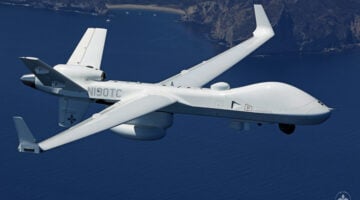
MQ-9B SeaGuardian® offers Navy-Marine Corps a decisive edge in today’s battlespace
The MQ-9B is uniquely suited to meet the challenges of modern conflict.
By contrast, the organization the JIATF replaced, the Joint Counter-Small UAS Office (JCO), was widely considered too weak to impose discipline on the sprawling profusion of programs to defeat small drones. As Air Force program executive officer Lea Kirkwoood said today, “the JCO … didn’t have a lot of teeth, didn’t have a lot of acquisition authority.”
So what is the new task force doing with all this power?
“We just tipped over our 100-day anniversary … and we’re moving very quickly,” Beha said. “We’ve already delivered some requirements. We’ve already delivered equipment. We’ve already procured equipment. We’ve already changed some processes to make them move faster.”
Looking further ahead, he said, “one area where we can, I think, add a lot of value is standardization [and] helping the services identify best-in-breed.”
One aspect of that will be standards for testing counter-drone defenses, Beha said. Today, different organizations test counter-drone systems in different ways to different standards, he explained, which make it difficult or impossible to make an apples-to-apples comparison of what actually works best.
“The good news is we in the JIATF already have draft test standards that we’re expecting to go final, I’ll say very soon, weeks, or maybe small-digit numbers of months,” Beha said.
The JIATF can also act as a central clearinghouse for data on counter-drone operations, he added, modeled on how the Air Force’s 350th Spectrum Warfare Wing brings together all Air Force data on electronic warfare threats and pushes out updated Mission Data Files on how to handle them.
Beha emphasized that the JIATF will focus on “synchronizing” the services’ counter-drone programs, not on trying to do all that development in-house. That said, it will run some research and development itself.
Hegseth’s charter for the task force has already given it control over preexisting Department-wide counter-drone research and development efforts, including part of the Biden-era Replicator initiative, the defensive systems known as Replicator 2. (The other half of Replicator, now renamed and refocused on developing long-range attack drones, moved under Special Operations Command.) And, Beha said, JIATF will explore new technologies and start new programs as needed to cover gaps in what the services are doing.
“We have a science and tech division [looking at] ideas to potentially invest in because we think they might be the future,” Beha said. “However, the focus of the task force is moving very quicky … to deliver whatever the solutions are that we need to very current problems.”