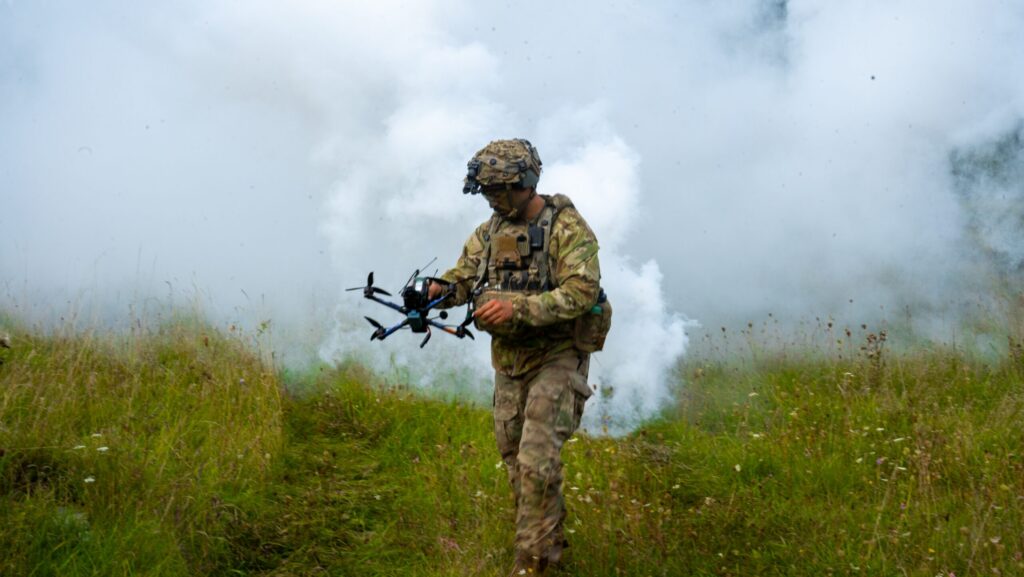
WASHINGTON — The Army’s lead for the Drone Dominance program said today that the Defense Department’s gauntlet-style competitions have, in part, helped get enough small, one-way attack drones for every squad, but now the service needs more trained personnel to operate them, especially when operating in a contested electromagnetic spectrum.
“We do have the volume to do that. A lot of that has been facilitated by [the Pentagon’s] Drone Dominance program,” Col. Gregory Merkl, the Army’s Drone Dominance director, said. “Where we still have some work to do, candidly, is getting everybody trained at the appropriate level.
“I think if you look across the force, you have that capability in every platoon. We still have a little bit of work to do in terms of getting the qualified pilots down to the squad level,” he added.
Following publication, a service spokesperson clarified to Breaking Defense that since such small drones are attritable, they’ll never actually have “enough” of the systems. The spokesperson also wanted to clarify that though the Army has the amount of drones to outfit each squad with small one-way attack drones, “these systems have not yet reached every squad across the Army,” but they are “moving quickly to achieve that objective with an agile, sustained process for acquisition, fielding, and replacement.”
When Defense Secretary Pete Hegseth announced the Drone Dominance program — an initiative aimed at cutting through bureaucratic red tape and accelerating drone production and fielding — in 2025, he mandated that every Army squad be outfitted with small, one-way attack drones by the end of fiscal 2026.
With that deadline approaching at the end of the month, Merkl said the service is now focusing on training soldiers to use the drones, especially when it comes to operating in a contested electromagnetic spectrum — an operational environment where the opposition forces actively try to jam or otherwise disrupt drones and communications equipment.
Merkl said the service is “running a whole series of working groups” within the Army’s headquarters level and with interagency partners like the Federal Aviation Administration so soldiers can better understand how to “safely use the spectrum.”
The service is also conducting such training abroad at a smaller level, like during the recent Saber Junction exercise in Germany. During the exercise, the 504th Parachute Infantry Regiment, a drone-focused unit that will soon go back to being a traditional infantry unit, soldiers were able to better understand how to operate in a contested spectrum by working with Ukrainian and NATO counterparts, Merkl said.

The Army’s Digital Transformation
AI is reshaping the Army’s approach to cyber, electronic warfare and command and control. At TechNet Augusta 2026, leaders outlined how they’re turning emerging technology into capabilities for the battlefield.
At the end of the exercise, he said the biggest lesson learned was that soldiers have to understand to navigate the electromagnetic magnetic spectrum like they “know how to navigate the terrain.” The troops made progress, Merkl said, but more results will come with continued training.
Further, Merkl told Breaking Defense after publication that the Army is still “missing some of the larger drones that enable combined arms maneuver within our battalions and brigades,” adding that the service is working to “close this gap.”
It’s unclear just how many drones the Pentagon has sent directly to Army units, but as of today, the Drone Dominance Leaderboard shows that units have accepted 12,080 drones from Gauntlet 1 of the program. As Breaking Defense previously reported, 11 companies have received deals to provide a total of 24,320 small drones through the first gauntlet.
Further, the top performers from Gauntlet 2, which specialized in long range strike and tactical assault missions in confined environments, could receive a share of the 60,000 platforms the department expects to order from that round. Earlier this week, the Drone Dominance Program announced nine winners from the second gauntlet competition out of the initial 19 participants.
UPDATED 9/18/2026 at 10:10 a.m. ET to clarify that the Army has enough small, one-way attack drones and to include an additional statement from Col. Gregory Merkl.
UPDATED 9/18/2026 at 4:29 p.m. ET to add additional comments from an Army spokesperson.
Breaking Defense Video