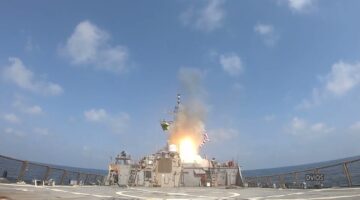
Missiles


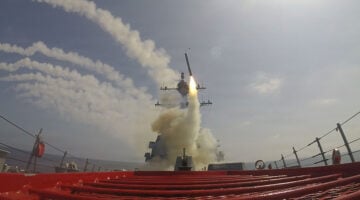
WASHINGTON: What homemade roadside bombs could do to Army and Marine ground vehicles was the ugly surprise of the last decade. What sophisticated long-range missiles could do to Navy aircraft carriers could be the ugly surprise of the next. “I think it would almost follow like the night to the day,” Rep. Randy Forbes told me in a recent interview. “The last decade… we asked a disproportionate sacrifice from the Army and Marine Corps,” he went on. “The next decade’s going to be the decade of seapower and projection forces, [and] some of those ugly surprises we see bits and pieces of already.”

As chairman of the House Armed Services seapower and projection forces subcommittee, Forbes wants to refocus fellow legislators, the Pentagon, and, for that matter, the media from a narrow debate over the troubled F-35 Joint Strike Fighter program to a wider look at all the capabilities that a carrier can support. That includes not just traditional manned fighters like the F-35, but also unmanned drones like the X-47B and the future UCLASS (Unmanned Carrier-Launched Airborne Surveillance and Strike System), electronic warfare aircraft like the EA-18G Growler, and even cyber attacks. Keep reading →


We have heard much about the anti-access/area denial threat China poses to American and allied forces in the Pacific. We have read much about new Chinese missiles such as the DF-21, which supposedly can destroy maneuvering ships at sea — especially US aircraft carriers. We have read that Pacific allies wish to deploy substantial fleets of F-35s, and then critics decide that these “short range” assets can not meet the crucial needs of warfighting in the Pacific.

We have also learned in the press that core competencies like amphibious assault have now become virtually impossible because of the A2/AD capabilities of China. What is lost in all of this hyperbole is what the United States and its allies are doing to shape a new combat capability appropriate to the 21st century. It may be true that a linear airpower force would find it difficult to cope with such threats. One deploying what we call S-cubed evolution capabilities — sensors, stealth, and speed — can create a powerful distributed force in the Pacific, one that so complicates Chinese military planning as to greatly enhance US deterrence. Keep reading →


As part of its ongoing strategic “pivot” towards the Pacific, early this year the Defense Department announced it would design a new missile able to quickly cross long distances and penetrate sophisticated air defenses, of the kind rapidly proliferating across Asia. The so-called “conventional prompt strike option” would be submarine-launched, the Pentagon said in its January Defense Budget Priorities and Choices release.

The department placed great emphasis on the new weapon, declaring that “we had to invest in capabilities required to maintain our military’s continued freedom of action.” Keep reading →

RADM Joe Horn (bio@ http://1.usa.gov/Y1l7Rq) to be Navy’s PEO Integrated Warfare Systems (http://bit.ly/Q6UUjx). Release @ http://1.usa.gov/VDUOwC SydneyFreedberg

WASHINGTON: This Saturday the Navy will christen its newest nuclear-powered submarine, the $2.6 billion USS Minnesota at the Newport News shipyard in Virginia. Countless movies have cemented the popular image of subs as stealthy underwater killers, stalking hapless surface vessels with periscope and torpedo. But today’s Navy is experimenting with launching robotic mini-subs and even unmanned aerial vehicles (UAVs) from Virginia-class attack subs like the Minnesota.

In Navy tests of a mini-UAV called Switchblade, “you can launch it, you can control it, you can get video feed back to the submarine,” said Rear Adm. Barry Bruner, chief of the undersea warfare section (N97) on the Navy staff, at the recent Naval Submarine League symposium in suburban Washington. Future subs could also launch unmanned underwater vehicles (UUVs) to scout ahead stealthily beneath the surface. “It sure beats the heck out of looking out of a periscope at a range of maybe 10,000 to 15,000 yards on a good day,” Bruner said. “Now you’re talking 20 to 40 miles.” Keep reading →

WASHINGTON: As US defense spending drops, lots of arms makers are seeking sales abroad, including mighty Lockheed Martin. But Raytheon executive Thomas Kennedy insists his company’s different.

While other US contractors began emphasizing foreign sales in the last year, “54 percent of the revenue for the IDS business is from international [already],” said Kennedy, president of Raytheon’s Integrated Defense Systems (IDS) division, in a breakfast with reporters on the sidelines of this week’s Association of the US Army conference. For Raytheon as a whole, he said, the percentage of foreign sales is a smaller but still impressive 25 percent, higher than (for example) Lockheed. Keep reading →


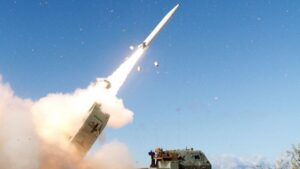
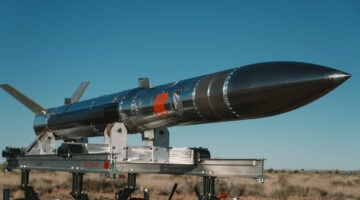
The missile launched from the wing pylon of a B-52 heavy bomber and streaked over the desert of western Utah. At pre-set coordinates, a microwave emitter installed in the winged, jet-propelled cruise missile blasted a target building. But there was no big bang, no billowing clouds of dust and debris. Instead, the building was struck with disruptive, high-frequency microwaves.

The goal of the test on the morning of Oct. 16 was “to render … electronic and data systems useless,” according to Boeing, the lead contractor for the three-year, $40-million Counter-electronics High-powered Microwave Advanced Missile Project, or CHAMP, initiated in 2009. Keep reading →

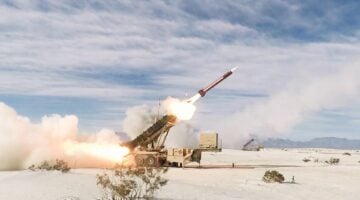
Washington: SM-3 proponents can breathe easy. The missile won’t be coming under the Pentagon’s budget ax anytime soon, according to a soon-to-be released DoD report.

Members of the Defense Science Board briefed the Hill on the initial findings of that report, which focused on ballistic missile defense operations, particularly in the early launch phase. Keep reading →