
WASHINGTON — In the first earnings calls since President Donald Trump unloaded on the industry, leaders at the biggest defense firms tried to walk a fine line, promising to meet the White House demand for more investments while pledging to not abandon dividends to shareholders.
Analysts say that might not be a problem, as long as contractors demonstrate that they are willing to show significant growth in capital expenditures that Pentagon leaders say are pivotal for scaling up weapons production.
“The amount of cash that these companies expect to generate should leave them with an ability to pay their dividend and invest more in the business,” said Seth Seifman of JP Morgan. “And to the extent that something has to give, it’s going to be in share repurchases, because that’s considered more discretionary.”
Last month, Trump signed off on an executive order that allows the Defense Department to take action against “underperforming” defense firms and to write future contracts to enable the department to constrain executive pay, share buybacks and dividends during periods of poor performance.
Trump’s own statements on the matter, made in Jan. 7 posts on Truth Social, directly targeted the practices of buybacks and dividends.
“Defense Contractors are currently issuing massive Dividends to their Shareholders and massive Stock Buybacks, at the expense and detriment of investing in Plants and Equipment. This situation will no longer be allowed or tolerated!” he wrote.
Despite the tough rhetoric from the White House, executives from RTX, General Dynamics, Northrop Grumman and L3Harris all affirmed their commitment to dividends as they rolled out their financial expectations for 2026.

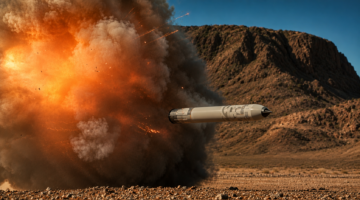
Weaponizing the supply chain for a liquid-fueled howitzer-fired munition that flies 150 km
The goal of such weaponization is to tie warfighter needs to the RDT&E cycle.
“We’ve paid a dividend for over 25 years, and every year, in March, the board decides the extent of any increase,” GD CEO Phebe Novakovic during an earnings call last week. “But we’re committed to the dividend.”
RTX CEO Chris Calio noted that shareholders “rely” on and “have come to expect” dividends from the company.
“That said, again, we’re comfortable we can accommodate both the investment needs that come with delivering the current backlog and the potential future volumes on key programs,” he added.
Companies were more reticent to talk about plans for future share repurchases. Northrop Grumman Chief Financial Officer John Greene confirmed that the company would not engage in stock buybacks moving forward, while L3Harris CFO Kenneth Bedingfield said that he expects share count “to be relatively consistent with year end 2025.”
Shipbuilder HII did not conduct any stock buybacks in 2025, and CEO Chris Kastner appeared to close the door on repurchases in the near future in his response to a question on whether the company would consider restarting the practice if performance improved.
“We think the overwhelming opportunity, from a value standpoint, is to continue to invest in the shipyards,” he said during an earnings call today. “So we’re going to do that. It’s going to improve both the top and bottom line, so that’s our focus right now.”
Still, other executives didn’t entirely rule out the prospect of share repurchases going forward.
Lockheed Martin CEO Jim Taiclet declined to comment specifically on the company’s approach on dividends and share buybacks, saying, “We will be evaluating all of our capital deployment options as time progresses.”
Novakovic also declined to comment on whether General Dynamics would conduct share buybacks in the future, stating that “it’s not particularly popular right now, so our habit and penchant for not commenting on share repurchases is, I believe, appropriate.”
Boeing — which has logged a cash burn for the past several years amid turmoil in its commercial and defense businesses — was not asked about its approach to stock buybacks and dividends.
Breaking Defense asked the White House to weigh in on whether the Trump administration was satisfied with defense companies’ most recent statements on capital expenditures, stock buy backs and dividends.
“President Trump has been clear that all defense contractors should be prioritizing the on-time delivery of weapons to our warfighters over their own stock buy-backs, excessive corporate dividends, and inflated executive salaries,” White House deputy press secretary Anna Kelly said. “If defense contractors refuse to honor their commitments to our military, there will be consequences.”
For defense executives parsing that statement, the key word on dividends may be “excessive.”
One defense analyst, who is not authorized to speak to the press, said the Pentagon may see a distinction between buybacks and dividends.
“Many of these companies have said they plan to limit their buybacks or keep share counts flat. Dividends are long standing and will continue,” the analyst wrote in an email to Breaking Defense. “I think [the Pentagon] views buybacks [as] poor uses of cash when these [companies] can be investing in growth. Dividends may be viewed as acceptable forms of returning cash to shareholders.”
Seifman, of JP Morgan, added that a halt on dividends would cause “a fair amount of disruption” in the shareholder base of the largest defense contractors.
“For large blue chip companies like the big defense primes, to step back from their dividends is a very big deal because of what it signals to their investors,” he said. “Some of the investors that are their shareholders are specifically dividend funds, or they might have a guideline around the way that they invest that says ‘We’ll only invest in companies that pay dividends.’”
A Shot In the Arm for CapEx
Following Russia’s invasion of Ukraine in 2022, the Pentagon called on the defense industry to boost weapons production.
However, defense company investments in facility modernization and internal research and development has shown little growth in recent years, Byron Callan, an analyst with Capital Alpha Partners, wrote in a Sunday note to investors.
“For example, capital expenditures as a percent of sales for General Dynamics three defense segments was 2.1% in 2025, compared to 1.9% in 2024 and 2.1% in 2023. In 2021-22, they were 2.6%,” he wrote.
“Northrop Grumman’s R&D expense was 2.6% of 2025 sales. That was lower than 2019-24, when it was 2.8%-3.3%,” he continued. “Lockheed Martin’s capex to sales was 2.2%, the same, more or less, as in 2022-24. R&D increased to 2.7% of sales in 2025 from 2.3% in 2024, but it was 2.6% in 2022.”
In the wake of pressure from the White House, all of the defense primes have pledged sizable increases to investments in factories and facilities over 2026, though Seifman noted they were not “shockingly high numbers” in light of the executive order.
Boeing, which led spending on capital expenditures in 2025, will bring CapEx up to about $4 billion in 2026, executives said.
“We’ve invested ahead of contract on F-47. I think it was a key part of our win strategy, and I think the department clearly recognizes that we went out at risk and made significant investments,” said CEO Kelly Ortberg, adding that the bulk of the company’s defense related CapEx would continue to flow to the F-47 program.
General Dynamics intends to increase its capital expenditures by about $900 million in 2026 — about a 75 percent bump compared to last year, and the largest increase by percentage of the US defense primes.
Novakovic said about half of that will go toward its Electric Boat division, which manufactures the Virginia-class attack submarine and Columbia-class ballistic missile submarine, and that the heightened level of investment would continue for the near future.
“We’ll continue to invest year-over-year in our businesses, because we have a long term growth there and it’s embedded in our backlog,” she said. “The investments year-over-year in CapEx may vary a bit, but you should expect that strategy going forward.”
HII plans to raise capital spending from $396 million in 2025 to somewhere between $500 million and $600 million this year, executives said during an earnings call today.
“In 2026 we will again target hundreds of millions of dollars of capital investment in the shipyards, specifically at Newport News,” Kastner said. “These projects include finishing a multi-purpose carrier refueling and overhaul work center, making pier updates to support carrier inactivation, significant investments in manufacturing centers of excellence to support higher submarine throughput and completion of a new parking garage that began construction in 2025.”
RTX will raise capital expenditures from $2.9 billion to $3.1 billion in 2026. The company was previously called out by Trump in January for being the “least responsive” to the Pentagon’s needs, but earlier this week announced a multiyear agreement with the Pentagon to boost munitions production for five weapons, including the Tomahawk cruise missile, just days after it declared earnings.
Lockheed forecasted a range between $2.5 billion and $2.8 billion for its CapEx spending, up from $1.6 billion last year.
Meanwhile, Northrop Grumman plans to grow its CapEx spending from $1.45 billion to $1.65 billion this year. L3Harris anticipates spending about $600 million on capital improvements in 2026, up from $424 million in 2025.
Despite White House pressure on companies to step up their investments and demands from Defense Secretary Pete Hegseth for primes to speed up the pace of weapons development and development, the Trump administration’s vision for a $1.5 trillion defense budget for fiscal 2027 has largely soothed Wall Street fears and pushed defense stocks in a positive direction, analysts said.
“DoW acquisition reform appears less of an issue than feared, as growth accelerates and cash is little changed,” NP Paribas Equity Research analyst Matthew Akers wrote in a note on Monday.
When the Trump administration returned to office, traditional defense companies had concerns that tech start ups could eat into their market share and the White House’s emphasis on investment would erode returns, Seifman said.
“Those concerns were already there, and to some degree, were being reflected in investor perception,” he said. “But if the budget is going to grow significantly, then there’s room for everybody to participate.”
Breaking Defense Video