
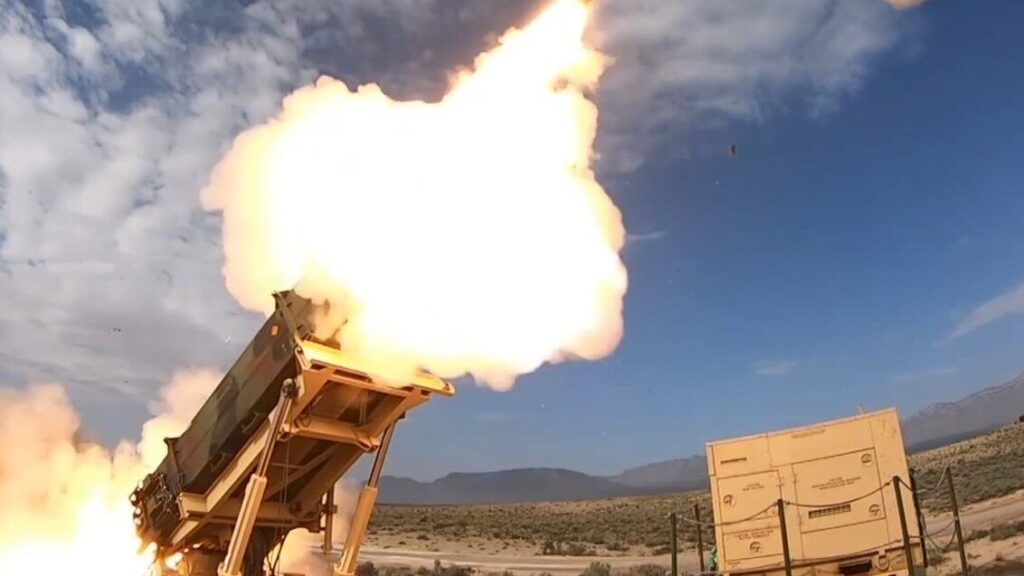
WASHINGTON — The Pentagon and Boeing have signed off on a framework agreement to triple seeker production for the PAC-3 interceptor over the next seven years, they announced today.
The deal comes as the Defense Department pushes to replenish its munitions stockpiles and follows more than half a dozen other multiyear weapons agreements announced since the start of the year, including a previous one with Lockheed Martin to increase production of the PAC-3 interceptor to 2,000 annually by 2030 and triple it in seven years.
The PAC-3 seeker, which Boeing delivers to Lockheed, has been a chokepoint for accelerating production of the interceptor in the past.
Pentagon acquisition czar Michael Duffey said in a statement that the department is forging contract agreements directly with critical suppliers, a departure from the typical practice of negotiating only with the prime contractor of a weapons system.
“To build a true Arsenal of Freedom, we must strengthen every link in the chain,” Duffey said. “This agreement with Boeing is a direct reflection that speed, volume, and a resilient supply chain are paramount.”
Today’s deal — the first such agreement for Boeing — will allow the company to “immediately” begin ramping up production ahead of a final contract anticipated later this year, Boeing said in a news release.
The framework deal “paves the way” for Boeing to make additional, “cash-neutral” investments to enable PAC-3 seeker production, the company stated. Boeing has already invested upwards of $200 million since 2024 on infrastructure meant to facilitate a production ramp up, including a new 35,000 square foot expansion at its factory in Huntsville, Ala.


Support for Patriot air-and-missile defense is a case study for the industrial base
Manufacturing scale, global sustainment, and next-gen tech are becoming inseparable.
“The administration’s Acquisition Transformation Strategy empowers industry to invest and accelerate the delivery of complex systems at scale and strengthen the Department’s Arsenal of Freedom,” said Steve Parker, president and CEO of Boeing Defense, Space & Security. “With this framework, we’ll be able to produce and deliver more advanced seekers and enhance our military’s advantage.”
The PAC-3 seeker deal was widely expected in the defense community following Boeing CEO Kelly Ortberg’s comments in a January earnings call that the company was in the midst of discussions with the Pentagon over a multiyear production deal.
Since the beginning of the year, the Defense Department has announced a series of multiyear munitions deals including:
- A seven-year deal with Lockheed Martin to triple PAC-3 production
- A seven-year deal with Lockheed to expand THAAD interceptor production from 96 to 400 missiles per year
- Agreements with RTX to boost production of five munitions, including the Tomahawk cruise missile, AMRAAM air-to-air missile and several variants of the Standard Missile family
- A deal with Lockheed to accelerate Precision Strike Missile (PrSM) production
- An agreement with BAE Systems to expand THAAD seeker production
- An agreement by Honeywell to invest $500 million into the production of “critical components” for munitions like navigation systems, actuators, and electronic warfare solutions.
To date, none of those framework agreements have been turned into finalized contacts.