
WASHINGTON — Dan Driscoll, the 26th secretary of the Army, has submitted his letter of resignation, after serving in his position for less than two years, two Army officials told Breaking Defense.
One of the officials said Driscoll tendered his resignation after speaking with President Donald Trump about the state of the Army. The official did not elaborate.
The news comes on the heels of multiple reports that the secretary would be exiting his role before the end of the year, possibly as soon as Labor Day. Driscoll’s departure comes amid months of a reported strained relationship with Defense Secretary Pete Hegseth.
A spokesperson for the Army declined to comment on the development, first reported by The Wall Street Journal, and referred Breaking Defense to the White House for comment. Anna Kelly, a White House spokesperson, praised the Army Secretary in a statement to Breaking Defense but did not directly address Driscoll’s status.
“Secretary Driscoll has been highly effective in advancing President Trump’s agenda to Make America Strong Again at the Department of the Army by providing outstanding leadership during historic military operations, restoring an emphasis on readiness and lethality, assisting with negotiations between Russia and Ukraine, and more,” Kelly said in the statement, also shared with The Journal. The United States Army is more powerful than ever thanks to his work alongside the Commander-in-Chief and Secretary of War.”
A spokesperson for the Pentagon also declined to comment and referred Breaking Defense to the Army.
It is not immediately clear who will replace Driscoll, however an Army official told Breaking Defense before Driscoll’s departure that “usually” the service’s undersecretary, held by Michael Obadal, would step into the role. Following reports on Driscoll and Hegseth’s tenuous working relationship, the Army official told Breaking Defense that Obadal and Hegseth “have a great working relationship.”

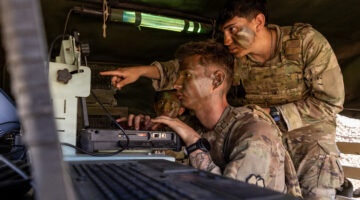
Island surge: the Army’s Next Generation Command and Control in action
Lightning Surge exercises are turning soldier feedback on NGC2 into operational software changes in days, not years.
However, Hegseth would be able to appoint whomever he wanted in an acting role, and would be under no obligation to put Obadal in, either as acting secretary or as the nominee for the full job. Notably, The Washington Post reported in April that Sean Parnell, the Pentagon’s chief spokesman, told colleagues he is interested in the job following the abrupt firing of the Army’s former Chief of Staff, Gen. Randy George.
Driscoll’s exit from his post as the top service civilian leader leaves the Army absent a Senate-confirmed leader, as the service’s Vice Chief of Staff, Gen. Christopher LaNeve, formerly Hegseth’s senior military aide, has yet to be nominated nor confirmed for the roll of Army chief. LaNeve is currently in the role in an acting capacity. According to The Wall Street Journal, in addition to expected Democratic opposition, LaNeve’s Senate confirmation is not fully supported by some Republican lawmakers, including Iowa Sen. Joni Ernst.
During his tenure as the Army’s secretary, Driscoll, who is close friends with Vice President JD Vance, formed a close working relationship with George as the two traveled to Ukraine together last year for ceasefire negotiations and to try to harness Ukraine’s lessons on drone warfare. As The Hill previously reported, this arrangement seemingly agitated Hegseth. Further, The Journal also reported Hegseth was unhappy with Driscoll after the Army secretary began arranging plans to have Vance and Trump meet soldiers and discuss further Army reform.
As secretary Driscoll leveraged his background in the private equity and venture capital worlds to introduce more commercial practices into the service and shake up the defense sector, even going as far as to calling it a “success” if a large prime contractor closes its doors in the coming years if they can’t start operating more efficiently.
In recent months Driscoll launched the Army’s low-cost interceptor program to produce scalable, affordable interceptors in an effort to end the days of relying solely on multimillion-dollar systems, mainly manufactured by large defense primes, to down drones costing a couple thousand dollars. He also created the Army’s FUZE program — a venture-capital-like acquisition model designed to speed up the private development of emerging technologies for later use by soldiers.
This is a developing story.