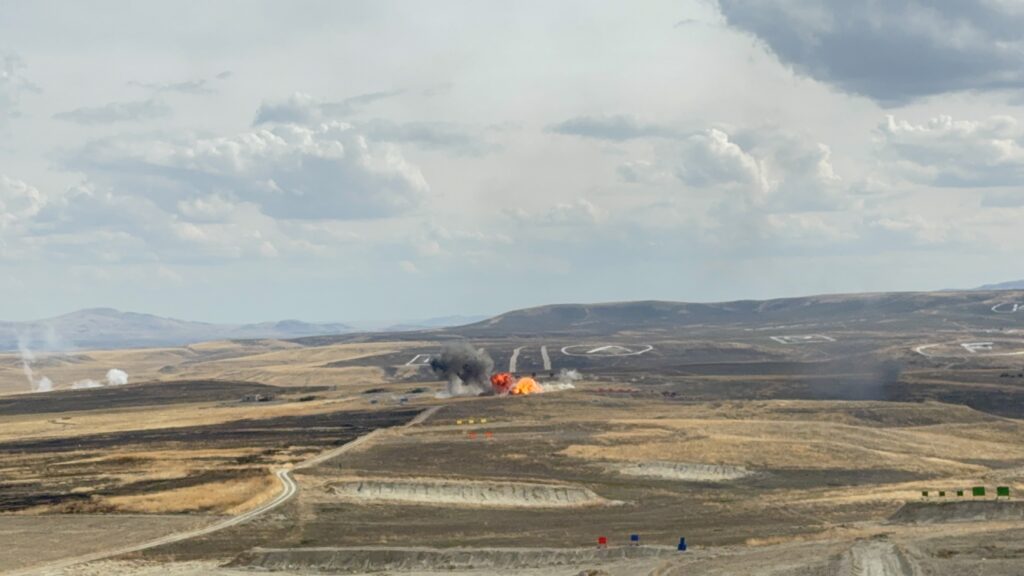
ANKARA — Turkish F-16 fighter jets flew overhead, dropping bombs perfectly aimed at targets below, the ground shaking as journalists and visitors alike watched on from a distance.
Drones buzzed around conducting missions while smoke plumes erupted from every direction as targets were hit. If it weren’t for the civilians walking around taking notes the scene could easily be mistaken for a battlefield. Instead, all of this took place at the Ateş Serbest exercise in Ankara earlier this month.
Translated as “Free Fire” in Turkish, the exercise, which took place at the General Nahit Şenoğul Firing and Exercise Area, showed off layered live-fire capabilities, air defense platforms, fighter jet strike capabilities and more. (Breaking Defense, like other outlets, accepted travel and accommodations from the Turkish Ministry of Defense to cover the event.)
The exercise aims to improve “coordination of fire support between forces,” to “introduce weapons and systems in the inventory and demonstrate the effect of the weapons on the target,” and “to provide deterrence” through the firepower, according to a brochure distributed to journalists by the Turkish Ministry of Defense.
At the forefront of the exercise were unmanned systems, many of which were also viewed in various stages of production by Breaking Defense during a series of industry visits to Aselsan, Turkish Aerospace, Asfat, MKE and Roketsan. In discussions during those visits, company officials across the board emphasized the importance of unmanned systems both for Turkey’s domestic use and as potential export items.
The highlight of the exercise may have been the Turkish military showing off a new drone for the first time: Turkish Aerospace Industries’ Ayaz, a turbojet-powered one-way attack unmanned aerial vehicle.
Breaking Defense saw a nearly completed Ayaz drone on the assembly line. On that same tour, the company also showed off its Super Simsek UAV on the assembly line. The exercise marked the first time the Super Simsek flew with a warhead after its maiden voyage in 2023.


MQ-9B and Gambit Series: Advancing European Defense Capabilities
GA-ASI will build Gambit aircraft in Europe, partnered with European-based companies, with airframes available for international procurement starting in 2027.
Both the Ayaz and the Super Simsek “successfully conducted dive attacks and struck their targets during the Atış Serbest exercise, marking their first use with live warheads,” a company official told Breaking Defense during the tour.
Another highlight was watching as 20 Kargu one-way attack drones from STM hit their targets simultaneously. The drones, which flew in swarms, shared real-time data with each other and the operator, and when they got closer to the enemy infantry, the platforms were divided into two categories and headed towards their targets.
The unmanned systems aren’t just used for attacking. On the far right side of the exercise, a Puhu UAV, which is produced by DASAL Aviation and Space Technologies, was seen carrying medical aid to help snipers injured in the simulated battlefield. A Palem unmanned ground vehicle provided medical evacuations as well.
Throughout the exercise, soldiers used artificial intelligence to control the unmanned systems as well as conduct intelligence, surveillance and reconnaissance missions. For example, battlefield information collected from ISR drones was gathered at the Mobile Command System to help soldiers decide whether to strike or not.
As drones become a more prominent part of the warfield, countries have been giving more attention to developing counter-drone systems — and Turkey is no exception. Drones were used heavily in the recent war between Iran, US and Israel where Shahed UAVs were used extensively by Iran to strike neighboring Gulf states. The US also used one-way attack drones similar to the Shahed, dubbed the Low-Cost Unmanned Combat Attack System, to attack targets in Iran. Further, it used unmanned surface vessels to monitor the Gulf seas and to attack Iranian ports.
Other scenarios carried out during the exercise included Atak helicopters flying overhead, releasing flares and firing Cirit and UMTAS missiles.
Factory Tours
The industrial tours did not result in any new revelations of technology about to break through, but taken as a whole, gave the sense that Turkey’s defense companies are trying to meet the global demand, both domestically and for export. Here are a few notes:
- At Roketsan’s factory, Cirit and UMTAS missiles were shown moving through the assembly line, starting from small parts and finishing as completed missiles. There were also models of the company’s other weapons on display. A company official told Breaking Defense that the latest conflicts in the Middle East and Ukraine have led to doubling production of missiles, on average, although they did not provide more detailed numbers.
- Counter-drone systems seem a priority for a number of companies. At the exercise, Aselsan’s Ejderha microwave platforms and Gokberk laser systems could be seen shooting down drones. Additionally, MKE’s Tolga. which is a short-range air defense system, could be seen striking targets, with drones falling out of the sky leaving a black trail in their wake.
- At Aselsan’s factory, Breaking Defense saw the Gokberk system sitting completed in the final assembly line, looking as if it was ready to be delivered to a customer. However, no comment was made about what the customer may be. The factory also had air defense systems in two colors — a dark green camouflage, and a yellow camouflage, the latter of which company officials said were for unspecified Middle East customers.
- The tour also included a visit to ASFAT, a Turkish state-owned defense contractor. The firm operates twenty seven military factories and ten naval shipyards across Turkey. Company officials said that the firm has started building the first TF200 guided missile destroyer, Turkey’s ambitious air defense destroyer project.
- At the tour of ASFAT, helicopters from different origins at different stages of refurbishment and MRO could be seen. That meant an unusual sight: Russian built MI-17 helicopters used by the Janderma (armed general law enforcement organization) were sitting next to US-built Sikorsky S-70 and French Cougar H215 helicopters, used by the military.
- As Breaking Defense previously reported, TAI has completed a second production line of its Anka 3 unmanned vehicle.
Breaking Defense Video