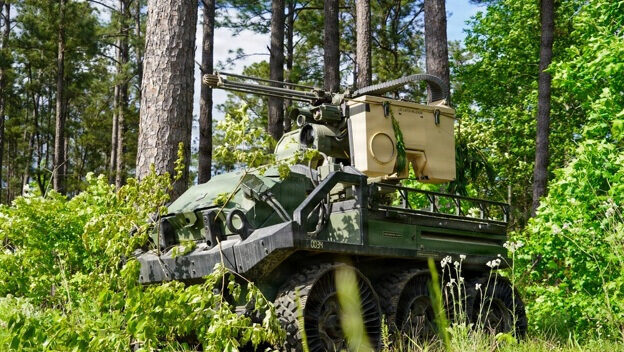
WASHINGTON — The Army’s goal of scaling unmanned ground vehicles is being sabotaged by the service’s inability to provide clear, coherent demand signal to industry, according to the head of the National Advanced Mobility Consortium (NAMC), a nonprofit organization bridging the Pentagon and industry for ground drone projects.
“I think [industry has] the challenge of understanding what the demand signal is, and then again where to put their dollars. We do talk a lot about these capabilities that the Army has asked for, but they [industry] want to know what’s next,” Warren Sponsler, NAMC’s CEO, said in a recent interview.
“[Industry is] trying to align themselves to what’s next. I think that’s probably one of the biggest challenges — just being able to produce at scale.”
Oftentimes companies order parts and put stress on their supply chains before the Army has settled on a contract mechanism or specific capability, Sponsler said. The commitment from industry is there, but the commitment from the Army, or any service for that matter, is not distinct, Sponsler said, which can be rather discouraging for companies.
READ MORE: Is the Pentagon’s demand signal for drones working? It depends on who you ask.
“Following through on those programs, I think it is critical to maintain that relationship between government and industry,” Sponsler said.
Exercises also sometimes send a murky demand signal, Sponsler said. While the Army has invited industry to demonstrate ground autonomy platforms at several events, the sheer amount of opportunities and unclear mission objectives leave companies unsure where to invest their time and money.
“I think it’s kind of the opposite challenge in many cases,” Sponsler said when asked if he thinks there are enough Army exercises for industry to demo their platforms. “There are so many opportunities right now, and then companies, especially those small companies, are having to make often hard decisions as to which experiments they participate in, and which ones they choose not to.”

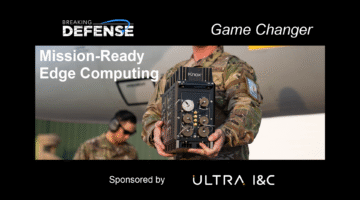
Processor upgrades enable computing at the edge
Avoiding vendor lock and providing more room for sensors and upgrades are critical considerations.
He added that “focusing some of the demonstration experimentation activities would be a help” to provide a clear demand signal.
“There’s a lot of opportunities right now that the Army talks about for robotics and autonomy companies to get their stuff out in the field, get user feedback, and I think what [industry] is looking for is, ‘What is that path to scaling? Like, where is that path to revenue?’
“The more that they can describe what capabilities they’re actually looking to field and put together, the better,” he said.
Programs Of Record
Sponsler said the Army’s venture capital acquisition hub, FUZE, has provided a strong example through its xTech competitions for how the service should focus its demonstrations on certain capabilities. For example, xTech has held demonstrations, which are a part of larger competitions that will result in contract awards, for autonomous logistics and sustainment projects and for autonomous breaching. The path to revenue is clear in such cases as companies know they could be the winner of an eventual contract.
Sponsler said he urges companies, especially the nontraditionals, to enter such competitions, but he also urges them pay close attention to the Army’s programs of record for ground autonomy as they are the most indicative of how the Army plans to spend its money. The challenge there: the Army’s programs of record for ground autonomy have also fallen prey to the same lack of clarity as its outreach to industry.
For example, within roughly 18 months, the Army altered its UxS program of record and transformed the former Robotic Combat Vehicle program into the Unmanned Ground Commercial Robotic Vehicle program but then dispersed that program into Project Sustainment and the Engineer Autonomous Breaching Capability program.
The service also relocated its acquisition office for autonomy then stood up a separate Portfolio Acquisition Executive for autonomy and redesignated its Futures and Concepts Command as the new Army Futures and Autonomous Systems Command (FASCOM), which will work in coordination with the Pentagon’s newly established Autonomous Warfare Command (AUTOWARCOM).
The good news, Sponsler said, is that he believes the new AUTOWARCOM, which has yet to be formally established since it requires Congressional approval, and FASCOM will allow the Army and the Pentagon’s autonomy efforts to be better streamlined.
He said the new organizations will help in “providing additional focus to robotics and autonomy integration at the formation level, looking beyond a product and more to a capability,” Sponsler said.
“[It] should also help to align resources and leadership to best prioritize based on the services’ needs. As the Army operates in multiple domains — ground, air, sea — having a [DoD]-level organization with a vision across services should help to mitigate duplicative efforts and better align resources,” he added.
Breaking Defense Video