WASHINGTON — Following the Army’s sprawling acquisition overhaul in the fall, the service is once again reworking some of its weapons portfolios after a brief trial period that revealed some programs should be kept separate and others should report to new bosses, a service spokesperson told Breaking Defense today.
“Acquisition reform is, and always will be, an iterative process. Over the past six months, we’ve adjusted this approach,” Ashley John, top spokesperson for the acquisition reforms spearheaded by the Assistant Secretary of the Army for Acquisition, Logistics and Technology, told Breaking Defense today.
John added that through all the acquisition reorganizations, and for those still to come, the Army’s approach is to “keep what is working and change what is not.”
The changes shared with Breaking Defense today come after the service’s major acquisition reorganization in November that consolidated the original 12 Program Executive Offices (PEOs), now called Capability Program Executives (CPEs), under six Program Acquisition Executives (PAEs), and called for a reduction on the number of general officers at the top rank, establishing an entirely new reporting structure up the chain.
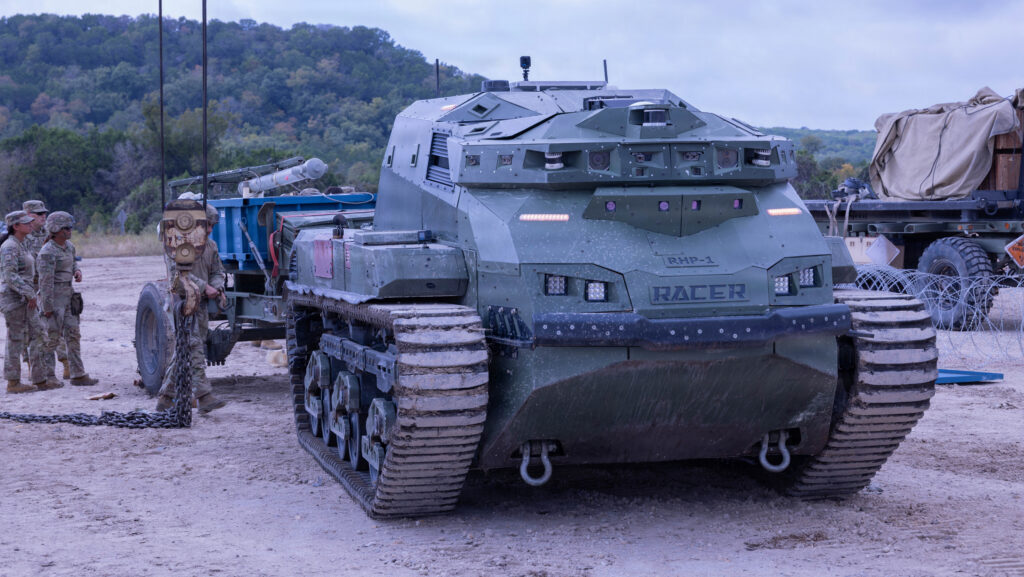
Among the most recent changes is a realignment of the Army’s autonomy acquisition office, also known as the CPE Mission Autonomy. According to John, the CPE, which was newly established under the overhaul in November, has been moved from PAE Maneuver Air to PAE Layered Protection and Integration.
Inside Defense first reported on the autonomy’s office realignment today.
Though John did not say exactly why the service decided to move the office, she said the decision “better nest[s] cross-disciplinary functions across all PAEs.” She added that the decision was made in May, meaning it was not a result of the Defense Department’s recent decision to stand up a new Direct Reporting Portfolio Manager (DRPM) for autonomy, which will serve as “the single joint integrator for all unmanned and autonomous system programs” within the Pentagon, per the memo establishing the DRPM.
From requirement-driven to market-ready: Rethinking how defense technology reaches the warfighter
As threats continue to evolve, speed will increasingly depend on what is already available when the need emerges.
Further, John said that in early May, the Army established CPE Special Programs Air, which is to be integrated into PAE Maneuver Air. The new CPE is aimed at “aligning Special Operations Aviation with conventional Army programs,” she said.
John said the Army also made the “strategic decision” to keep CPE Ground Combat Platforms and CPE Soldier Systems separated under PAE Maneuver rather than combine them into one office, CPE Ground, as the November acquisition overhaul intended. The decision “preserv[es] the intended efficiencies of acquisition reform,” John said, noting that the portfolios were previously their own PEOs as well.
Another change made in May was the establishment of the Enterprise Software and Services, or ES2, which was formerly PEO Enterprise. The original plan in November was to align PEO Enterprise with the Army’s Chief Information Officer. However, John said today that ES2 will serve as a “critical enabler” to the Army akin to the service’s Pathway for Innovation and Technology (PIT), which works alongside the six PAEs.
The PIT was often referred to as the “plus one” in the Army’s new acquisition structure because it was created to work alongside the other PAEs to speed up innovation by getting technology deployed to units faster through completions, industry embeds and more. With the establishment of ES2, John said there is now a “plus two” construct. She added that ES2 is responsible for “managing the digital backbone that underpins everything we do.”
During the November overhaul, one Army official described it to Breaking Defense as an effort driven by senior leaders’ desire to force offices to coordinate better and save money. Separately, another official, Lt. Col. Charlie Dietz, who was working in the Army undersecretary’s office at the time, said the goal is to streamline the bureaucracy between different offices that don’t always communicate well.
“Too often they are pointing at each other, ‘Like, well, we’re waiting on them.’ ‘[No,] we’re waiting on them right now,’” Dietz explained at the time. “Hey, you guys are all together now, so you can’t blame each other. We’re going to make this quicker. We’re going to give you less paperwork. … And, this is supposed to save money.”
Breaking Defense Video