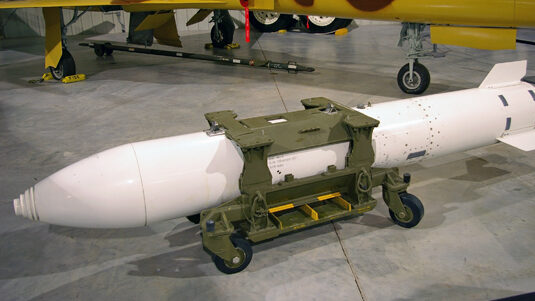
WASHINGTON — A draft spending bill released by the Senate Appropriations Committee last week revealed a new nuclear bomb designation known as the B94, which experts believe could be capable of penetrating deep into the earth before detonating.
The B94 was first spotted by experts online, who identified the designation buried in a fiscal 2027 spending plan for the Department of Energy. The DOE includes the National Nuclear Security Administration (NNSA), a semi-autonomous agency that oversees the production and safety of nuclear weapons.
Explanatory text for the draft bill published by the committee [PDF] shows roughly $77 million budgeted for the B94, after no money was allocated for the program in FY26. The B94 is listed under “stockpile modernization” alongside other ongoing nuclear weapons programs such as the W87-1 warhead that officials plan to mount atop the forthcoming LGM-35A Sentinel ballistic missile.
The Senate document does not explain the novel weapon name, though arms control expert Jeffrey Lewis opined on X that the B94 is likely a fresh designation for the air-launched Nuclear Delivery System (NDS-A) program previously identified in budget documents. The B94, Lewis said, “appears to be a replacement” for the B83-1 thermonuclear gravity bomb that the Biden administration moved to retire.
Representatives for Senate Appropriations Committee Chair Susan Collins, committee Vice Chair Patty Murray and the NNSA did not respond by press time to requests for comment.
James Acton, co-director of the Nuclear Policy Program at the Carnegie Endowment for International Peace, told Breaking Defense the B94 is “clearly a new capability” that appears to be an air-delivered gravity bomb capable of destroying deeply buried targets. If that is the case, Acton agreed the weapon would likely serve as a replacement for the B83.
“Effectively, what this capability would be doing would be increasing somewhat the number of targets that could be destroyed,” Acton said, reasoning that several subterranean targets are currently out of reach by American weapons.


Rethinking defense innovation
How a product-driven approach can accelerate technology delivery and get proven capabilities to warfighters faster.
But Acton, for his part, questioned the weapon’s expected efficacy, drawing from a National Academies report published in 2005 to argue that “once targets are below about 700 meters in depth, they’re simply not destroyable with reliability by any kind of penetrator” — though he noted that penetrating technologies have likely improved in the decades since. He stated that a higher blast yield generally helps reach more deeply buried targets, but it’s not currently clear what kind of yield the B94 may boast.
Additionally, he criticized the vacuum of information around the B94, reasoning that a new nuclear weapon deserves transparency and explanation of a larger strategy similar to what’s been promulgated by previous administrations.
“One could go on forever identifying new missions for nuclear weapons and inventing new requirements, and I view that as an essentially endless process, if not guided by some kind of broader strategy,” he said. He then raised doubts about the B94’s justification, since “there’s just going to be too many targets” it won’t be able to reach.
“I think we’re witnessing both qualitative and quantitative arms racing, and I think if the administration wants to make the case for this weapon, it should give us a clear strategy and allow us and give us enough information to really debate this capability,” he said.
Breaking Defense Video