WASHINGTON — Earlier this month, drones flew over a military base in Santa Rosa del Sur, in Colombia’s Bolívar department, dropping explosives that killed three soldiers when detonated.
Just days before that in October, the Colombian military said a vessel assigned to Riverine Marine Battalion No. 42 was attacked in the Guapi River in a similar fashion, killing one Marine and injuring four others.
In September, a civilian radar in the Valle del Cauca region was damaged after what appeared to be an explosive-laden drone reportedly collided with it.
And a new attack occurred just this Saturday evening: the headquarters of a battalion in La Jagua de Ibirico, César department, were attacked with drones and explosives. One soldier died and at least 12 were wounded.
The incidents, analysts say, are the latest examples of militant groups operating drones in ways that mirror battlefield uses — leaving local governments to race to catch up with the technology needed to defend against them. And Colombia appears to be ground zero for what could emerged as a new wave of conflict against rebels and narco groups in South and Central America.
The explosive-carrying drones are “inexpensive, easy to acquire and useful for monitoring security forces and protecting illicit operations,” Rebecca Bill Chavez, former US deputy assistant secretary for defense for Western Hemisphere Affairs, told Breaking Defense.
Use of small drones by militant and drug-trafficking groups isn’t new, but Chavez, the president of the Inter American Dialogue, said a growing problem is that the groups “have gone from using drones to monitor troop movements to launching coordinated attacks with multiple drones,” including unmanned systems using fiber-optic guidance systems.

Missiles and radar need more than demand – they need manufacturing capacity
Expanding manufacturing capacity is critical to producing missiles, radars, and launch systems.
Colombia has emerged as the flash point since August, when a new government led by President Abelardo de la Espriella promised a “mano dura” — or strong hand — approach to countering cartel and other armed groups. The Colombian armed forces have carried out several major operations, including air strikes, against historic rebel groups like the ELN and FARC, as well as drug cartels like the Clan del Golfo, and other non-state criminal networks. (Each of the named groups have been declared a terrorist organization by the US State Department.)
In response, during just the first 100 days of de la Espriella’s term, Colombia has suffered at least 93 attacks that involved drones, according to country’s news agency Caracol Radio. Of the 26 Army personnel killed during these 100 days, “at least 11” were killed due to drone-dropped explosives. (Colombian insurgents generally do not take responsibility for drone attacks, with the government usually assigning blame.)
On Nov. 8, the Ministry of Defense announced the seizure of a weapons cache, property of the Clan del Golfo, which included one drone and 35 grenades “conditioned to be dropped by this [uncrewed] aircraft,” suggesting that local insurgent groups are still investing in these weapons.
“There is no conventional drone warfare in Colombia,” a Colombian former army colonel told Breaking Defense on the condition of anonymity. “Rather, there are sporadic attacks against units in frontline areas which have no c-UAS [counter-unmanned aerial systems] protection.”
Counter Options
The surge in drone threats is likely to lead to greater investment in counter-drone systems.
The previous president, Gustavo Petro, announced Bogotá would create an “anti-drone shield” that would include fixed, mobile and man-portable counter-drone systems. But Colombia’s new defense minister, Jorge Eduardo Mora, said the effort hadn’t amounted to much by the time the new administration came in.
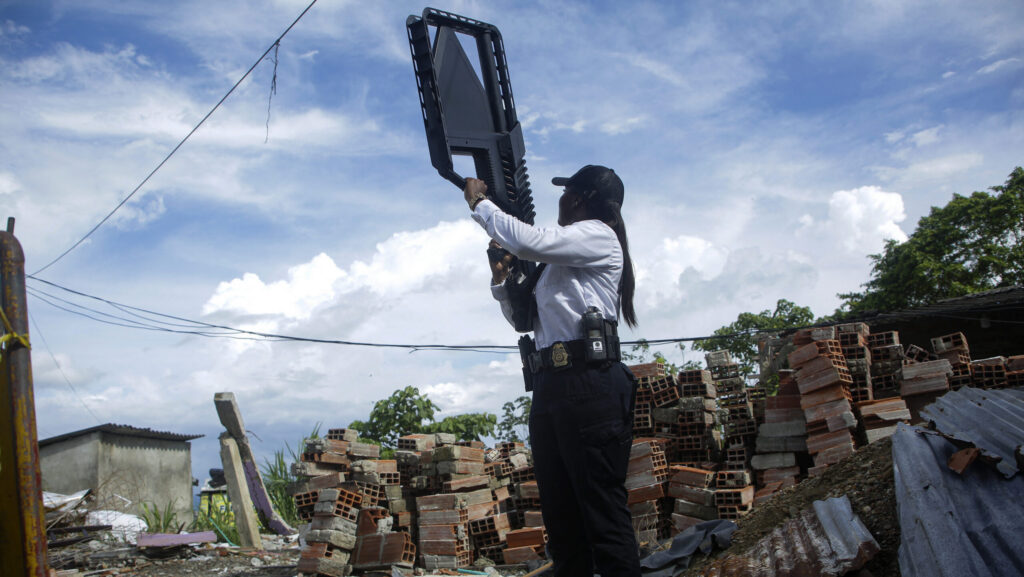
The Colombian armed forces do operate some counter-UAS systems. The Defense Ministry released photos of soldiers with jamming rifles on Nov. 8, stating that troops in the Chocó department had neutralized a drone to prevent “grenades from being dropped on soldiers.”
However, more systems are needed. The retired colonel explained to Breaking Defense that the armed forces require “air defense systems specifically for drone threats, both mobile and fixed.” Chavez agreed, saying “investing in counter-drone defenses is essential to protect soldiers, police, and civilians.”
One potential remedy, according to Henry Ziemer of the Americas Program at the Center for Strategic and International Studies, would be for Colombia to join the US-run drone and counter-drone marketplace, as Argentina, Mexico and Panama have reportedly done. In August, the US military sent out the first “tranche” of invitations to “selected international partners” with a second tranche to follow.
But relations between Washington and Bogotá may have become more complicated this month after The New York Times reported that de la Espriella had rebuffed an American offer of joint counter-drug operations — though de la Espriella denied the report. On Friday, US Defense Secretary Pete Hegseth wrapped up a Central and South American tour, praising the closeness of US and Colombian militaries.
Still, getting help with counter-drone capabilities from the US or elsewhere and training up Colombian soldiers is only “part of the answer,” Chavez said.
“Without stronger intelligence and investigative capabilities, governments will keep responding to attacks without stopping the criminal organizations behind them,” she said.
“Who is supplying and modifying these drones? Who is training the operators?” she asked. “The goal should be to dismantle those networks, not just shoot down drones once they’re airborne.”
The retired Colombian colonel, a Lancero, said he agreed. The Ministry of Defense and other agencies “need to strengthen intelligence operations to locate where the narco-insurgents’ drone bases are,” he said.
And it’s not just Colombia. So far, drones carrying lethal explosives have also been used in attacks in Brazil and Mexico. Ziemer is pessimistic about the future.
“As knowledge of drone tactics proliferates faster than governments deploy countermeasures, it seems likely we will begin to see them crop up in more countries in the region.”
Breaking Defense Video