WASHINGTON ― The Space Force has approved California-based startups Impulse Space and Relativity Federal to join the pool of competitors for launching less critical, less complex national security payloads, Space Systems Command (SSC) announced today.
The two additions to SSC’s National Security Space Launch Phase 3 Lane 1 program bring the total number of qualified launch providers to seven ― joining Rocket Lab and Stoke Space, which were tapped last March, as well as Blue Origin, SpaceX and United Launch Alliance (ULA), which were added to the pool of competitors in June 2024 [PDF].
Lane 1 involves launches to easier-to-reach orbits, payloads with less mass, and missions that are not absolute must-gos, such as the Space Development Agency’s data transport and missile tracking satellites, and those used by the Space Force Test Program.
The expansion of the Lane 1 program comes at a time when the US launch market is being roiled by SpaceX’s move to cut off orders of commercial rideshares on its workhorse Falcon 9 rocket starting in late 2028, according to a report by Space News. Falcon 9 went up 165 times in 2025, accounting for about 85 percent of all US launches — both government and commercial — and is approved to fly both NSSL Phase 3 Lane 1 missions and NSSL Phase 3 Lane 2 missions that carry must-succeed, high-value national security spacecraft.
The Space Force’s continued expansion of Lane 1 likely has several drivers, according to Todd Harrison, senior fellow at the American Enterprise Institute.
Those factors include the service’s “desire to take advantage of new launch capabilities as they come online; a wariness about over dependence on SpaceX in general; and a concern that SpaceX seems to be pivoting away from its traditional launch business by retiring the Falcon 9 and moving on to Starship and AI data centers,” Harrison said. “Each of these factors would point toward expanding Lane 1 as prudent risk mitigation.”
NSSL Phase 3 Lane 1 is funded via an indefinite delivery, indefinite quantity contract vehicle worth $5.6 billion through 2030. Like earlier inductees, Impulse Space and Relativity Federal — the government sales arm of Relativity Space — have been granted a first award of $5 million each “to conduct an initial capabilities assessment and develop their approach to tailored mission assurance,” the SSC press release said.
Building logistics networks for contested environments
Explore how software, edge AI and resilient connectivity can strengthen military logistics in contested environments. Join Breaking Defense on Oct. 21 and earn 1 CPE credit.
“Tailored mission assurance” is a process designed to allow the Space Force to assess each Lane 1 company’s capabilities and “the associated risks to the mission,” the release explained.
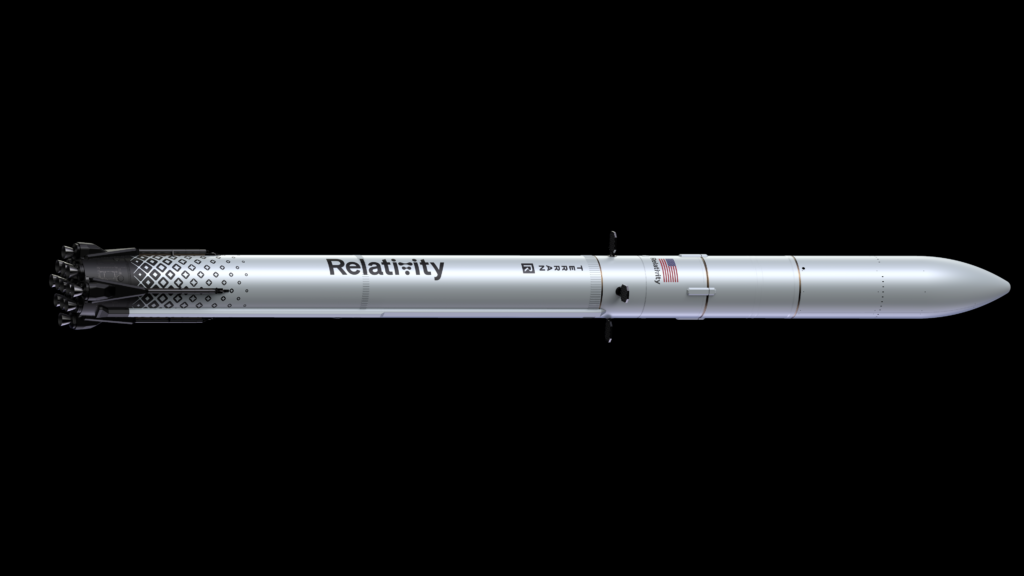
Relativity expects a first launch of its Terran R reusable rocket later this year.
Impulse is developing a kick-stage — the specialized upper stage of a rocket that offers a final “kick” or boost to payloads — called Helios that is designed to attach to any medium-lift rocket to boost payloads from low Earth orbit to higher orbits more quickly than traditional electric propulsion systems. Impulse plans to fly the first Helios mission on a Falcon 9 at the end of this year.
In a press release today, Impulse said the award marks the first time an “upper-stage provider” has been chosen to “serve as a prime” under the NSSL program.
Eric Romo, Impulse president and chief operating officer, explained that Helios will be paired “with a standard medium-lift launch vehicle” to offer “a more operationally flexible and cost-effective path to high-energy orbits than other solutions.”
Breaking Defense Video