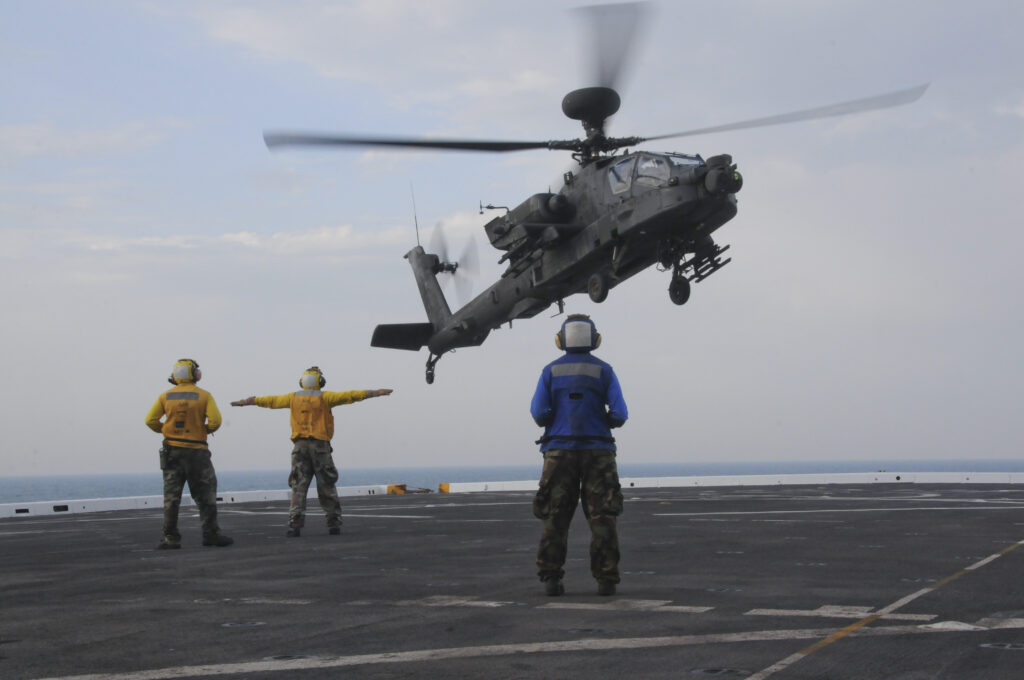
A National Guard AH-64 Apache lands on a Navy ship — a rare skill in the Army. But the Pentagon’s budget plans would move all Guard Apaches to active-duty units.
The Deployability Debate: ‘A Tremendous Desire For More Apache Helicopters’
What drives the Army’s calculations is not the number of Apaches they might need to send to a major war: It’s the number of Apaches they need to keep deployed all the time.
“We have combatant commanders” — the military’s regional chiefs — “who have a tremendous desire for more Apache helicopters,” Carson told me. “What the combatant commanders tell us is they need a certain number of attack helicopters, they need them in certain configurations, they need them teamed with unmanned sensors [i.e. drones]. Trying to satisfy their demands, which is after all is our fundamental job here as a [US Code] Title X Army, is extremely difficult to do.”
“We have to get more deployable time out of the ones we’ve got,” Carson continued, “[so] we have to have those Apaches in the active component.”
“Certainly having combat power in the Guard is absolutely critical,” said Brig. Gen. Lundy. “If we had more brigades and more money and more time, would we do that? Absolutely. But we’ve got to go down to 20 [Apache] battalions and we’ve got a steady state requirement for 20 battalions just in the active component.”
After years of wartime buildup, the Army now has 35 battalion-sized units of armed helicopters, both attack battalions (Apaches) and cavalry squadrons (currently Kiowas). Under the planned cuts, “we’re only going to have twenty in the entire Army,” active, Guard, and Reserve combined, said Lundy. “Right now we’ve got nine committed, and that’s not just in combat in [Afghanistan].”

Why Bigger Fences Aren’t Enough in the Age of Drones
Traditional thinking about how to protect facilities must adapt to new threats such as drones or downstream attacks.
If that level of activity continues after the drawdown in Afghanistan — which Carson and Lundy think it will; witness the recent deployment of Apaches to Iraq — then it puts an ever-harder burden on a smaller force.
Nine units deployed out of 35 total is manageable: Each battalion can average almost four months at home for every month deployed. Naturally, Guard troops would get more “dwell time” between missions, because they have civilian jobs to go to, and regulars would get less, since they’re full-time soldiers. But nine deployed out of 20 is nearly 50:50: Each battalion would spend almost as much time deployed as it did at home. That’s painful enough for regulars, as the past decade has shown. For Guard units, it would be unbearable.
Under current Defense Department policies, said Lundy, a Guard unit can deploy only one-third as often as a regular one. By this math, it would take 60 Guard battalions to provide the same steady-state presence abroad as 20 active battalions. Of course, the Pentagon could simply change those policies. But there limits. If Guard soldiers spend as much time deployed as regulars do, they might as well not be in the Guard anymore: They’d effectively become active-duty troops with inferior pay and benefits — and some very unhappy civilian employers.
Similarly, though the Pentagon can fund more or fewer training days, if Guard troops spent as much time training as their active-duty counterparts, they’d have no time for their civilian jobs. Army leaders argue Guard training time was adequate for most missions in Afghanistan and Iraq, but not for the most tactically complex tasks involving many aircraft supporting a large ground operation, which they believe will be the norm in future wars.
Guard advocates, of course, aren’t buying the Army’s assumptions. Guard soldiers may train fewer days, but they’re also often older and more experienced than their active-duty counterparts, so arguably they need less time. Especially in the Guard Apache community, “the pilots have flown that aircraft for years and years,” Goheen said. “You’re talking about taking aircraft away from the most experienced pilots and maintainers in the total Army….You’re just squandering the expertise resident in the National Guard.”
Goheen is also skeptical that deployments won’t drop significantly after the drawdown in Afghanistan. “I think what’s in order is really more discussion about this demand” from the combatant commanders, he said. “We all read that some Apaches are going to be in reserve over in Iraq; that could’ve been a Guard unit.”
In the end, the question goes beyond calculations of training days, cost-effectiveness, and force size to something fundamental: What is the National Guard for?
Breaking Defense Video