The Fairness Debate: ‘Here’s What’s Painful’
But doesn’t losing all their combat helicopters — both Apaches and Kiowas — make the Army’s chosen solution disproportionately painful for the National Guard? That’s the question I had asked Brig. Gen. Michael Lundy, commander of the Army’s aviation center at Fort Rucker, just the day before I met with Under Sec. Carson.
“Here’s what’s painful,” Lundy said, interrupting. “If we want to talk about what’s painful, it’s painful for Army aviation [as a whole]. We’re losing ten thousand soldiers out of our branch.”
Yes, Lundy said, all the Guard’s AH-64 pilots and maintainers will have to retrain to operate other aircraft if they want to stay. But the same is true for everyone who works on OH-58D Kiowas, which are being retired from both active and reserve units. “I’m a 58D guy,” Lundy said. “That’s what I’ve flown all my life, so I can understand the emotion and passion, but emotion and passion mean very little when you look at what’s best for the nation.”
“Last week I notified nine captains, active-duty captains, that they had been selected…to leave the service,” Lundy said, visibly struggling with his own emotion and passion. “I can tell you all nine of them were great officers,” he added: After 13 years of war, with helicopters in high demand, the deadwood is long gone.
“Throughout all three compos” – i.e. the active, Guard, and reserve components of the aviation branch – “there are going to be some great people that are going to be handed their walking papers,” Lundy said. “That’s emotional, that certainly is.”

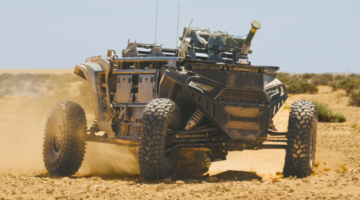
AGVs vs. UGVs: A new class of ground autonomy takes the field
One commander, many robots: Fully autonomous ground vehicles are reshaping the battlefield.
With three active-component aviation brigades disbanding, Lundy added, “The majority of the downsizing is coming out of the active component; about 23 percent of active Army aviation is going away, [compared to] only eight percent of the Guard. So the active component is taking a disproportionate cut, significantly disproportionate.”
Guard advocates have heard those figures before, however, and they’re distinctly unconvinced. Proportionately is beside the point, they say: What matters in the time of budget cuts is cost-effectiveness, and by that criterion you should cut the Guard as little as possible.
“We’re doing this to save money and the Guard is cheaper,” said John Goheen, spokesman for the powerful National Guard Association of the United States. “It just makes sense that you would cut the Guard less. [Instead], the active component is really trying too hard to consolidate all the Apaches in the active force, which will actually cost the nation more money.”
Yes, the equipment itself costs the same whoever has it: about $20 million to upgrade an Apache to the latest AH-64E standard, $600-$700 million to kit out an entire Apache battalion. But Guard personnel are paid part-time to train part-time – albeit much more often than in the bad old “weekend warrior” days” – so once equipped a Guard unit costs much less to keep up than its active-duty component, until you actually mobilize it.
So if you want to keep the largest possible number of Apaches and pilots in service at the lowest possible cost, ready to darken the enemy’s skies in time of war, then putting them in the Guard is the way to go. But that’s not what the Army is trying to do.
Breaking Defense Video