WASHINGTON — The Army today announced Anduril will lead its common data layer baseline for its Next Generation Command and Control (NGC2) effort, marking the first major contract award as the service moves beyond the prototype.
Anduril, with Palantir, will provide an edge-to-cloud data mesh via Anduril’s Lattice and Palantir’s Foundry, along with associated software deployment tools, the Army said. Anduril will also partner with tech and AI firm Raft for NGC2 data and services registries, data transformation tools, and data federation via the Raft Data Platform.
“This is a major step forward as NGC2 evolves into a phase of continuous delivery and we provide this capability at the speed of relevance,” Brig. Gen. Shane Taylor, the capability program executive for Command and Control Information Network, said. “We continue to encourage industry self-teaming and collaboration to adjust capabilities to commander priorities, operational needs and emerging technologies.”
No dollar amount was provided for the contract as it was awarded under an enterprise licensing agreement that the Army entered into with Anduril for a 10-year, $20 billion ceiling, officials said. That agreement provides the Army flexibility by consolidating other agreements under this singular vehicle, meaning the Army can pick and choose Anduril software and hardware to procure under this umbrella.
NGC2 is one of the Army’s top modernization priorities, updating how units share and pass data across the battlefield. The data layer Anduril has been selected to provide is one of four layers in the so-called NGC2 “full stack,” which also includes the transport layer, integration layer and application layer.
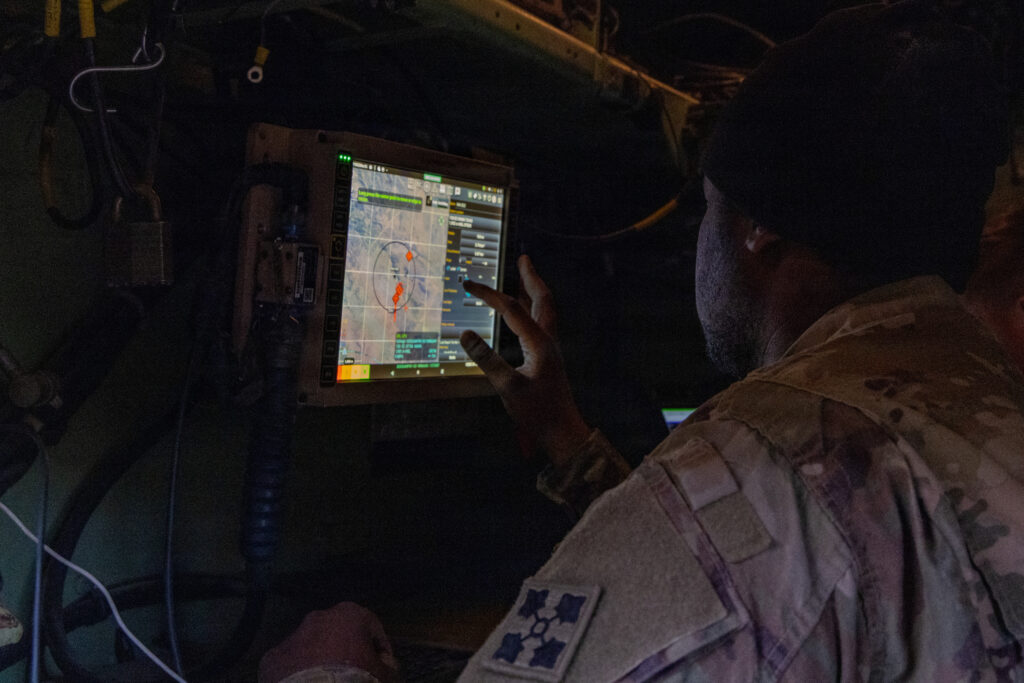
For the last year, Anduril as team lead, has been prototyping that full stack with 4th Infantry Division. The division just concluded the culmination of its incremental sprint series in May and will be going to Project Convergence in July as the last test.
These dual architectures will help the Army determine what mix of capability is needed for an architecture across the whole service, which has a combination of legacy and modernized kit.


How readiness stays ready: The F110 delivers power, reliability and scale for the F-15EX
GE Aerospace’s investments in the F110 are paying off in both production and delivery performance.
Following a series of sprints and events with both divisions, the Army plans to begin making a series of acquisition decisions to begin fielding the full NGC2 stack ecosystem across the Army.
Now, those architectures will converge under the new agreement.
In parallel, Lockheed Martin and a team of vendors have been prototyping a different data layer design with 25th Infantry Division. Unlike the 4th ID layer, which was built from scratch, the 25th ID layer was a modernized network baseline called C2 Fix. Despite Anduril’s win today, Lockheed will remain the lead for 25th ID’s full stack operational implementation, the Army said.
“Lockheed Martin continues to support the US Army’s 25th Infantry Division and the development of the Next Generation Command and Control (NGC2) ecosystem through the six‑series Lightning Surge exercises,” the company said in a statement. “The development of an integrated command and control (C2) ecosystem in close collaboration with industry partners – which has been proven to connect soldiers across the battlefield in contested and denied zones – remains our top focus. We look forward to continuing to showcase that with the remaining three Lightning Surge exercises this year.”
Officials have said the Army is focusing on I Corps to be the target formations next year as the service pivots to the Pacific. The service also plans to field all 11 divisions within a five year window. However, the secretary wants to go even faster than that.
“The biggest risk [to the Army Transformation Initiative] is not going fast enough. Next Gen C2, we think we will be in all the divisions, or we’re modeling it to be in all the divisions within five years. I don’t think that’s sufficient,” Dan Driscoll, told the Senate Armed Services Committee in May. “I think we need to do it two or three. It is just simply a spending pacing item at this point, because we know what we need to do.”
Breaking Defense Video