WASHINGTON — The Space Force has granted task orders worth a total of $615 million to develop satellites to detect fast-moving targets in the air to three companies: Rocket Lab, STR and a company whose name was not disclosed due to “operational security,” according to Space Systems Command (SSC).
The awards represent the second round of task orders under the service’s April-issued indefinite delivery/indefinite quantity (ID/IQ) Space-Based Airborne Moving Target Indicator (SB-AMTI) contract vehicle, SSC said in a press release Tuesday. The contract is being managed by SSC’s Space-Based Sensing and Targeting portfolio office.
The first task order, worth a whopping $4.6 billion, was awarded to SpaceX in May. The company also last week won a separate $1.6 billion Space Force contract to launch the future AMTI satellites.
“The core focus of this second task order is diversifying our capabilities and ensuring we don’t rely on a single technical solution,” Col. Ryan Frazier, acting Space Based Sensing and Targeting portfolio acquisition executive, said in the SSC release.
“With these new partnerships, we are exploring unique innovations and technologies and fundamentally different ways to accomplish the airborne moving target indication mission. Maturing these varied technical solutions now gives us distinct performance advantages for the future and guarantees we are fielding the absolute best technology available,” he added.
RELATED: With funding flush, Space Force hopes to speed satellites to track aircraft, missiles
SSC did not break out the individual awards. However, Rocket Lab in a Tuesday press release said the California-based company was awarded $397 million.

Addressing the ‘four tyrannies’ of the Pacific to keep logistics flowing
Predictive artificial intelligence and autonomy will reshape how forces are sustained across the Pacific.
“Under the contract, Rocket Lab will develop, launch, and operate multiple advanced Flatellites — a next-generation flat satellite design optimized for large constellations — with space-based sensors and low latency, high bandwidth communication links,” according to the release.
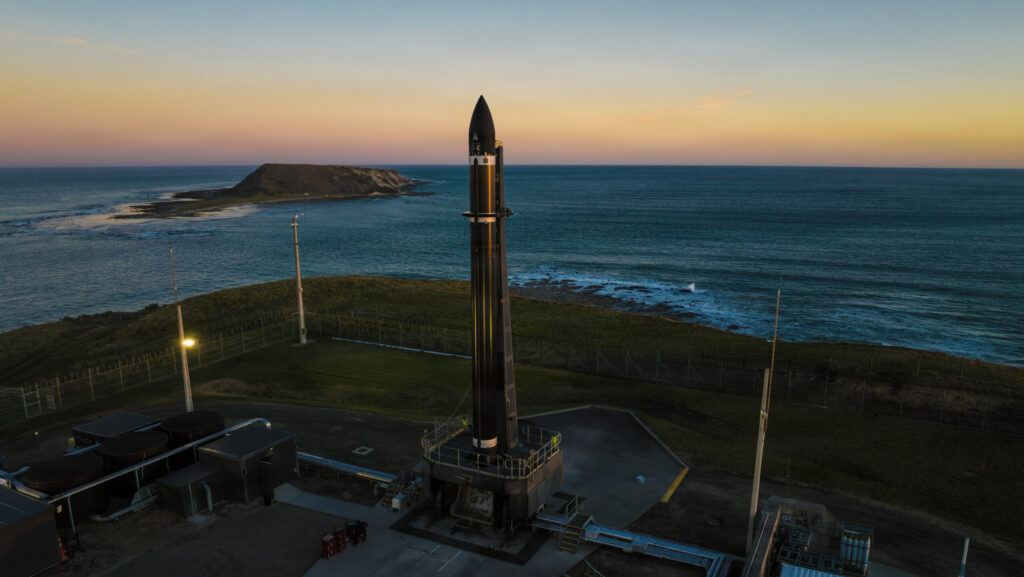
The satellites will be launched on the company’s new Neutron heavy-lift rocket, the release added, which is slated to lift off sometime between October and December from the Rocket Lab’s launch complex on Wallops Island, Va.
STR, based in Woburn, Mass., could not be reached for comment about its award.
Asked by Breaking Defense what criteria led to the decision to keep the remaining awardee’s identity under wraps, an SCC spokesperson responded by email:
“To help clarify, the decision to not disclose the identity of the third vendor is based strictly on operational security (OPSEC) protocols designed to protect sensitive mission profiles and capabilities. We carefully evaluate each award on a case-by-case basis to determine what information can be safely released publicly without compromising our operational advantages.
“All partners selected for these awards have met our rigorous security, technical, and operational requirements to support Space Force missions.”
The Pentagon has been increasingly citing the need for “operational security” to protect developing capabilities from falling into the hands of China and other adversaries as a rational for refusing to detail specifics about contracts — including information about companies involved and the values of awards that were routinely disclosed in the past.
This practice is partially enabled by the use of non-traditional contract vehicles such as ID/IQs and Other Transaction Authorities that do not come with the public reporting requirements embedded in the use of contracts under the Federal Acquisition Regulations (FAR). In addition, the 2025 National Defense Authorization Act included an exemption for “non-traditional defense contractors” waiving certain FAR-required cost and pricing requirements including some types of reporting, according to an analysis by Federal News Network.