WASHINGTON — Warfighting in space circa 2040 will be vastly more complex and dangerous than today, therefore the US joint force needs to begin now to develop both the capabilities and concepts of operation to succeed in that environment, according to a foundational assessment by US Space Command (SPACECOM).
The paper, titled Space Warfighting Environment 2040, is a “first-of-its-kind USSPACECOM document,” a SPACECOM official told Breaking Defense — the first of three that, when put together, are expected to offer a fulsome glimpse into how the only full military command dedicated to the stars sees the basics of the future extraterrestrial security landscape.
The document is “intended to establish a common understanding of the future space warfighting environment and provide the foundation for follow-on concept development, force development, experimentation, and planning,” the SPACECOM official, a member of the command’s Joint Forces Development and Training team, told Breaking Defense in an Aug. 11 email.
It identifies four key emerging challenges that will shape future space warfighting, according to a SPACECOM fact sheet:
- “the vulnerability of fixed terrestrial space-enabling infrastructure;
- proliferated dual-use [commercial/military] spacecraft that absorb and regenerate under attack;
- in-space servicing and maneuver that turn orbit into a dynamic network; and
- quantum developments that reshape trust, timing, and secure communication.”
The SPACECOM official, who spoke to Breaking Defense on the condition of anonymity, emphasized that the Space Warfighting Environment 2040’s focus on joint operations makes it unique for other sorts of futures documents previously released by the Pentagon and the Space Force.
The Joint Forces Development and Training team was responsible for helping craft the 37-page document, which was signed out by outgoing SPACECOM commander Gen. Stephen Whiting on July 27.

Power at the sprocket: it’s the transmission that gives tracked vehicles their control
Army vehicles like Bradley need greater power at the sprocket for speed, braking, and manueverability.
The official said the document is not meant to be “predictive,” but was “prompted by the reality that the space environment is changing faster” than current US strategy and warfighting approaches can account for.
At the same time, it was also an effort to help inform “senior leaders across the Joint Force — many of whom are not space professionals,” the official said. Those leaders have been looking to SPACECOM “to clearly articulate what future space warfighting may look like and assumptions should underpin future plans, concepts, capabilities, and force development,” the SPACECOM official.
Ultimately for SPACECOM, the goal of the document “is to provide an enduring framework that defines the future space warfighting environment from the perspective of the joint warfighter,” the official said.
The document sets out to characterize the battlefield conditions SPACECOM forces will face in 2040, including adversary threats, new technologies and evolving capabilities.
“By 2040, space will be more crowded, contested, and central to military operations. Innovation cycles that once took decades now occur within a single operational cycle, driven by commercial actors, allies, partners, and competitors,” the document says. “Advantage will belong to forces that can adapt, maneuver, and sustain trusted effects under pressure. Technology will evolve, but the warfighter’s needs will not: to see, connect, decide, and act with trust and tempo.”
In addition to the four emerging challenges, SPACECOM identifies nine “forces” that “will define the warfighter’s reality by 2040 and beyond,” presenting both risks and opportunities:
- Quantum developments that reshape trust, timing, and secure communication.
- Proliferated dual-use spacecraft that absorb and regenerate under attack.
- Advanced materials technology that will redefine stealth and deception.
- Direct-to-device connectivity that keeps the tactical edge connected.
- Optical and laser links that move data quietly and securely.
- Artificial intelligence (AI)-enabled networks that reroute and self-heal faster than adversaries can disrupt.
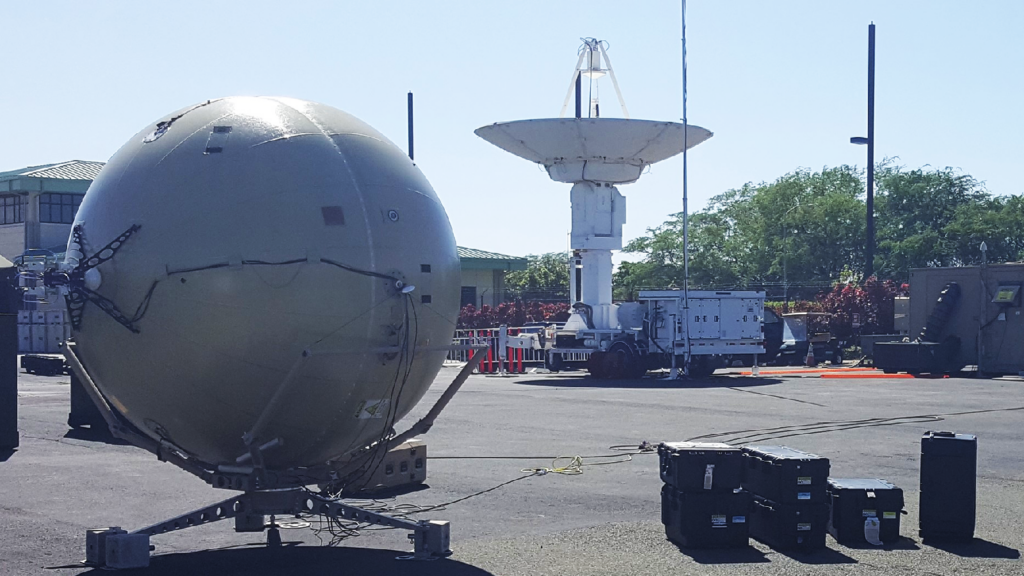
- Distributed, mobile, coalition-ready ground nodes that remove single points of failure.
- In-space servicing and maneuver that turn orbit into a dynamic network.
- Stewardship challenges—debris, traffic management, and norms that shape freedom of action.
Focus On Future Joint Warfighting, Not Kit
In his forward to the document, Whiting explained that The Space Warfighting Environment 2040 is the first in a “trilogy” of planned SPACECOM documents designed to frame “the future of space operations for the Joint Force.” The second document, called “The Space Futures Series,” will provide “issue-driven analysis” of “emerging challenges and problem sets.” The final document, “The Space Warfighting Concept,” will guide how the joint force and SPACECOM “fight and win in space.”
Thus, Space Warfighting Environment 2040 is the foundation that the other two documents in the trilogy will build on to fill a gap in current thinking about space war by concentrating on the how, rather than the what.
“Much of the existing work across the Department of War is focused on technical capabilities, systems, acquisition, or Service-specific requirements. The Space Warfighting Environment 2040 was deliberately written to be warfighter-first, not technology-first,” the SPACECOM official said.
“That distinction is important,” the official stressed.
Jessica West, long-time space policy analyst at Canada’s Project Ploughshares concurred that the document is centrally concerned with space warfare, rather than making a broader assessment of future national security challenges and opportunities as is typical for such assessments.
“This is a warfighting concept dressed as a futures document. It tells us less about what space will look like in 2040 than about how U.S. Space Command sees the world today: as an increasingly integrated battlespace encompassing commercial services, civilian infrastructure and cislunar space,” she told Breaking Defense in an email.
The document is clear about “how the United States might operate and prevail in a degraded and contested space environment,” she said. However, she fretted, it is not so clear about how the country might use its military space power to deter conflict or shape tomorrow’s environment to the betterment of civilians, industry or the wider global community who all depend on space.
“It is a vision of power with remarkably little account of the purpose that power is meant to serve,” West said.
Diverging (A Bit) With Space Force’s Vision Of The Future
The document’s focus on battlefield operations also accounts for SPACECOM’s slightly different take on future threats and needs articulated by the Space Force in a similar 2040-focused document, called “Future Operating Environment,” released by recently retired Chief of Space Operations Chance Saltzman in April. (SPACECOM is a US unified combatant command in charge of joint force operations above 100 km (62 miles) in altitude, comprising warfighters from all the military services. The Space Force is a military service responsible for organizing, training and equipping Guardians to serve under SPACECOM and the other 10 combatant commands.)
For example, the SPACECOM futures document highlights ground segment vulnerabilities as a key issue, something hardly mentioned by the Space Force version.
In addition, SPACECOM puts a spotlight on cislunar space as a domain of emerging military space competition, whereas the Space Force hasn’t voiced a strong interest beyond citing a need to monitor adversary activity in the vast volume of space between the Earth and the moon.
Different foci aside, the two futures documents “are complementary and look at the future environment from different but mutually supporting perspectives,” the SPACECOM official said. “The Space Force’s Future Operating Environment 2040 examines the changing character of warfare and what it may demand of the Service, while U.S. Space Command’s Space Warfighting Environment 2040 approaches that future from the perspective of the combatant command and the joint warfighter.”
One similarity between both the SPACECOM and Space Force future’s documents that is they assert the ascendency of artificial intelligence (AI) that will increase the speed of any conflict’s action-reaction cycle.
Both SPACECOM and the Space Force documents also attest to a need for “maneuverability” and “agility” for satellites on orbit in order to avoid attack and pursue adversary spacecraft, but also in how space operations are conducted.
John “Patsy” Klein, a nonresident fellow at the Atlantic Council, said that SPACECOM’s version is particularly interesting for its “novel contribution by discussing AI as part of mesh networks (kill-webs) and the need for sustained maneuver capability to improve resilience.”
Victoria Samson, chief director for space security and stability at the Secure World Foundation, said that the document’s broad focus on maneuverability, not just in space but also on the ground and in the electromagnetic spectrum, was particularly noteworthy.
“What really struck me was the focus on maneuverability/agility, and not just in regards to [on-orbit rendezvous and proximity operations],” but across the board in future SPACECOM operations, she said.
Further, the SPACECOM official said, the two documents at the “strategic level” are “strongly aligned” on the need to prepare now to ensure US success in the space warfighting domain.
To that end, Whiting’s staff “deliberately” coordinated Space Warfighting Environment 2040 with Space Force officials via the service’s component command to SPACECOM, as well as the component commands of all the other military services.
“The intent is therefore not to create competing visions of 2040, but to ensure that the Service’s future force development and the combatant command’s future warfighting requirements remain connected,” the SPACECOM official added.
Vulnerable Ground Infrastructure
Whiting told reporters at the annual Army Space and Missile Defense Symposium in Huntsville, Ala. on Aug. 12 that the SPACECOM futures document “talks to a lot of important facets and trends,” making it difficult to say what is the “most important.”
However, he said “one of the most important” is the need to address the vulnerabilities of US satellite ground infrastructure that is is based on fixed-site receivers and processing centers — whether linked to traditional small networks comprising a few large satellites or the new mega-constellations in low Earth orbit, also known as proliferated LEO (pLEO) constellations.
“[N]ot only are our satellites at risk, but our critical ground infrastructure is at risk, as we have seen now in the Middle East,” Whiting said. “And so anywhere we are reliant on fixed, centralized nodes, we need to really think through how are we making that as resilient as a pLEO constellation is resilient compared to the traditional constellations we have.”

The 2040 environment document elaborates: “Static ground nodes, once the norm, will become liabilities. They represent single points of failure that adversaries can attack through cyber intrusion, directed energy, precision fires, or sabotage. In a future where space effects must persist through the first strike, fixed infrastructure will be targeted early and often.”
SPACECOM’s concerns got a bit of a boost from the White House on Thursday, with a new executive order on space transportation signed by President Donald Trump. Citing the need to protect US launch facilities, the executive order charges the Pentagon and the Department of Homeland Security to come up with a plan within the next 180 days to “to secure” US infrastructure at federal launch sites like Vandenberg Space Force Base in California and Cape Canaveral Space Force Station in Florida.
At the same time, Whiting stressed during his Aug. 12 presentation that the US needs to develop weapon systems designed to take out adversary pLEO constellations in a conflict to ensure space superiority — a requirement that he placed as second on his “Integrated Priorities List” for fiscal 2029-2033. And attacking adversary ground systems is one way to do that.
Klein applauded SPACECOM’s recognition of the “importance of the ground and link segments” of space systems, as many strategy discussions tend to focus solely on the in-space segment. He also complemented the futures document’s stress on countering adversary “gray-zone operations.”
Cislunar: Challenging Assumptions, Expanding Views
The SPACECOM official said that one of the critical aspects driving the Space Warfighting Environment 2040 is that it is not designed to “provide all of the answers or prescribe exactly how the Joint Force will operate in every aspect of the 2040 environment.” Instead, the intention is “to challenge assumptions, expand how we think about the future fight, and surface problems that the Joint Force may not yet have fully considered.”
The discussion of cislunar operations was “one of those areas,” the official said. “The emphasis on cislunar should not necessarily be read as an indication that every associated operational concept has already been solved. Rather, it is an acknowledgment that the future warfighting environment is expanding, and that we need to begin thinking deliberately about the implications now rather than waiting until the problem is fully upon us.”
The futures document reiterates DoD’s long-stated concerns about the potential conflicts stemming from China’s plans for exploring and exploiting the moon. However, it suggests that the current interest for the US military in cislunar space is not prepping for a war on and around the moon, but instead the possible advantages of operating there.
“What makes cislunar relevant now is not speculation about future conflict, but the terrain itself. The space between Earth, the Moon, and the Lagrange points contains areas of gravitational stability, maneuver corridors, and vantage points where presence confers positional advantage,” the document asserts.
It also suggests that the US will gain “first-mover advantage” from beating other nations to occupy and control use of the cislunar domain.
The SPACECOM official stressed that the cislunar region is “increasingly important” in understanding the challenges the military services and the command “will have to address” in understanding how wars in space will be fought.
“While every aspect of how the Joint Force will operate in that environment by 2040 may not yet be fully realized, U.S. Space Command is thinking about those problems now,” the official said.
And that thinking ahead process is “exactly the behavior Space Warfighting Environment 2040 is intended to generate” within the joint force, US allies and partners, industry and academia as well, the SPACECOM official added. It provides “a common framework from which to begin asking harder questions, challenging existing assumptions, and exploring what future warfighting requirements may emerge and the Joint warfighter must need to succeed.”
Breaking Defense Video