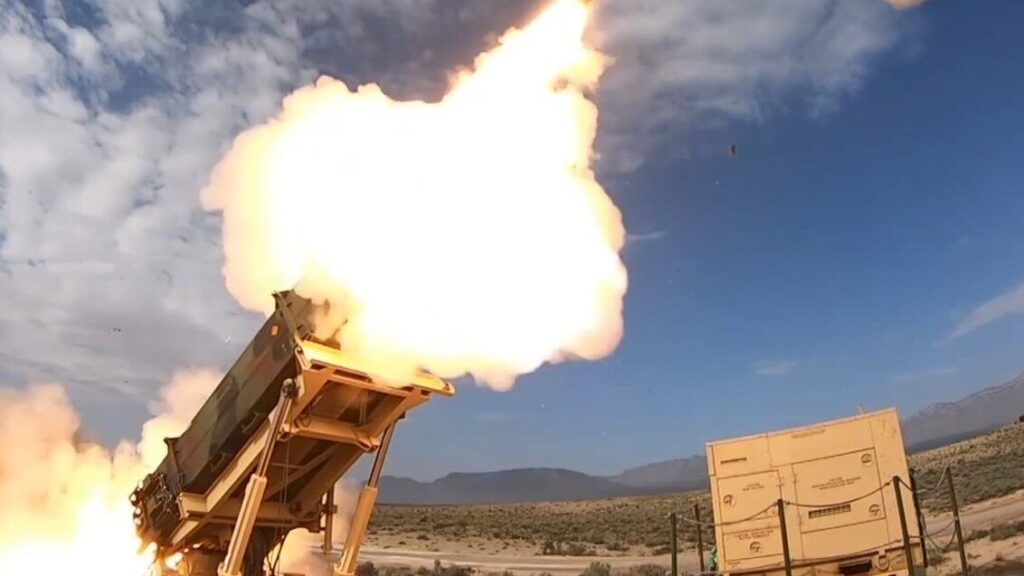
FARNBOROUGH — The Pentagon is looking at options for how to license production of Patriot interceptors to Ukraine, but it’s too early to say when Kyiv will be able to start building its own missiles, a senior defense official told Breaking Defense last week.
“We’re evaluating a set of COAs [courses of action] right now, which include a mix of domestic and international sourcing for end units, where they’re going to be located, how we’re going to build it, [and] which variant,” said Michael Cadenazzi, the assistant secretary of defense for industrial policy.
Cadenazzi, who is also currently performing the duties of assistant secretary of defense for international armaments cooperation, said his team is working with the Army, the Defense Security Cooperation Agency, Defense Technology Security Administration, industry and other stakeholders on the effort.
“I think we’ve got a long way to go to sort of formalize that, but there is robust, well-resourced effort and a commitment to meet the president’s target for coming up with the plan,” he said July 22 on the sidelines of Farnborough Airshow.
Earlier this month, President Donald Trump announced at the NATO summit in Ankara that the United States would give Ukraine a license to produce Patriot interceptors but gave few details, raising questions about the timeline and security considerations needed to allow Ukraine to begin building sensitive US technology during a hot war with Russia.
“We’re going to give a license to you to make Patriots. That’s pretty cool,” Trump told Ukrainian President Volodymyr Zelenskyy then.
“This way, you can’t complain that we’re not giving ‘em enough,” he added. “I say, make them yourself. We haven’t informed the company of that yet, but that’ll work out all right.”

Weaponizing the supply chain for a liquid-fueled howitzer-fired munition that flies 150 km
The goal of such weaponization is to tie warfighter needs to the RDT&E cycle.
In a post on X, Zelenskyy said that he and Trump further discussed the matter during an Oval Office meeting Tuesday.
“The President and I discussed licenses for Patriot interceptor production and several other ideas that could help,” he said without providing details.
Zelenskyy later said he had met with a team of Lockheed Martin officials to talk about future opportunities for “joint production and technology exchange.” Lockheed Martin manufactures the PAC-3 interceptor, one of the weapons used by the Patriot missile defense system.
“We spoke about our joint capabilities related to Patriots and other systems. Our teams are already working on specific solutions to move to co-production as quickly as possible and increase our capabilities to protect lives,” he said in another post on X.
According to Cadenazzi, the “hard part” of licensing PAC-3 production to Ukraine will be qualifying and certifying the indigenous supply chain that will build the interceptors.
“There’s only so many engineers that know how to do this stuff. There’s only so many qualified parts [already available],” he said. “As you’re building a new supply chain … it takes time to find the qualified suppliers.”
If the US opts to license a PAC-3 design that is “less capable” and less expensive than the standard PAC-3 variant, that certification process can sometimes be even more difficult, because “you need to do some other engineering to go and make sure you’re meeting the same level of reliability” while using cheaper parts sourced from new suppliers.
“So we’re working through that right now, and I’m excited that we’re a part of that analysis and that we’re working towards a timeline that’ll deliver the weapons in line with the president’s objectives,” he said.
Cadenazzi’s comments underscore those from Lockheed and RTX’s Raytheon, who told Breaking Defense last week that talks about Ukraine’s production of Patriot interceptors are still in early stages.
“That process has just started,” Tom Laliberty, Raytheon’s president of land and air defense systems, told reporters during a briefing last week at Farnborough. “And we’ll of course be following the United States government’s lead.”
Tim Cahill, who leads the Lockheed’s missiles and fire control division, told reporters last week that “it’s early,” but that discussions are underway with the Army.
Breaking Defense Video