WASHINGTON — The Navy’s youngest of its four public shipyards is more than 100 years old.
Now, President Donald Trump says it’s time for a fifth, in an effort to expand repair capacity for nuclear-powered aircraft carriers and submarines.
Plans for the additional public shipyard were revealed in a new National Security Presidential Memorandum, along with several other key initiatives. The memorandum instructs Secretary of Defense Pete Hegseth to submit a proposal within 120 days to bolster submarine and aircraft carrier readiness — harnessing both the private sector and an additional shipyard to achieve those results.
The possibility of an additional public shipyard has been floated previously, as for years the Navy has struggled with maintenance delays. Chief of Naval Operations Daryl Caudle told reporters in April that the service was studying the creation of a new public shipyard, although he expressed reservations at the time about whether they could shore up the necessary workforce to man another yard — in addition to the price tag that would accompany such an endeavor.
RELATED: Is a new Navy shipyard realistic, or just a ‘tall order’?
Two analysts told Breaking Defense that while the Navy certainly needs expanded capacity, especially if the service wants to meet the growth targets under its latest shipbuilding plan, establishing a new public shipyard would prove costly — and may not necessarily solve maintenance issues largely stemming from workforce shortages.
“If you go down this path, it’s expensive, and it would take a long time to do it. You’re talking about building new shipyards that would take at least a decade, maybe more,” said Eric Labs, a senior analyst for naval forces and weapons at the Congressional Budget Office. “And cost estimates for something like that have been varied over the map. But for nuclear-powered — meaning a shipyard cable doing maintenance on nuclear-powered ships — you’re probably talking about something in the $10 to $20 billion dollar-range in today’s dollars.”

From directed energy to AI and hardening, JIATF-401 is widening counter-UAS options
There is no single answer to the drone threat, pushing the Pentagon toward a broader mix of defenses.
Even with the steep price tag, Bradley Martin, a senior policy researcher at RAND and retired Navy captain, said he doesn’t expect any lawmakers would come out as “strictly opposed” to the endeavor. Rather, logistical hurdles are the more likely challenges to emerge.
“It’s not really a political problem supporting ship maintenance and ship construction, it’s more like a practical problem of who you’re going to get to come do it,” Martin said.
An Eye On The Pacific
Analysts said the exact price is dependent on several factors, including location. The Navy has previously operated multiple other shipyards — including Philadelphia Naval Shipyard, Charleston Naval Shipyard, Mare Island Naval Shipyard, and Long Beach Naval Shipyard. All of those were shuttered as naval facilities in the 1990s, after Congress passed the Base Realignment and Closure Act (BRAC) in 1988. The Navy’s current four shipyards are in Virginia, Maine, Washington and Hawaii.
It’s not clear whether the administration wants to build a completely new shipyard location, or wants to revive one of its previous shipyards or another former facility.
“I think one of the first steps you have to do would be to identify where you’re going to put the shipyard, because by identifying where you’re going to put the shipyard, then you’ve got to figure out then how much it’s going to cost, and that is to some degree going to be site-dependent,” Labs said.
While several of the former shipyards are on the East Coast, the administration appears to have its eye on the Pacific, according to the memo.
“The plan for the fifth yard shall address: sufficient drydock capacity to service the planned growth of the fast attack submarine fleet over the next two decades; locations proximate to the United States Pacific Fleet, including in the continental United States, Alaska, Hawaii, and the United States territories; site options that include up to three new drydocks designed and built to hold the ranges of every current and projected class of submarine; innovative financing mechanisms such as public-private partnerships; and timelines and resourcing requirements,” the memo said.
Congress also has to have a say in the matter. The administration must garner support from lawmakers to move forward with the initiative, which could receive funding incrementally, Labs said.
“You certainly have to get the Congress and the administration in agreement that this is something that needs to happen, and therefore it needs to be funded,” Labs said. “It’s not something that has to be funded all in one year.”
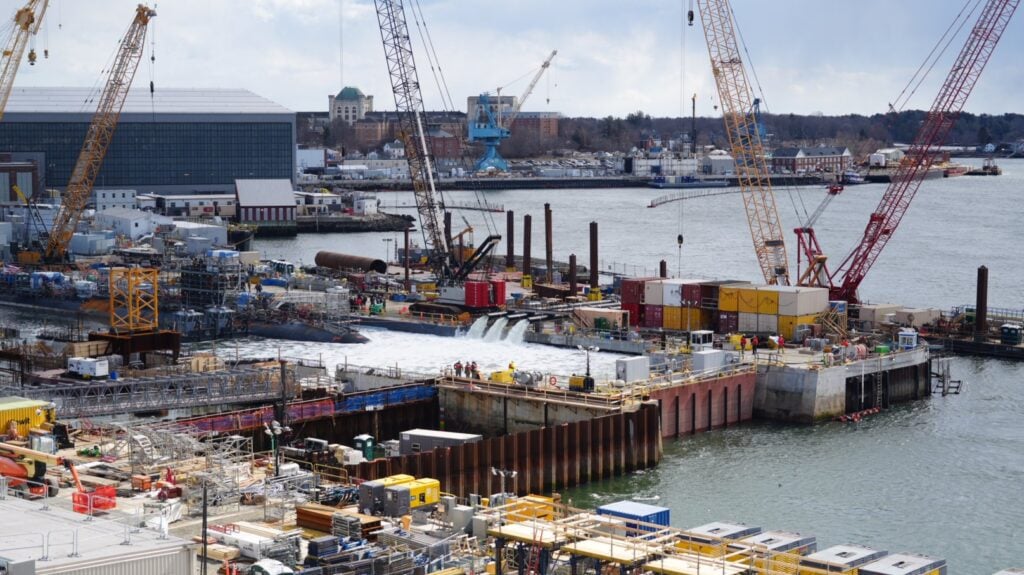
Meanwhile, the Navy is in the process of revamping its current four public shipyards, and kicked off the Shipyard Infrastructure Optimization Program (SIOP) program office in 2018. The more than 20-year effort seeks to upgrade the dry docks and the standard equipment.
Navy officials previously told Breaking Defense in 2025 that once the SIOP program concludes, they expect a 10 percent improvement in aircraft carrier maintenance and a 15 percent improvement for submarine maintenance. While a submarine maintenance availability typically lasts 25 to 36 months, improvements stemming from the SIOP program would whittle roughly three months off that timeline, officials previously said.
Efforts to install a new public shipyard could be folded into the SIOP program, or could remain an independent project. However, the additional shipyard shouldn’t detract resources from the SIOP program, Labs said.
“Any public shipyard is going to be additive on top of that, and you wouldn’t want to do it in such a way that the money competes with the SIOP efforts because the SIOP efforts are really essential,” Labs said.
Martin also said the SIOP program could house efforts tied to the additional shipyard.
“It’s ongoing and potentially that could be expanded, but the really, really big issue with all of this is labor and getting people who can actually do all this work,” Martin said. “That’s not something that’s going to be done in a year or two. That’s a generation-long thing.”
The Navy has struggled to keep workers at its shipyards, despite recent recruitment initiatives. For example, Brett Seidle, then the Navy’s acting acquisition executive, said last year that despite millions of applications and nearly 10,000 employees hired in fiscal year 2023, a large number depart, largely driven by compensation issues, Breaking Defense previously reported.
“Those folks are coming, and then we’re attriting out way too quick,” Seidle told lawmakers on a Senate Armed Services Committee subcommittee in March 2025. “We probably are seeing 50 to 60 percent attrition in our first-year employees.”
‘Hard Push’ For New Yard
Early signs of the administration’s interest in another shipyard were publicly revealed in June, when Office of Management and Budget Director Russ Vought said the administration was “pushing hard for an additional public shipyard” as it seeks to expand the fleet.
“If we’re going to spend a one-and-a-half trillion dollars, or have the types of direct foreign investment that’s coming in, we want to make sure that we have the ability to have enough public shipyards to do maintenance,” Vought said at the Washington Times’ IndoPac 2026 event in June. “You’re going to have contracts with companies that are doing maintenance [in private shipyards], and that’s all fine, and will continue, but … to do it at scale is something that is absolutely vital.”
At the time, Vought noted the decision in April to inactivate the Los Angeles-class attack submarine Boise, which hadn’t operated at sea in over a decade and encountered a host of maintenance delays.
“We all agree that at that point it needed to occur, but that had come after 10, 15 years of bad management, and we need to fix that,” Vought said in June.
Martin said the Boise’s situation likely factored into the administration’s desire to open another shipyard, but said the lack of a shipyard workforce contributed more to such delays than the absence of another facility.
“The impulse to expand public shipyard capacity is a good one,” Martin said. “The idea that [that] is best done by opening another shipyard is a little bit more problematic.”
Breaking Defense Video